
The New Mandate for Growth
In 2026, growth in digital marketing and web experimentation is no longer contingent on brand-standard-styled CMOs – but their now pivotal, progressive role to be a growth architect.
CMOs today pioneer the digital direction a company takes, and how that use of marketing is perceived by potential clients and users. This is because the C-suite now expects marketing to deliver quantifiable business results, from revenue to customer lifetime value.
What Does a CMO Do?
A CMO, otherwise known as a Chief Marketing Officer, is the head of marketing operations in an organization. In turn, other roles in the marketing team will report to the CMO – with the CMO often communicating with other C-level executives in the organization.
CMOs are responsible for developing the planning and execution of all marketing activities within the organization. This means that successful CMOs should learn to be comfortable with growing technology and understanding changing consumer behavior.
Some of the new tasks CMOs are responsible for in web experimentation include:

Discover new potential AI-driven marketing solutions

Communicate value of product across partners & C-suite

Improve digital marketing efficiency as digital age skyrockets toward AI

Driving company revenue & building brand relationships for future income generation
The Web Experimentation Gap: How CMOs Inspire Teams
The challenge with web optimization in 2026 is that many experimentation teams are still focused on low-impact “superficial optimization”.
To drive meaningful growth, CMOs must reset their expectations. Accomplishing this requires demanding that their experimentation teams evolve from tactical testers into strategic partners who can answer their business’s most pressing marketing endeavors and critical questions.
Demand #1: A Shift From Tactical Uplifts to Strategic Impact
Moving Beyond Conversion Rate Optimization (CRO)
There’s no doubt that CRO is important, but it’s only one piece of the puzzle – as the real goal of web experimentation is Business Experience Optimization (BXO).
BXO, or Business Experience Optimization, refers to the process of seeking to better understand your customers and improve their shopping experience accordingly.
In turn, CMOs should question how they read their analytics. Experimentation teams often share how many conversion lifts are on a single page. Instead, CMOs could pursue analytics that reveal how experiments increase their revenue per visitor, reduce customer churn, and improve lifetime value.
Connecting Experiments to Business KPIs
To get real value from experimentation, every test should be tied to a clear business objective. Without that link, teams risk running isolated experiments that generate substantial insights – but little to no meaningful impact. A strong framework ensures that each experiment contributes to a bigger picture, whether that’s driving revenue, improving retention, or increasing customer lifetime value.
This is where concepts like North Star Metrics and OKRs (Objectives and Key Results) are key. A North Star Metric defines the single most important measure of long-term success for your business – such as active users, transactions, or engagement. This provides all experimentation efforts with a unified goal, helping teams prioritize tests that move the metric that matters most.
Meanwhile, OKRs translate that high-level ambition into actionable goals. While objectives define what you want to achieve, key results reveal how success will be measured. When experimentation is aligned with OKRs, each test has an individual motive: to influence a specific outcome. This can make it easier to measure the true impact of your experimentation program.
By tying experiments to both a North Star Metric and structured OKRs, organizations shift from running tests for incremental gains to building a disciplined, outcome-driven experimentation culture.
Here’s an example of how CMOs could inspire new conversations regarding KPIs and OKRs:
Old way: “We increased the click-through rate on the homepage banner by 8%.”
New way: “Our experiment on the homepage banner drove a 4% increase in average order value for first-time visitors. As a result, our models predict we will add $1.2M in incremental revenue this quarter.”
Demand #2: Leverage AI to Answer Bigger Questions, Faster
It is imperative that CMOs view AI agents as a strategic co-pilot as opposed to an automation tool. This is because in 2026, AI is no longer just a tool for simple tasks – but a valuable, strategic partner for insight discovery and prediction.
Here are three main points CMOs should expect from their experimentation teams with AI:
Three Core AI-Driven Demands From CMOs
Demand for Predictive Personalization at Scale
CMOs should anticipate teams to use predictive AI to personalize experiences for the 90% of anonymous traffic, not just known customers.
In this case, CMOs could ask their teams to avoid relying on static, rule-based segments. Instead, CMOs should convey to their experimentation teams that it’s better to use AI tools to forecast user intent in real-time and adapt the experience for every visitor, whether they’re logged-in or out.
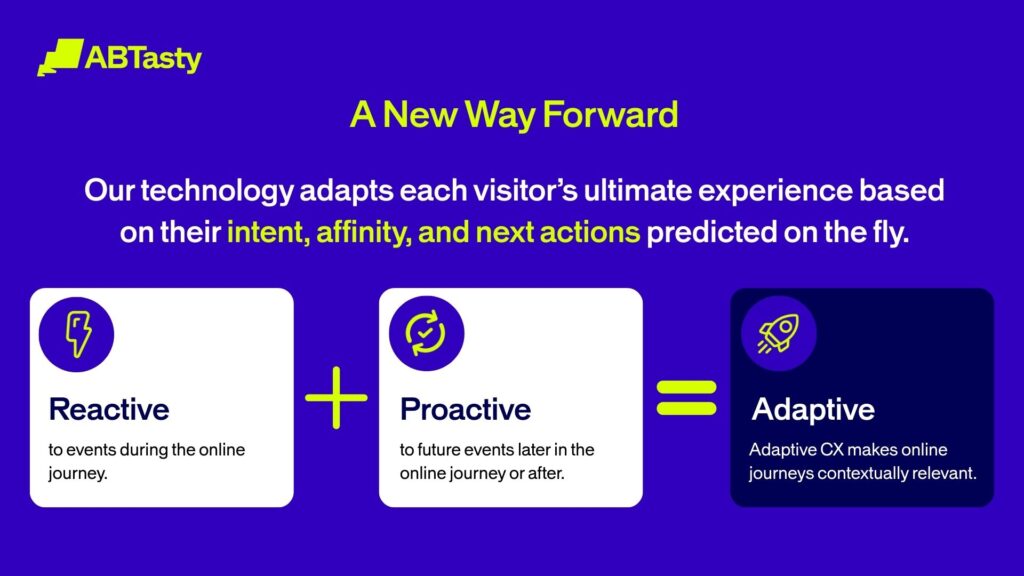
Tools like AdaptiveCX can help web experimentation teams to easily implement this exact strategy. This is because AdaptiveCX, cookieless by design, allows brands to personalize according to user preferences on the fly – even for anonymous visitors.
Demand for Deeper Audience Understanding
As users today are more impatient than ever, it’s crucial for CMOs to employ the concept of emotional and psychological segmentation. This is because to succeed with conversions, it’s key to understand not just what users do, but why they do it.
CMO’s should challenge their teams to go beyond demographics. This includes using AI to reveal the emotional incentives of key audience segments. Tools like EmotionsAI can accomplish this, as it groups visitors into 10 different categories according to their sentimental preferences.
Demand for AI-Powered Ideation and Analysis
Experimentation teams shouldn’t be limited by their own biases. These predisposition results could be inclusive and fail to lead brands towards their next best test. Luckily, AI can analyze data to generate high-potential hypotheses – which can pave the path for better experimentation, improved conversions, and greater brand loyalty long-term.
CMOs should be examining AI’s current involvement in how their experimentation teams come up with test ideas. Instead, CMOs could encourage their experimentation teams to explore generating hypotheses with AI that has analyzed our site data, competitor trends, and user feedback.
Demand #3: Build a Privacy-First, Future-Proof Program
In 2026, people are increasingly concerned with third-party cookies and personal information. As the use of these cookies has come to an end, brands that continue to rely on them have hit a strategic dead end. This means brands must find a new method to ensure data privacy for their users.
The Strategic Advantage of Privacy
Privacy doesn’t have to be a constraint, but can be used as a competitive advantage – as it’s a way to build deeper trust with your users. This is paramount for brands that want to cultivate a sense of exclusivity, long-term loyalty, and returning customers with high conversion rates.
CMOs and their experimentation teams should aim to create a cookie-less personalization strategy with their experimentation teams. Seeking to implement the use of in-session, first-party data to create relevant experiences without compromising user privacy is key to making users feel safe to convert.
The Right Technology
To make users more comfortable in this new age of data privacy, the right technology needs to be used. Our in-house tool at AB Tasty, AdaptiveCX, can help brands focus on real-time behavior rather than stored personal data. This ensures compliance with regulations like GDPR and CCPA and builds a sustainable foundation for the future.

Demand #4: Foster a Culture of Experimentation, Not Just a Team
One Team, Endless Dreams
Experimentation shouldn’t be the sole responsibility of a small, isolated team – but rather a shared task across marketing, product, and even sales.
This cross collaboration can allow for new, innovative ideas across the board – contributing to continued growth and more robust experimentation.
Empower Every Idea
Experimentation teams should strive to go from being the “testers” to being the “enablers” who provide the tools, frameworks, and education for others to test safely and effectively.
In this case, CMOs should be evaluating their team’s plan to increase experimentation velocity across the entire organization. This can include how teams are scaling access to testing and creating a shared repository of learnings that are approachable for everyone.
From Trial to Better
Introduce the concept of an “Experimentation Maturity Model”.
An experimentation program shouldn’t be static, but something that re-shapes itself in real-time to accommodate for new learnings and discoveries.
This is why CMOs should demand a clear roadmap for this evolution by using an Experimentation Maturity Model – which is a method for organizing the efficiency of how brands run various experiments, such as A/B tests or Multivariate testing. The main goal of an Experimentation Maturity Model is to build an organized experimentation program that delivers real results.
This framework charts the path from early testing to a fully integrated culture of continuous improvement. This involves the organization progressing from the initial Discover stage, where tests are simple and singular, to the Scale and Blaze stages.
At these more advanced levels, experimentation becomes an integral pillar for brands. This is because high-velocity testing, cross-team collaboration, and strategic insights contribute to major business decision making.
This is exactly why CMOs should prioritize a clear path for advancing the organization from a “Discover” stage to a “Scale” or “Blaze” stage, where experimentation is eventually embedded in the company’s core culture.
The interactive timeline below will break down these different stages: Discover, Scale, and Blaze:
Stage 1
Discover
Analyze performance, identify low-hanging fruit, and set benchmarks for initial experimentation success.
Stage 2
Scale
Expand testing across departments, implement automated personalization, and unify your customer data stream.
Stage 3
Blaze
Achieve full journey orchestration and predictive AI intent to lead with a culture of constant optimization.
Conclusion: The CMO as the Chief Experimenter
CMOs could spark growth in web experimentation by encouraging their teams to make more daring decisions in testing.
This includes”
- Valuing strategic impact over tactical lifts
- Benefiting from AI-powered insights over automation
- Curating a privacy first foundation
- Creating an enabling a company-wide culture of growth.
Teamwork makes the dream work
Working smarter instead of harder is key for efficiency. Encouraging your web experimentation teams to take new, innovative paths towards success could prove worthwhile in the end.
By making these demands, CMOs are not just overseeing a function – but transforming marketing to be the sustainable, customer-centric business model for growth suitable for 2026 and beyond.
FAQs
Still have questions about CMOs and web experimentation? Here are the answers you need.
What Does a CMO Do?
CMOs are in charge of leading digital marketing and raising brand awareness for a company. In turn, they spend a lot of their time scouting new technology to improve efficiency in digital marketing, cross-coordinating with other teams and C-suite level, and organizing meetings with other brands, both online and in-person, to further promote the company and its product or service.
How Can Web Experimentation Benefit CMOs?
Web experimentation and optimization platforms like AB Tasty can greatly benefit CMOs as it provides them direct insight into how certain catch phrases, CTAs, colors, banners, buttons, and more are performing on the site. Furthermore, they’ll gain a better understanding of what their users respond to – allowing for more efficacious digital optimization, and ultimately improved revenue long-term.
Are CMOs responsible for seeking AI-driven marketing opportunities?
Yes, CMOs are responsible for scouting out new AI-driven technologies that could help their marketing teams to run more efficiently. This is one of the new, evolving responsibilities of CMOs in the age of artificial intelligence and optimization.

About the Author
Stephanie Safdie
Stephanie Safdie holds a bachelor’s degree in English Language and Literature from the University of Maryland, specializing in multimedia studies. She has worked as a social media video creator, freelance copywriter, SEO copywriter at Greenly climate tech, and runs a travel blog Destination Dreamer Diaries.