
From Static to Living: The New Marketing Imperative
Marketing and websites used to be less complex than it is today, as they once operated in a more straightforward, linear way. However, modern marketing requires a more adaptive and interconnected approach – highlighting the differences between a static vs dynamic website.
A helpful way to understand this evolution is through how personalization has changed in digital environments. In the past, marketing relied on broad assumptions and generalized messaging. Today, it is driven by data – leveraging user behavior, segmentation, and real-time signals to tailor content and experiences to individual preferences.
Previously, campaigns followed a simple path: present a message, reach a wide audience, and cross your fingers for conversion. Now, with the rise of data platforms and tagging systems, marketers continuously refine and optimize these interactions. Personalization is no longer static, as it evolves according to how users engage. This allows brands to deliver more relevant and timely experiences.
Static and dynamic websites still share the same goal, which is to drive conversion, even if they differ in execution. The traditional approach relied on a one-size-fits-all message, whereas modern marketing focuses on continuous engagement, adapting in real time based on context, behavior, and intent. Instead of presenting a single message for a product and hoping it resonates, today’s strategies guide customers step-by-step through personalized journeys toward conversion.
The End of One-Size-Fits-All
This era of one-size-fits-all marketing is over. Today’s consumers expect experiences that are relevant, timely, and tailored to them. This is where the core conflict arises: the differences between static and dynamic marketing, and which one each brand should use.
Static marketing, which broadcasts the same message to everyone, is different than dynamic marketing – which adapts to individual user behavior in real-time.
In this article, we’ll break down the differences between static and dynamic websites, how to create a significant and sustainable competitive advantage, and why optimization software is no longer just a tool – but the essential engine that powers dynamic websites and marketing.
The Old Playbook: What are Static Websites?
Static websites are like going back to the basics, as it’s a marketing strategy that relies on fixed content, broad audience segments and historical data that quickly becomes outdated. This is because many of the methods used to implement static marketing for static websites do not change alongside evolving circumstances and interests of the user and aren’t conducive to ensure long-term exposure.
Here are some of the common tactics used with static websites and marketing:

Brochures
A classic example of static marketing, brochures deliver a fixed message to a broad audience, regardless of individual interests.

Billboard Ads
Billboards are designed for mass exposure, presenting the same content to everyone who passes by, making them a prime example of one-to-many advertising.

Pre-recorded Commercials
These ads are produced once and aired repeatedly, offering a non-personalized message that doesn’t adapt to viewer behavior or preferences.
Marketing on Autopilot: The Limits of a Static Strategy
The main goal of a static website is to build trust and interest with consumers by providing easily recognizable content to draw the consumer in.
However, static websites have an “anonymity blindspot” – as its fundamental flaw is its ineffectiveness for the 90% of website traffic that is anonymous. Static methods based on past purchases or third-party cookies fail to engage these visitors.
Here are some of the key limitations of static websites:
- Reactive, Not Proactive: Static websites optimize for who customers based on stagnant data like their age, location, and more information subject to change as opposed to who they are in the moment.
- Low Engagement: Outdated marketing strategies such as those used for static websites use generic messaging. This leads to lower relevance, higher bounce rates, and missed conversion opportunities.
- Inefficient Spend: Static websites can waste valuable resources by showing irrelevant offers or content to large segments of the audience.
This begs the question: what happens when brands switch from static to dynamic websties?

The Dynamic Revolution: A Website That Listens and Adapts
There’s a solution to our once static ways of sharing products and services to potential customers – and that’s where a dynamic website steps in. This is because dynamic websites create “living” customer journeys by adapting content, offers, and experiences in real-time based on a user’s in-session behavior.
Dynamic websites serve as an approach to advertising that adapts content, messaging, and experiences in real time according to each user’s individual needs.
Examples of dynamic marketing in dynamic websites include:
Personalized Email Campaigns
Go beyond “Hi {{First Name}}”. Tailor content based on past purchases and browsing behavior to drive higher click-through rates and long-term loyalty.
Targeted Advertising
Deliver highly relevant ads to specific segments. Use behavioral data to ensure your message reaches the right person at exactly the right time in their journey.
Interactive Quizzes
Engage users while collecting valuable zero-party data. Use results to offer instant, personalized product recommendations that feel helpful rather than intrusive.
Dynamic Landing Pages
Swap headlines, images, and CTAs in real-time based on the user’s source, location, or previous interaction with your brand to maximize conversion potential.
Enter Dynamic Marketing: From Monologue to Dialogue
Modern marketing is no longer about broadcasting static, passive messages. It’s about responding to real-time user intent as it happens.
Micro-interactions like pauses, scroll speed, and clicks can help brands better understand a user’s immediate intent without needing cookies or login data.
Here are some of the additional benefits of dynamic marketing for websites:
- Tangible Business Impact: Shifting to a dynamic model can have a substantial impact on revenue, such as combating high cart abandonment rates (around 70%) and achieving significant uplifts like a +10% increase in conversion rates and a +15% uplift in revenue per visitor.
- Privacy-First Advantage: Dynamic websites are one of the best solutions to align with the needs of today’s modern, privacy-focused web browsing. By leveraging first-party, in-session data – brands can build trust and deliver hyper-relevant experiences that are compliant with regulations like GDPR and CCPA.
The Engine Room: How Optimization Software Makes Dynamic Websites Possible
With all of the optimization software available for web experimentation today, it can be difficult to know which one could have the biggest impact on your brand’s success.
Making progress doesn’t have to be a mystery. AB Tasty’s own in-house tools like AdaptiveCX and EmotionsAI can make switching from a static website to a dynamic website a cinch.
The Power Couple: Introducing AdaptiveCX and EmotionsAI
The thing with real-time adaptation is that it takes a lot less manual work than most brands believe. Instead, it’s powered by sophisticated optimization software.
The “What” Engine: AdaptiveCX
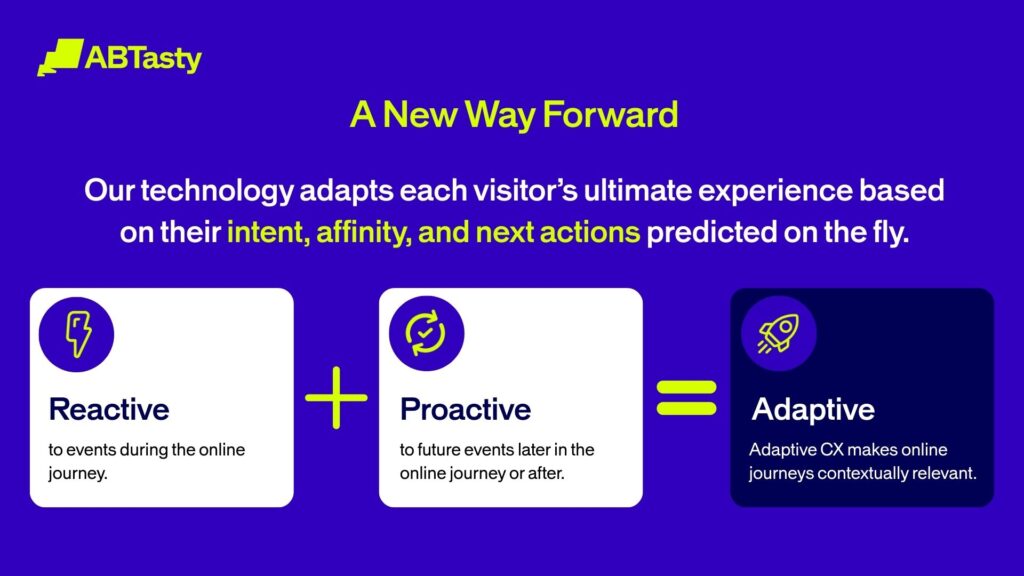
AdaptiveCX is a real-time personalization engine that detects live behavioral signals. Within a mere 20 milliseconds, it predicts user intent and instantly transforms the website to align with their preferences.
The “Why” Engine: EmotionsAI
EmotionsAI provides the missing layer of insight that can direct AdaptiveCX to impose the best pop-up messages, banners, and more for users while they’re still browsing. It analyzes user activity to identify their dominant emotional need within the first 30 seconds of a session.
By providing the context behind user behavior, AdaptiveCX can then be better informed with the answers as to why they are taking certain actions – and personalize the rest of the experience accordingly.
Better Together: The Synergy
Static and dynamic websites both play a pivotal role in the development of effective marketing strategies. However, finding a steady middle ground between these two marketing tactics can unlock greater levels of growth.
Together, AdaptiveCX and EmotionsAI form an unbeatable team. This is because AdaptiveCX provides the real-time action (the what), while EmotionsAI provides the emotional context (the why).
Imagine this: a returning shopper hesitates on a product page. EmotionsAI detects uncertainty and the need for reassurance, while AdaptiveCX instantly responds by highlighting reviews or trust signals. This creates an experience tailored to the specific user. Having been adapted in real time, harnessing these dynamic marketing tactics for your website will allow the brand to boost their chances of conversion.

The Proof is in the Personalization: Real-World Wins
Dynamic websites have tangible benefits for businesses, especially when teaming up with AB Tasty.
From Theory to Revenue: Optimization in Action
Discover some of our case studies revealing the effectiveness of using dynamic website strategies through tools like AdaptiveCX and EmotionsAI with AB Tasty.
AdaptiveCX Your Way to Customer Success with Kurt Geiger
Challenge: A static homepage carousel was hiding relevant products from users.
Solution: Kurt Geiger used AdaptiveCX to power an adaptive “Suggested For You” carousel aligned with in-session intent signals.
Result: A +23.28% uplift in homepage-to-product page conversion rate, proving the power of real-time behavioral adaptation.
Discover the full case study with Kurt Geiger here →
EmotionsAI To Entice Users to Buy with Clarins
Challenge: Clarins needed to boost transaction rates by reassuring hesitant buyers.
Solution: Used EmotionsAI to identify the “Safety” and “Comfort” emotional segments and targeted them with a pop-up highlighting free delivery and secure payment.
Result: An 18% conversion rate increase for the targeted segments, demonstrating the impact of emotionally intelligent personalization.
Discover the full case study with Clarins here →
Conclusion: Adapt or Be Left Behind
Static websites are a relic of the past. The future belongs to dynamic, adaptive, and empathetic experiences.
Optimizing for the path ahead doesn’t have to be an uphill battle. By partnering with AB Tasty and using tools like AdaptiveCX and EmotionsAI can help you to achieve progress beyond your possible imagination.
Your Next Competitive Edge Isn’t Static
It’s true that both static and dynamic websites have their advantages, but as the digital world continues to progress towards instantaneous satisfaction – it’s clear that dynamic websites will allow brands to gain a competitive advantage that wouldn’t be possible with static websites.
Using dynamic website tools like AdaptiveCX and EmotionsAI is key to taking one step toward the future of advertising. This is because these tools empower brands to stop guessing and start creating customer-centric experiences that encourage conversions at scale.
Build Better, Together
The question is no longer if you should adopt a dynamic strategy, but how quickly you can implement it to win and retain customers in a competitive digital landscape.
Ready to see the future in action?
FAQs
Still have questions about static vs. dynamic websites? Here are the answers you need.
What is the main difference between static and dynamic websites?
The main difference between static and dynamic websites is that static website presents a more simple, passive way to promote a product or service with straightforward messaging. Dynamic websites, on the other hand, offer a more personalized way of marketing – as it changes according to the users personal preferences and live, in-session behaviors.
Which one should my brand use: static or dynamic marketing for my website?
Both forms of marketing can be effective, but dynamic websites have marketing that is better suited for today’s fast-changing, customer-centric landscape. This is because it allows you to adapt messaging in real time based on user behavior, making experiences more engaging – which increases the chances of conversion. That being said, static websites can still work for broad, passive awareness – like social media ads or billboards for new movies or music.
What is the 3-3-3 rule in marketing?
The 3-3-3 rule in marketing refers to the idea that brands have a mere 3 seconds to grab attention, 30 seconds to pique their interest, and 3 minutes to convert users. In turn, the 3-3-3 rule in marketing reveals how crucial it is to have catchy and clear messaging throughout the user’s shopping experience. This is relevant with static vs. dynamic websites, as the latter is much more effective in aligning with the 3-3-3 rule.
About the Author
Angélique de Taddeo
Angélique is Chief of Staff at AB Tasty, where she works closely with leadership on strategic initiatives and cross-functional projects. With a strong interest in product, customer experience, and market trends, she shares insights and perspectives through her articles.