
Personalization has long been a priority for e-commerce brands. Most teams now understand the value of tailoring the customer experience, and many have already invested in recommendation engines, targeted campaigns, and audience-based journeys.
But for many e-commerce managers, there is still a gap between the promise of personalization and the reality of the shopping experience.
Why? Because personalization often stops at a few touchpoints. Product recommendations may be personalized, but category pages, merchandising rules, and search experiences are still frequently driven by static logic. Best sellers, stock levels, margin, and catalog attributes continue to determine what shoppers see, regardless of what they are actually doing in the moment.
That is where hyperpersonalization in e-commerce comes in.
What is hyperpersonalization in e-commerce?
Hyperpersonalization is the ability to adapt the shopping experience using live behavioral signals, and in some cases audience or segment data, to make product discovery more relevant for each shopper.
Instead of showing the same product ranking to every visitor, brands can respond dynamically to in-session behavior:
Products viewed
Products clicked
Items added to cart
Purchases
On-site search queries
For e-commerce managers, the value is straightforward: hyperpersonalization turns product discovery from a static journey into a more responsive and relevant experience.
Why traditional merchandising is no longer enough
Traditional merchandising still plays an important role. Ranking by best sellers, highlighting high-margin products, and using stock-aware logic are all valuable tactics. But on their own, they are no longer enough.
Today’s shoppers send clear intent signals throughout their session. They browse a certain category, search for a specific product type, explore gift options, or repeatedly engage with items tied to a size, color, or use case. When the site does not adapt to those signals, the experience feels generic.
Imagine two visitors landing on the same category page. One is shopping for a gift, while the other is browsing for themselves. Or one shopper has searched for “dress,” while another has been looking at products for a specific age range. If both see the same product order, the site is missing a chance to make discovery more relevant.
For e-commerce managers focused on conversion, engagement, and customer experience, that creates unnecessary friction.
The business case for hyperpersonalization is growing stronger:

73%–76%
of consumers expect brands to deliver personalized experiences.
Source: Salesforce

10%–15%
average revenue uplift on personalized product listing pages.
Source: McKinsey

Up to 40%
revenue gains achieved by top-performing personalized PLPs.
Source: McKinsey
From static ranking to shopper-aware merchandising
The promise of hyperpersonalization is that it allows merchandising to move from static ranking to something far more adaptive.
Instead of relying only on aggregate performance or pre-set sorting rules, brands can reorder product listing pages based on what the shopper is doing in real time. That matters because product listing pages are often where discovery happens and purchase intent begins to take shape.
A hyperpersonalized approach can help surface products that better match immediate intent. If a shopper has viewed products in a particular size range, similar items can be prioritized across the session. If a shopper is showing gifting intent, products tagged as giftable can be surfaced more prominently. If a shopper has searched for a specific term, that query can influence what products are highlighted next.
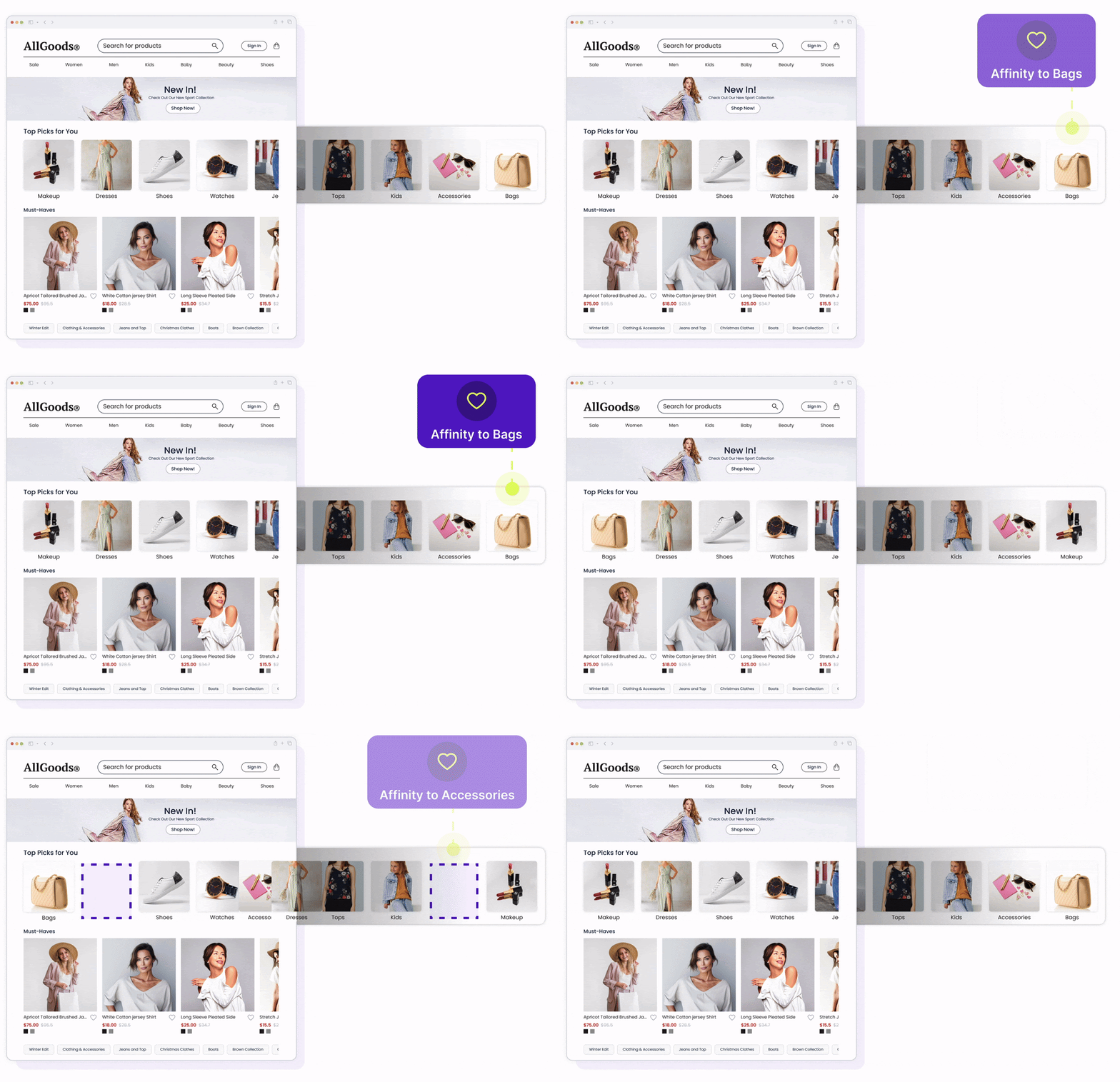
This is not just about recommendations. It is about making the broader browsing experience more relevant and useful.
Why it matters for e-commerce managers
For e-commerce leaders, hyperpersonalization is not just a technical evolution. It is a business opportunity.
It can improve product discovery by helping shoppers find relevant items faster. It can create more effective category pages, which are often under-optimized despite their importance in the path to purchase. And it can support stronger conversion potential by reducing the gap between shopper intent and product visibility.
It also helps create a more coherent personalization strategy. Many brands already invest in personalized recommendations, but shoppers do not experience recommendations, merchandising, and search as separate systems. They experience one journey. Hyperpersonalization helps bring those parts closer together.
How AB Tasty Commerce supports hyperpersonalization for e-commerce
At AB Tasty, we see hyperpersonalization as the next step in making commerce experiences more relevant, more connected, and more performance-driven.
AB Tasty Commerce helps brands optimize product discovery across key touchpoints such as recommendations, merchandising, and search. The goal is to help e-commerce teams move beyond isolated optimization tactics and toward a more unified commerce strategy.
In the context of hyperpersonalization, this means helping brands use shopper signals to create more dynamic product experiences. Rather than relying only on static ranking logic, teams can make merchandising more responsive to browsing behavior, search intent, and, over time, audience-based signals as well.
For e-commerce managers, this creates a clear advantage: the ability to think about personalization not as a collection of disconnected tools, but as part of a broader commerce experience.
Final thoughts
Hyperpersonalization is not about adding complexity for the sake of innovation. It is about using the signals shoppers already provide to make their experience better.
When merchandising adapts to what shoppers are doing in real time, product discovery becomes more useful. And when product discovery becomes more useful, brands are better positioned to increase engagement, improve conversion, and deliver a stronger customer experience.
For e-commerce managers, that is the real value of hyperpersonalization: moving from static product ranking to a shopping journey that feels more aligned with each shopper’s intent.

About the Author
Emily Healy
Emily Healy holds a Bachelor’s degree in Public Relations and Spanish from the University of Louisiana and a Master’s in Business from UC3M. She has worked in content and product marketing and holds PMA certifications in brand, positioning, messaging, and AI marketing.