

Be sure to check out the series introduction, part 1 with Zion & Zion, and part 2 with Cro Metrics if you haven’t read them yet.
For the third blog in our series on a data-driven approach to customer-centric marketing, we talked with our partner Matt Wright, Director of Behavioral Science at Widerfunnel, and Alex Anquetil, Manager of North America Customer Success at AB Tasty, who discuss what emotional connection means in a marketing context, why it’s critical for brands to forge emotional connections with their customers, and how data can be used to both build and measure the efficacy of these connections.
What do we mean when we talk about creating an “emotional connection” in a marketing context?
Simply put, emotions are the driving force behind every purchase. People don’t buy from a given brand because they need a product they could easily find elsewhere, but because they feel an affinity, a sense of trust, well-being, or inclusion with or loyalty to that brand.
In such a crowded market, forging deep emotional connections with customers is essential for marketers to attract and retain customers today. Marketers can’t merely “appeal to emotions,” but need to understand their behaviors and motivations and ensure that their missions and messages align with customers’ emotions and needs.
Matt asks to reframe the question, “What’s the role of emotional decision-making in marketing? People build mental models around their emotions, experiences, and cultural associations. They think of some as ‘good’ or ‘bad’… they tie emotion to them. The key for marketers is to understand which emotions resonate with which group of people. And this is where A/B testing can help you find clues as to what works and what doesn’t. Creating strong emotional connections is paramount, and through experimentation, you can create them all throughout your sales funnel.”
“Our brains have limited bandwidth,” remarks Alex, “so we tend to save our resources for the important things. When we make a simple purchase, we take shortcuts. We grab what’s available from the wheel of our basic emotions – happiness, anger, surprise – to enable us to make quick decisions. If brands can leverage these emotions, whether positive or negative, and align their sales tactics to them, they can create frictionless experiences. The fact that every purchase is emotional is the reason why we don’t have ‘one perfect user interface,’ or ‘one ideal sales funnel:’ every brand, product, and user is different.”
Matt says, “That’s a great analogy. Usability is the foundation, but you need to build upon it. Even if your UI is ugly, in the right circumstances, it will convert. For example, if your website is for a charity, people don’t want you to spend your money on making it look beautiful. They want the money to go to the cause – so they may negatively judge you if you have a digital masterpiece for a website. But if you’re designing for a chic brand, people want it to look and feel exclusive. This is what A/B testing teaches us: it’s not about win or lose, it’s about gathering insights, which I think is often overlooked at a base level of experimentation.”
Why are emotional connections with customers so important for brands?
For Matt, emotion is especially important for positioning. “It’s not something people typically do experimentation around – I wish they did – because the data you can glean from testing things like value propositions or copywriting is extremely valuable for successfully positioning a product. Also, as customers move through their journeys, they’re going to have different emotions at different moments, including doubts, so give them signals to reassure them they’ve made the right decisions. By doing that, you’ll strengthen their loyalty to you.”
Alex thinks that first impressions matter, and if you don’t connect on the first day, you may not get another shot. “People look for meaning in what they buy, even when it’s something as banal as a pack of batteries. Utilitarian products can have ‘the right’ signals attached to them (think of the Energizer bunny, and the tradition and reliability attached to it). No one wants to buy products that have negative connotations. When it comes to clothing or luxury items, these are 100% emotional, and it’s essential for marketers to confer the correct image and status by selling to the right groups (because, of course, there are in-groups and out-groups by the brand’s standards) and by attaching the right emotions and motivators specific to each brand and product.
Should brands create different types of emotional connections for different audiences?
Again, Matt has a preliminary question to reposition how we approach the subject: “Is it worth it to build multiple experiences? The best way to decide is to start small then go deeper, and keep testing until the data leads you to a value proposition. If the data shows you it’s worth it, then build different approaches, yes.”
But Alex, who’s familiar with both the French and US markets, says yes right away. “When looking at short term and long term outcomes, I think there have to be different types of emotional connections for different cultural or geographical audiences. The question is, do you want the emotions to serve sales or marketing at all costs? In other words, do you want your value proposition to associate your brand with specific emotions? When brands expand to new markets, they may require different approaches. For example, certain French luxury brands sell product collections only in France and entirely different ones in the US. With perfume, US customers tend to buy larger bottles, while the French buy smaller ones, due to different cultural priorities and motivators.
Examples of motivators and leverage:
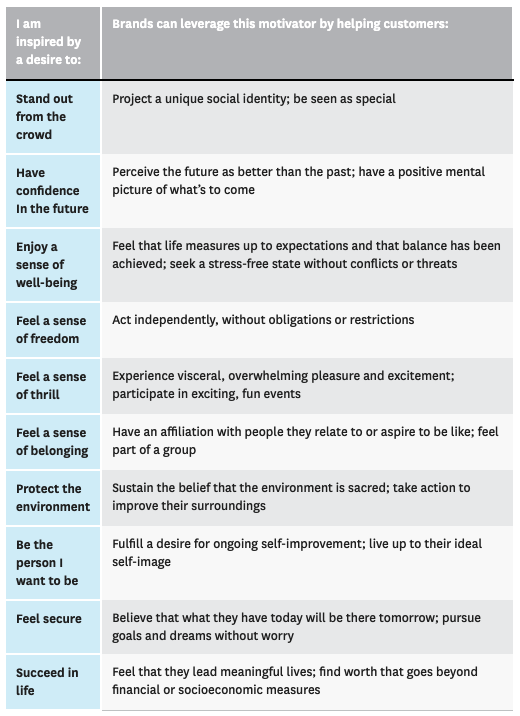
Source: HBR.org, “THE NEW SCIENCE OF CUSTOMER EMOTIONS,” NOVEMBER 2015, SCOTT MAGIDS, ALAN ZORFAS, AND DANIEL LEEMON
“You can analyze your own market data to find out what your highest-value group is and what their motivators are, then push that to the market and take everyone on your journey, or you can do it the other way around, and make sales your ultimate objective.”
Matt thinks the brand will usually lead and cites the example of Netflix. “There’s a debate going on right now to decide whether, in order to keep growing, Netflix should sell ads. Now, they can probably run an A/B test and find out they’ll make more money if they do sell ads, obviously. But how will that affect their brand image in the short, medium, and long term? They might not lose money, but on an emotional level, they might lose a lot of their historical appeal.
“When dabbling with emotions, it’s not as simple as just an A/B test. When making strategic decisions, experimentation can certainly help incrementally optimize things, but it can do bigger things, including help you make key decisions, better understand your customers, innovate, take risks… Not enough people realize the power of advanced testing. Companies that use them see exponential improvements.”
Talking about experimentation tools, Matt explains: “Early on in the industry, we talked about A/B testing in pretty much only an optimization win-or-lose mindset. And it’s so much more than that. When you make this investment, it’s going to help you make decisions, not just find tiny, incremental bits of revenue for your company. There’s a resourcing problem: conversion rate improvement isn’t the only thing you can do, there’s a huge range of other things you can achieve, and teams need more than a CRO manager to effect the full capabilities. It’s a key competitive differentiator.”
How can data be used to create emotional connections in marketing?
It’s a lot harder to target audiences today due to cookie policy changes and new regulations. But as Matt says (and everyone else agrees), “First-party data will lead to strong positioning and really good ads that connect with users. Because it’s owned by brands, it’s going to be the best quality data for testing hypotheses and segmenting data so brands can offer personalized, exclusive experiences.”
Alex puts it this way: “At the end of the day, you’re still going to be tracking conversions and clicks, so you need to do the groundwork in marketing. It’s more advanced than usability testing. To test for emotions, you have to do some groundwork and some guesswork. You need to know your brand; you need to work with market research. And when you find an emotion aligned with what you want your brand to represent, you need to identify a segment of high-potential customers. Then you find the motivators you associate with that segment, thanks to qualitative research and feedback; then you need to quantify all of that to see if you’re correct. Then you push motivators, measure results, see what boosts efficiency, retention, loyalty, customer lifetime value… and discover whether you’ve got a winning proposition.”
Matt grins: “I wouldn’t call any part of that approach ‘guesswork’. You’re simply combining qualitative with quantitative to come up with better hypotheses for testing. It’s the heart of good experimentation.”
The next installment in our Customer-Centric Data Series will be out in two weeks. Don’t miss it!