
For years, the digital experience industry has been driven by competition. Vendors compare features, publish competitive battlecards, launch migration campaigns, and work hard to differentiate themselves. That competition has played an important role in pushing the industry forward.
But it also led us to ask a different question:
What if the next breakthrough didn’t come from competing harder, but from building together?
A different way of thinking
When VWO and AB Tasty joined forces under Wingify, the question everyone asked was: why would two competitors team up? The answer is simpler than you’d think. Both companies had built products people trusted, teams they were proud of, and thousands of customers who relied on them. Neither needed the other to survive. But both shared the same belief: customer value matters more than company ego.
So instead of fighting over features or pricing, we asked a better question — how do we build the best possible platform for the people who use it? The answer was a partnership. Two teams, complementary strengths, and decades of shared expertise — coming together to build something neither could have created alone. That’s not competition. That’s progress.
Performance isn’t a feature. It’s an engineering philosophy.
There’s another reason this merger made sense.
Long before Wingify existed, both engineering teams had already spent years optimizing something customers rarely see—but benefit from every day: Performance.
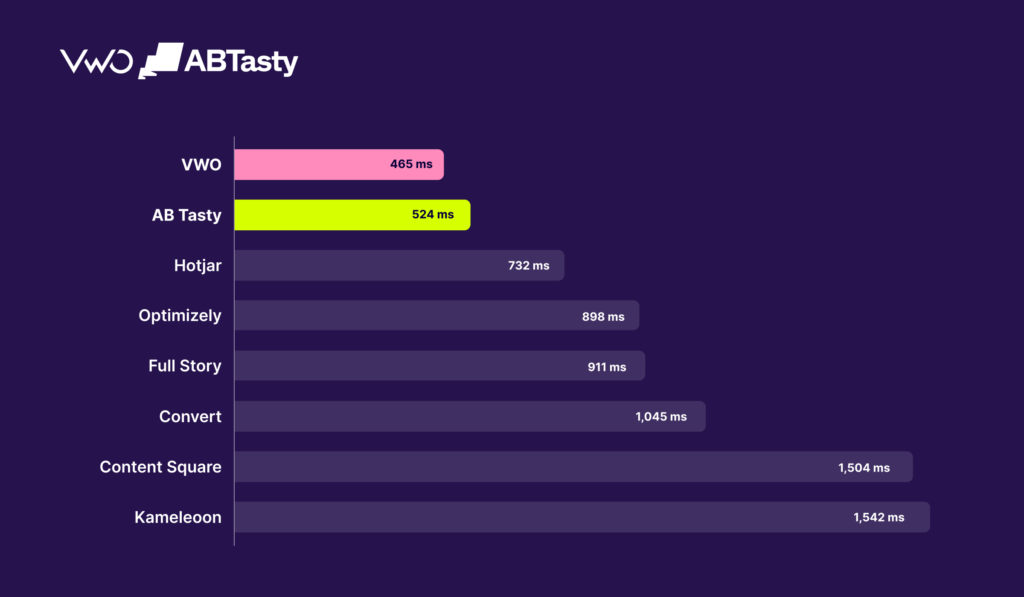
The independent Third Party Web project analyzes JavaScript execution using Lighthouse data collected across approximately four million websites. Its goal is to measure how much work third-party scripts ask browsers to perform.
One detail is particularly important.
These measurements don’t represent the cost of a single feature.
They represent the execution cost of the entire platform delivered through a single tag.
For VWO, that includes capabilities such as experimentation, personalization, behavioral insights, feature rollouts, and more.
In other words, these aren’t the numbers of a lightweight A/B testing library. They’re the numbers of a complete digital experience platform.
The latest benchmark reports:
| Platform | Average JavaScript execution impact |
| VWO | 465 ms |
| AB Tasty | 524 ms |
| Hotjar | 732 ms |
| Optimizely | 898 ms |
| FullStory | 911 ms |
| Convert | 1,045 ms |
| ContentSquare | 1,504 ms |
| Kameleoon | 1,542 ms |
Lower is better.
According to this independent benchmark, VWO delivers the lowest average JavaScript execution impact among the major digital experience platforms listed.
AB Tasty is closely behind, performing better than several well-known competitors, including Optimizely, ContentSquare and Kameleoon.
These aren’t marketing claims. They’re independent measurements.
Better engineering, not fewer capabilities
What makes these numbers meaningful is the context behind them.
Delivering experimentation, personalization, feature management, behavioral insights, and AI capabilities — while maintaining a low execution footprint — is genuinely hard.
Performance at this level doesn’t happen by accident. It’s the result of thousands of engineering decisions made over many years.
Looking at this benchmark, one thing becomes clear: both VWO and AB Tasty had already developed that engineering culture independently.
Better together
This merger between AB Tasty and VWO is about multiplying strengths.
Over the years, both companies have built deep expertise in different but highly complementary areas of digital experience optimization. VWO stands out with a powerful platform spanning experimentation, feature management, behavioral insights, and platform engineering. While, AB Tasty shines as a leader in personalization, merchandising, recommendations, and enterprise optimization.
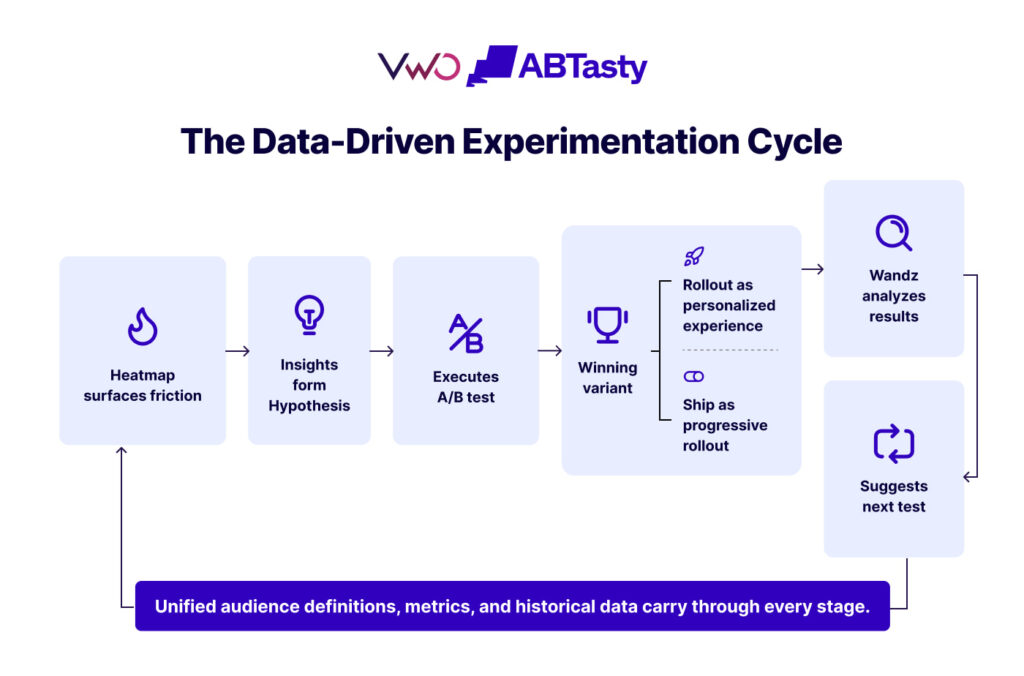
Bringing these capabilities together wasn’t simply about expanding a product portfolio. It was about creating a unified platform where these technologies work seamlessly together, powered by a shared AI layer, a single tag and one engineering vision.
In many industries, companies spend years protecting their territory and trying to outperform one another. We chose a different path. We believed our customers would benefit far more from collaboration than from another decade of vendor rivalry.
Competition helped both companies become stronger. Collaboration is what we believe will take the industry further. Because ultimately, our ambition isn’t to win against competitors—it’s to build the platform our customers will still choose five years from now.
About the Author
Angélique de Taddeo
Angélique de Taddeo is Chief of Staff at AB Tasty with a focus on web experience and conversion strategy. She has a background in user experience design and digital marketing, having led the revamp of the company’s blog with a strong conversion-focused approach.