Angélique is the Culture Officer of AB Tasty. Years of consulting with AB Tasty clients and several Marketing experiences has made her a CRO expert. A true 'digital native', she's passionate about new technologies, and applies the 'test and learn' philosophy to all aspects of her life - online and off!
What Happens When Two Competitors Put Their Egos Aside?
Angelique de Taddeo
For years, the digital experience industry has been driven by competition. Vendors compare features, publish competitive battlecards, launch migration campaigns, and work hard to differentiate themselves. That competition has played an important role in pushing the industry forward.
But it also led us to ask a different question:
What if the next breakthrough didn’t come from competing harder, but from building together?
A different way of thinking
When VWO and AB Tasty joined forces under Wingify, the question everyone asked was: why would two competitors team up? The answer is simpler than you’d think. Both companies had built products people trusted, teams they were proud of, and thousands of customers who relied on them. Neither needed the other to survive. But both shared the same belief: customer value matters more than company ego.
So instead of fighting over features or pricing, we asked a better question — how do we build the best possible platform for the people who use it? The answer was a partnership. Two teams, complementary strengths, and decades of shared expertise — coming together to build something neither could have created alone. That’s not competition. That’s progress.
Performance isn’t a feature. It’s an engineering philosophy.
There’s another reason this merger made sense.
Long before Wingify existed, both engineering teams had already spent years optimizing something customers rarely see—but benefit from every day: Performance.
The independent Third Party Web project analyzes JavaScript execution using Lighthouse data collected across approximately four million websites. Its goal is to measure how much work third-party scripts ask browsers to perform.
One detail is particularly important.
These measurements don’t represent the cost of a single feature.
They represent the execution cost of the entire platform delivered through a single tag.
For VWO, that includes capabilities such as experimentation, personalization, behavioral insights, feature rollouts, and more.
In other words, these aren’t the numbers of a lightweight A/B testing library. They’re the numbers of a complete digital experience platform.
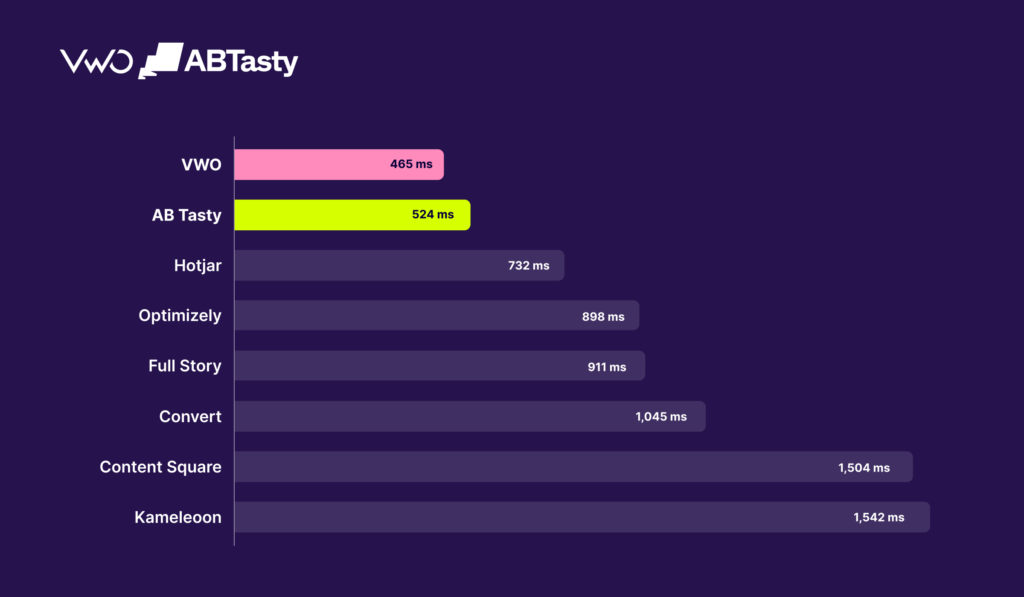
The latest benchmark reports:
Platform
Average JavaScript execution impact
VWO
465 ms
AB Tasty
524 ms
Hotjar
732 ms
Optimizely
898 ms
FullStory
911 ms
Convert
1,045 ms
ContentSquare
1,504 ms
Kameleoon
1,542 ms
Lower is better.
According to this independent benchmark, VWO delivers the lowest average JavaScript execution impact among the major digital experience platforms listed.
AB Tasty is closely behind, performing better than several well-known competitors, including Optimizely, ContentSquare and Kameleoon.
These aren’t marketing claims. They’re independent measurements.
Better engineering, not fewer capabilities
What makes these numbers meaningful is the context behind them.
Delivering experimentation, personalization, feature management, behavioral insights, and AI capabilities — while maintaining a low execution footprint — is genuinely hard.
Performance at this level doesn’t happen by accident. It’s the result of thousands of engineering decisions made over many years.
Looking at this benchmark, one thing becomes clear: both VWO and AB Tasty had already developed that engineering culture independently.
Better together
This merger between AB Tasty and VWO is about multiplying strengths.
Over the years, both companies have built deep expertise in different but highly complementary areas of digital experience optimization. VWO stands out with a powerful platform spanning experimentation, feature management, behavioral insights, and platform engineering. While, AB Tasty shines as a leader in personalization, merchandising, recommendations, and enterprise optimization.
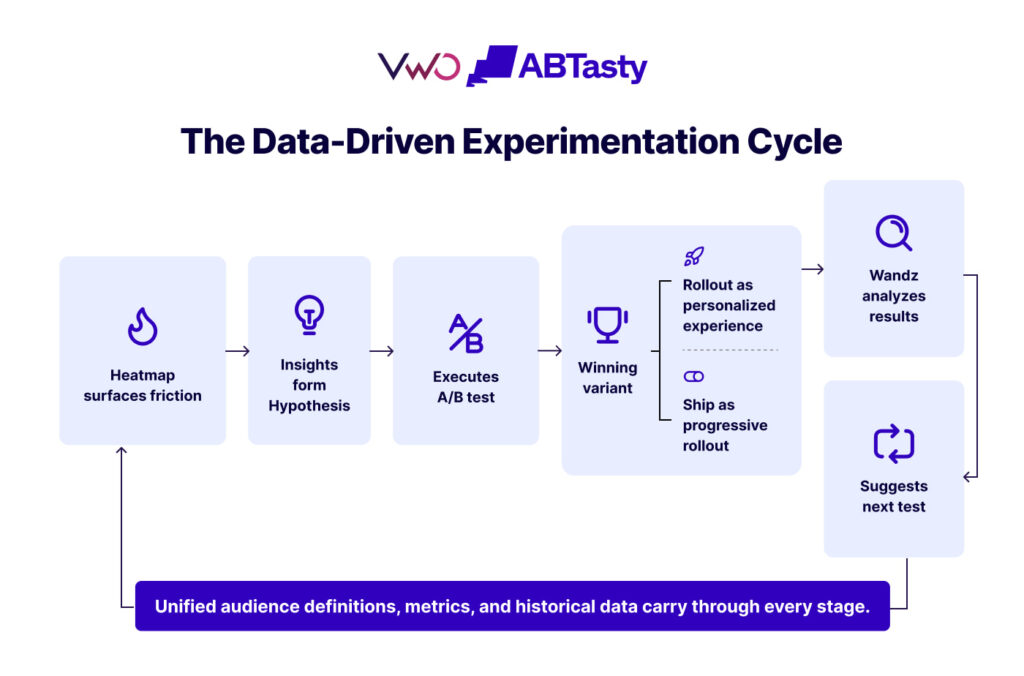
Bringing these capabilities together wasn’t simply about expanding a product portfolio. It was about creating a unified platform where these technologies work seamlessly together, powered by a shared AI layer, a single tag and one engineering vision.
In many industries, companies spend years protecting their territory and trying to outperform one another. We chose a different path. We believed our customers would benefit far more from collaboration than from another decade of vendor rivalry.
Competition helped both companies become stronger. Collaboration is what we believe will take the industry further. Because ultimately, our ambition isn’t to win against competitors—it’s to build the platform our customers will still choose five years from now.
About the Author
Angélique de Taddeo
Angélique de Taddeo is Chief of Staff at AB Tasty with a focus on web experience and conversion strategy. She has a background in user experience design and digital marketing, having led the revamp of the company’s blog with a strong conversion-focused approach.
Static vs. Dynamic Website: Why Optimization Software Wins
Angelique de Taddeo
From Static to Living: The New Marketing Imperative
Marketing and websites used to be less complex than it is today, as they once operated in a more straightforward, linear way. However, modern marketing requires a more adaptive and interconnected approach – highlighting the differences between a static vs dynamic website.
A helpful way to understand this evolution is through how personalization has changed in digital environments. In the past, marketing relied on broad assumptions and generalized messaging. Today, it is driven by data – leveraging user behavior, segmentation, and real-time signals to tailor content and experiences to individual preferences.
Previously, campaigns followed a simple path: present a message, reach a wide audience, and cross your fingers for conversion. Now, with the rise of data platforms and tagging systems, marketers continuously refine and optimize these interactions. Personalization is no longer static, as it evolves according to how users engage. This allows brands to deliver more relevant and timely experiences.
Static and dynamic websites still share the same goal, which is to drive conversion, even if they differ in execution. The traditional approach relied on a one-size-fits-all message, whereas modern marketing focuses on continuous engagement, adapting in real time based on context, behavior, and intent. Instead of presenting a single message for a product and hoping it resonates, today’s strategies guide customers step-by-step through personalized journeys toward conversion.
The End of One-Size-Fits-All
This era of one-size-fits-all marketing is over. Today’s consumers expect experiences that are relevant, timely, and tailored to them. This is where the core conflict arises: the differences between static and dynamic marketing, and which one each brand should use.
In this article, we’ll break down the differences between static and dynamic websites, how to create a significant and sustainable competitive advantage, and why optimization software is no longer just a tool – but the essential engine that powers dynamic websites and marketing.
The Old Playbook: What are Static Websites?
Static websites are like going back to the basics, as it’s a marketing strategy that relies on fixed content, broad audience segments and historical data that quickly becomes outdated. This is because many of the methods used to implement static marketing for static websites do not change alongside evolving circumstances and interests of the user and aren’t conducive to ensure long-term exposure.
Here are some of the common tactics used with static websites and marketing:
Brochures
A classic example of static marketing, brochures deliver a fixed message to a broad audience, regardless of individual interests.
Billboard Ads
Billboards are designed for mass exposure, presenting the same content to everyone who passes by, making them a prime example of one-to-many advertising.
Pre-recorded Commercials
These ads are produced once and aired repeatedly, offering a non-personalized message that doesn’t adapt to viewer behavior or preferences.
Marketing on Autopilot: The Limits of a Static Strategy
The main goal of a static website is to build trust and interest with consumers by providing easily recognizable content to draw the consumer in.
However, static websites have an “anonymity blindspot” – as its fundamental flaw is its ineffectiveness for the 90% of website traffic that is anonymous. Static methods based on past purchases or third-party cookies fail to engage these visitors.
Here are some of the key limitations of static websites:
Reactive, Not Proactive: Static websites optimize for who customers based on stagnant data like their age, location, and more information subject to change as opposed to who they are in the moment.
Low Engagement: Outdated marketing strategies such as those used for static websites use generic messaging. This leads to lower relevance, higher bounce rates, and missed conversion opportunities.
Inefficient Spend: Static websites can waste valuable resources by showing irrelevant offers or content to large segments of the audience.
This begs the question: what happens when brands switch from static to dynamic websties?
The Dynamic Revolution: A Website That Listens and Adapts
There’s a solution to our once static ways of sharing products and services to potential customers – and that’s where a dynamic website steps in. This is because dynamic websites create “living” customer journeys by adapting content, offers, and experiences in real-time based on a user’s in-session behavior.
Dynamic websites serve as an approach to advertising that adapts content, messaging, and experiences in real time according to each user’s individual needs.
Examples of dynamic marketing in dynamic websites include:
Personalized Email Campaigns
Go beyond “Hi {{First Name}}”. Tailor content based on past purchases and browsing behavior to drive higher click-through rates and long-term loyalty.
Targeted Advertising
Deliver highly relevant ads to specific segments. Use behavioral data to ensure your message reaches the right person at exactly the right time in their journey.
Interactive Quizzes
Engage users while collecting valuable zero-party data. Use results to offer instant, personalized product recommendations that feel helpful rather than intrusive.
Dynamic Landing Pages
Swap headlines, images, and CTAs in real-time based on the user’s source, location, or previous interaction with your brand to maximize conversion potential.
Enter Dynamic Marketing: From Monologue to Dialogue
Modern marketing is no longer about broadcasting static, passive messages. It’s about responding to real-time user intent as it happens.
Micro-interactions like pauses, scroll speed, and clicks can help brands better understand a user’s immediate intent without needing cookies or login data.
Here are some of the additional benefits of dynamic marketing for websites:
Tangible Business Impact: Shifting to a dynamic model can have a substantial impact on revenue, such as combating high cart abandonment rates (around 70%) and achieving significant uplifts like a +10% increase in conversion rates and a +15% uplift in revenue per visitor.
Privacy-First Advantage: Dynamic websites are one of the best solutions to align with the needs of today’s modern, privacy-focused web browsing. By leveraging first-party, in-session data – brands can build trust and deliver hyper-relevant experiences that are compliant with regulations like GDPR and CCPA.
The Engine Room: How Optimization Software Makes Dynamic Websites Possible
With all of the optimization software available for web experimentation today, it can be difficult to know which one could have the biggest impact on your brand’s success.
Making progress doesn’t have to be a mystery. AB Tasty’s own in-house tools like AdaptiveCX and EmotionsAI can make switching from a static website to a dynamic website a cinch.
The Power Couple: Introducing AdaptiveCX and EmotionsAI
The thing with real-time adaptation is that it takes a lot less manual work than most brands believe. Instead, it’s powered by sophisticated optimization software.
The “What” Engine: AdaptiveCX
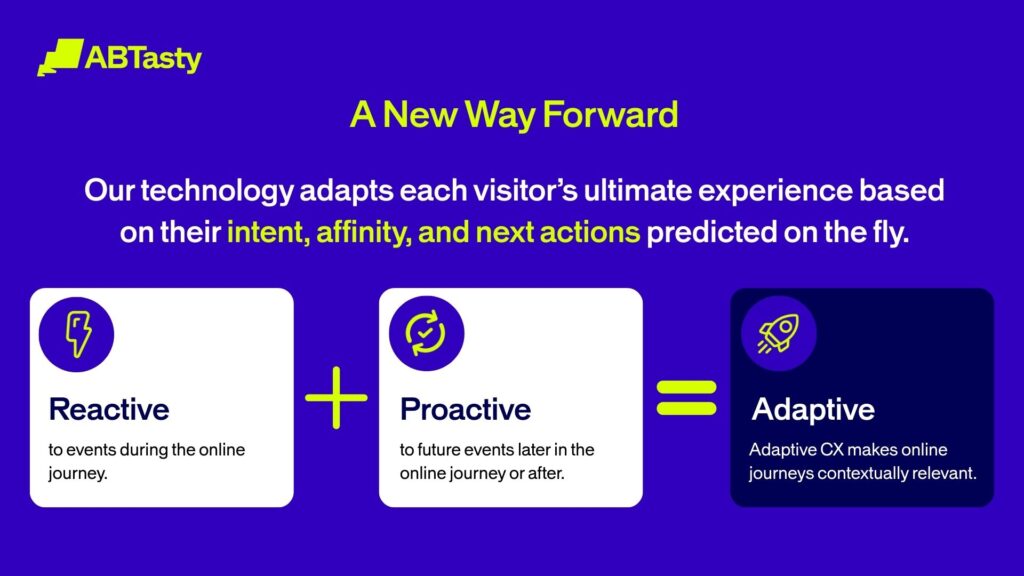
AdaptiveCX is a real-time personalization engine that detects live behavioral signals. Within a mere 20 milliseconds, it predicts user intent and instantly transforms the website to align with their preferences.
The “Why” Engine: EmotionsAI
EmotionsAI provides the missing layer of insight that can direct AdaptiveCX to impose the best pop-up messages, banners, and more for users while they’re still browsing. It analyzes user activity to identify their dominant emotional need within the first 30 seconds of a session.
By providing the context behind user behavior, AdaptiveCX can then be better informed with the answers as to why they are taking certain actions – and personalize the rest of the experience accordingly.
Better Together: The Synergy
Static and dynamic websites both play a pivotal role in the development of effective marketing strategies. However, finding a steady middle ground between these two marketing tactics can unlock greater levels of growth.
Together, AdaptiveCX and EmotionsAI form an unbeatable team. This is because AdaptiveCX provides the real-time action (the what), while EmotionsAI provides the emotional context (the why).
Imagine this: a returning shopper hesitates on a product page. EmotionsAI detects uncertainty and the need for reassurance, while AdaptiveCX instantly responds by highlighting reviews or trust signals. This creates an experience tailored to the specific user. Having been adapted in real time, harnessing these dynamic marketing tactics for your website will allow the brand to boost their chances of conversion.
The Proof is in the Personalization: Real-World Wins
Dynamic websites have tangible benefits for businesses, especially when teaming up with AB Tasty.
From Theory to Revenue: Optimization in Action
Discover some of our case studies revealing the effectiveness of using dynamic website strategies through tools like AdaptiveCX and EmotionsAI with AB Tasty.
AdaptiveCX Your Way to Customer Success with Kurt Geiger
Challenge: A static homepage carousel was hiding relevant products from users.
Solution: Kurt Geiger used AdaptiveCX to power an adaptive “Suggested For You” carousel aligned with in-session intent signals.
Result: A +23.28% uplift in homepage-to-product page conversion rate, proving the power of real-time behavioral adaptation.
Challenge: Clarins needed to boost transaction rates by reassuring hesitant buyers.
Solution: Used EmotionsAI to identify the “Safety” and “Comfort” emotional segments and targeted them with a pop-up highlighting free delivery and secure payment.
Result: An 18% conversion rate increase for the targeted segments, demonstrating the impact of emotionally intelligent personalization.
Static websites are a relic of the past. The future belongs to dynamic, adaptive, and empathetic experiences.
Optimizing for the path ahead doesn’t have to be an uphill battle. By partnering with AB Tasty and using tools like AdaptiveCX and EmotionsAI can help you to achieve progress beyond your possible imagination.
Your Next Competitive Edge Isn’t Static
It’s true that both static and dynamic websites have their advantages, but as the digital world continues to progress towards instantaneous satisfaction – it’s clear that dynamic websites will allow brands to gain a competitive advantage that wouldn’t be possible with static websites.
Using dynamic website tools like AdaptiveCX and EmotionsAI is key to taking one step toward the future of advertising. This is because these tools empower brands to stop guessing and start creating customer-centric experiences that encourage conversions at scale.
Build Better, Together
The question is no longer if you should adopt a dynamic strategy, but how quickly you can implement it to win and retain customers in a competitive digital landscape.
Still have questions about static vs. dynamic websites? Here are the answers you need.
What is the main difference between static and dynamic websites?
The main difference between static and dynamic websites is that static website presents a more simple, passive way to promote a product or service with straightforward messaging. Dynamic websites, on the other hand, offer a more personalized way of marketing – as it changes according to the users personal preferences and live, in-session behaviors.
Which one should my brand use: static or dynamic marketing for my website?
Both forms of marketing can be effective, but dynamic websites have marketing that is better suited for today’s fast-changing, customer-centric landscape. This is because it allows you to adapt messaging in real time based on user behavior, making experiences more engaging – which increases the chances of conversion. That being said, static websites can still work for broad, passive awareness – like social media ads or billboards for new movies or music.
What is the 3-3-3 rule in marketing?
The 3-3-3 rule in marketing refers to the idea that brands have a mere 3 seconds to grab attention, 30 seconds to pique their interest, and 3 minutes to convert users. In turn, the 3-3-3 rule in marketing reveals how crucial it is to have catchy and clear messaging throughout the user’s shopping experience. This is relevant with static vs. dynamic websites, as the latter is much more effective in aligning with the 3-3-3 rule.
About the Author
Angélique de Taddeo
Angélique is Chief of Staff at AB Tasty, where she works closely with leadership on strategic initiatives and cross-functional projects. With a strong interest in product, customer experience, and market trends, she shares insights and perspectives through her articles.
But why even evolve from smaller tests to more complex ones? The answer is simple: high-maturity teams that continue to expand their experimentation strategies don’t just “test” – but are more bound to learn, iterate, and drive increased revenue.
In this article, we’ll break down the roadmap from the first win to becoming an industry “blazer.”
What is Experimentation Maturity?
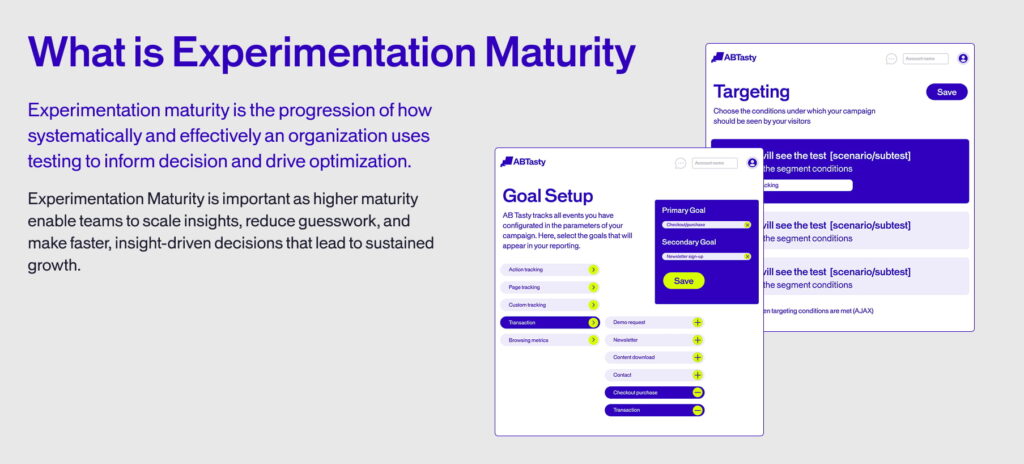
Experimentation maturity refers to how developed an organization’s current strategy is in running, analyzing, and learning from experiments.
This can include their expertise in running things like A/B tests, including its tools, processes, and culture.
Why is Experimentation Maturity Important?
Experimentation maturity is important as stronger expertise allows for more reliable, faster experiments – which can better aid decision-making.
In addition to an increase in data-informed decisions, more developed experimentation strategies also mean brands continuously improve products, outcomes, and reduce overall business risks.
Step 1: Discover – Find Your First Win
In the first stage of experimentation maturity, a single person or small group is still advocating for experimentation. This is better known as the “Ad Hoc Testing Phase”, which is where experimentation is more reactive than proactive.
Tests in this phase are typically:
Launched on a whim with less strategic planning in mind
Implement with a hypothesis, but without long-term goals in mind
Conducted without stable metrics for greater insight
Using ideas that haven’t been backed by data
Maybe you are looking for a quick win
During this first step of your brand’s experimentation journey, the platform may be live – but it hasn’t been put to its best use yet. This is similar to someone who has recently purchased a new smart device, but hasn’t set it up to sync with all of their other devices – making their new electronic device less efficient than it could be.
Oftentimes during the discovery phase, there is one “lone champion” trying to fight for greater optimization tactics. This person is challenging those around them to overcome skepticism and testing for the sake of testing, but instead as an effort to create real change.
Goals for this stage:
Achieve one clear, high-visibility win to prove the ROI of a testing program
Avoid mistaking excessive testing activity for experimentation maturity
View it as a stepping stone to ease into the world of optimization
Step 2: Structure – Build Your Blueprint
The second stage of experimentation maturity is when the organization shifts their focus from spontaneous tests to a more reputable, repeatable “rhythm”.
This step of a brand’s experimentation maturity usually involves:
Hypothesis Frameworks
Develop stronger frameworks for creating and validating your experimentation hypotheses.
Defined KPIs
Establish clear primary and secondary Key Performance Indicators to measure success accurately.
Clear Ownership
Define who owns which experiments to ensure accountability and streamline the process.
Starter Roadmap
Create a foundational experimentation roadmap to guide your initial testing efforts and strategy.
Adopted Templates
Ensure templates for experiment design and analysis are widely adopted for consistency.
Team Expansion
Expand usage beyond marketing and CRO teams for company-wide implementation and impact.
This stage of the experimentation journey is where the brand is no longer a complete stranger to the world of optimization, but not yet an expert either.
Goals for this stage:
Transition from “random tests” to a structured roadmap with prioritized hypotheses
Treat learnings as a more systematic process that can lead to better tests
Recognize that experimentation isn’t about singular wins, but creating a reliable formula for continuous improvement.
Bolder Tests to Your Better
We learned more about this with Marianna Stjernvall, who has conducted over 500 A/B tests and understands the value of learning from your failures to accomplish future wins.
With her ample knowledge in CRO, A/B testing, and experimentation – we discover all of the different ways that Marianna came to understand the value in testing, learning, and trying again.
In the third step of a brand’s experimentation journey, they will start to foster stronger cross-team collaboration. This is generally when experimentation will move beyond the marketing department and start to involve Product and UX.
During this phase, an organization becomes more well-versed in cross-team collaboration – ultimately standardizing the practice as they dive deeper into future experiments and testing.
Advancing with AB Tasty
Our work with Pion is the perfect example of teaming up to make progress. Through the use of Feature Experimentation & Rollout, Pion was able to benefit from our server-side platform. This helps brands manage various user experiments before the full release, which can allow for both precision and security throughout the testing process.
Partnering with AB Tasty allowed Pion to:
Select smarter tests to prioritize experiments that could deliver most valuable information to move forward
Be bold in their experiments to explore inventive ideas and break routine thinking
Develop stronger hypotheses to ensure tests conducted would provide meaningful insights
At this stage of the experimentation journey, optimization is no longer a project – but a core business strategy. In turn, this is usually when brands will begin to develop stronger standards, and maybe even experimentation or personalization “playbooks” to establish company-wide guidelines.
Empowering Speed with PUMA
PUMA and AB Tasty teamed up to accomplish this precise goal: personalization at scale that can bring long-term growth.
Gender-Based Personalization: PUMA implemented the use of our segment builder to see which products men and women preferred to purchase. This helped with metrics including page views, on-page time, and more.
Led Data Lead the Way: Through the use of newfound insights, PUMA guided their strategy to become more information-led. This encouraged more effective experimentation that resulted in increased revenue long-term.
Teamwork Makes the Dreamwork: Experimentation isn’t just for CRO teams, but can be used as a brand-wide method to boost optimization. PUMA learned this with AB Tasty, now fostering a company-wide culture where everyone can contribute ideas for new tests.
Hallmark characteristics for teams progressing to this stage of experimentation maturity include developing a Center of Excellence (CoE) model and an overall more robust team structure for optimization.
Goals for this stage:
Measuring KPIs and additional success metrics to ensure they are aligned with top-level business goals (Revenue per Visitor, CLV, etc.)
Encourage all departments to not only come up with ideas for tests, but to conduct them safely and independently at scale
Step 5: Blaze – Dare to Go Further
In the highest level of maturity, brands become experts in experimentation – recognizing that this is a pivotal growth and product strategy.
Once this last stage of experimentation maturity has been achieved, every employee can be considered an experimenter. This is when the “HiPPO” (Highest Paid Person’s Opinion) is replaced by data, and choices can be made from insight-led statistics as opposed to emotionally driven business decisions.
Goals for this stage:
A cultural shift where failure is viewed as a high-value learning opportunity to test and try again rather than a loss
Continuous and automated optimization that represents the organization’s DNA
Dedication toward long-term development of innovative ideas and pursuing bold experimentation
Conclusion: Your Journey to Better
Every stage of experimentation maturity is a stepping stone to finding your better.
No matter where your brand currently stands on their optimization roadmap, we believe that your next big insight is just one test away. Small steps can create big change, and it all starts with curiosity calling your company’s name.
Want to see your brand progress through the steps of experimentation maturity, together?
Still have questions about experimentation maturity? Here are the answers you need.
What is Experimentation Maturity?
Experimentation maturity refers to measuring how effectively your organization uses testing to make decisions and encourage company growth. This is usually determined by the level of your various processes, tools, and culture for running experiments consistently and at scale.
How can I know which stage of experimentation maturity my company is at?
You can determine how mature your brand’s experimentation process is by looking at how structured your testing process is, how many teams contribute, and how you use data to make decisions. Comparing these factors to industry benchmarks can help you identify your current stage in experimentation maturity.
How can my company boost its Experimentation Maturity?
Investing in training, tools, and clear processes can enable teams to run more tests confidently. This can also encourage collaboration across departments and use insights from experiments to guide strategic decisions, which also helps your brand progress through the stages of experimentation maturity.
About the Author
Angélique de Taddeo
Angélique is Chief of Staff at AB Tasty, where she works closely with leadership on strategic initiatives and cross-functional projects. With a strong interest in product, customer experience, and market trends, she shares insights and perspectives through her articles.
Do Experimentation Platforms Slow Down Your Site? How AB Tasty Ensures Performance First
Angelique de Taddeo
Website performance has never mattered more. Google Core Web Vitals now directly influence organic rankings, mobile conversions continue to dominate, and users expect instant experiences.
In this context, many digital teams ask the same question:
“Will an experimentation or personalization tool slow down my site?”
It’s a valid concern. After all, any third-party script has the potential to impact performance if it’s not engineered carefully.
In this article, we’ll break down what actually affects performance in an experimentation platform — and how AB Tasty has built a performance-first architecture that avoids common pitfalls.
1. The Real Reasons Experimentation Tools Can Slow Down a Website
Not all experimentation platforms behave the same. When performance issues appear, they usually come from a few well-identified causes.
1.1 Heavy, all-in-one tags
Some tools load everything upfront — all features, all experiments, for every visitor — even when most of that code is never used.
This leads to:
Slower execution in the browser
More JavaScript to download and process
Increased pressure on the main thread
Wasted network bandwidth on unused code
The result: a slower page and unnecessary work for the browser.
1.2 “Anti-flicker” scripts that block the page
To prevent visual flicker, many vendors solve flicker by hiding the page (e.g., opacity: 0) until the experiment loads.
While this may avoid a brief visual change, it comes at a cost:
The page cannot render immediately
First visual elements appear later (LCP, FCP)
It hurts SEO rankings
Users may face a noticeable “white screen,” especially on slower connections
The page looks stable — but it loads later than it should.
1.3 Limited optimization for modern websites
Modern websites are no longer simple static pages. Single-page applications, server-side rendering, and hydration flows all require precise timing.
When experimentation scripts are not adapted to these architectures:
They may re-run unnecessarily
They can interfere with rendering
They introduce delays that affect performance
2. AB Tasty’s Philosophy: Performance by Design, Not by Patch
At AB Tasty, we believe an experimentation platform should contribute to user experience — not compromise it. That’s why performance is woven directly into our architecture.
This gives CRO and technical teams full visibility and control over experimentation performance.
Conclusion: You Can Experiment Without Sacrificing Speed
A fast digital experience and an experimentation program are not mutually exclusive.
With its modular architecture, modern rendering logic, and performance-first philosophy, AB Tasty enables brands to run impactful campaigns without jeopardizing SEO or UX.
If performance is a concern for your engineering or CRO teams, we’d be happy to share:
Performance benchmarks
Technical documentation
Best practices for Core Web Vitals
Case studies from top global brands
Experiment boldly — with a platform engineered for speed.
FAQs
Does A/B testing slow down your website?
Yes, but AB Tasty minimizes it. Our tag delivers < 100ms load time, < 500ms execution, and < 10ms from cache—making us 2x faster than Kameleoon. Plus, we block releases if Core Web Vitals degrade by > 2%.
Does A/B testing affect Core Web Vitals?
It can — but AB Tasty minimizes this impact through dynamic imports, optimized rendering logic, and non-blocking execution.
Do I need anti-flicker for A/B testing?
Most of the time, no. Anti-flicker masking can degrade SEO and create a poor user experience.
Is AB Tasty fast?
Yes — benchmarks from independent sources consistently show AB Tasty among the fastest experimentation tags on the market.
AB Tasty: The Collaboration Engine Behind High-Performing CRO Teams
Angelique de Taddeo
Digital experimentation has matured. Where A/B testing was once handled by a handful of specialists, today it’s a team sport — involving marketing, product, UX, engineering, and data. Organizations now need platforms that connect these roles, reduce friction, and enable collective decision-making.
This is where AB Tasty stands apart. More than an experimentation tool, it is a collaborative ecosystem, designed to help companies run impactful tests at scale while empowering every contributor in the process. From idea generation to final reporting, AB Tasty removes silos and strengthens alignment — a critical ingredient for a successful CRO program.
A Platform Built for Cross-Functional Workflows
Modern experimentation involves teams with different expertise and expectations. AB Tasty addresses this diversity through a unified platform that brings everyone together.
1. Clear Governance and Team-Based Visibility
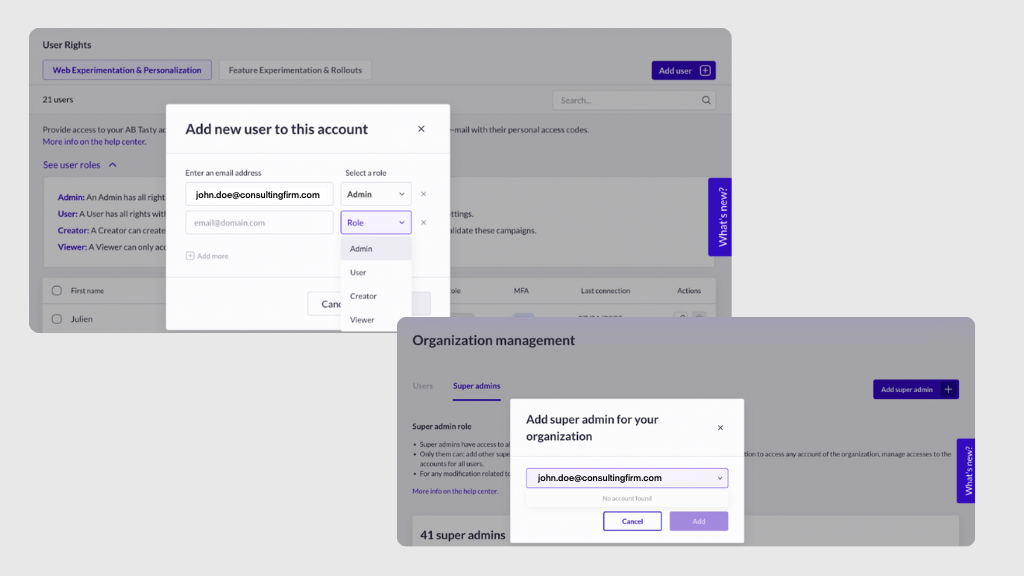
Large organizations often struggle with visibility: too many tests, too many markets, too much noise. AB Tasty’s advanced RBAC system solves this by assigning precise roles and allowing teams to create custom folders and views. A French editor only sees French campaigns; a central CRO manager sees everything; a developer accesses only what they need.
This structure reduces operational clutter and protects the integrity of local workflows, while still enabling global oversight.
2. Collaboration at Every Step of the Experiment Lifecycle
Where AB Tasty excels is its ability to facilitate teamwork throughout the entire testing process.
Before a Campaign
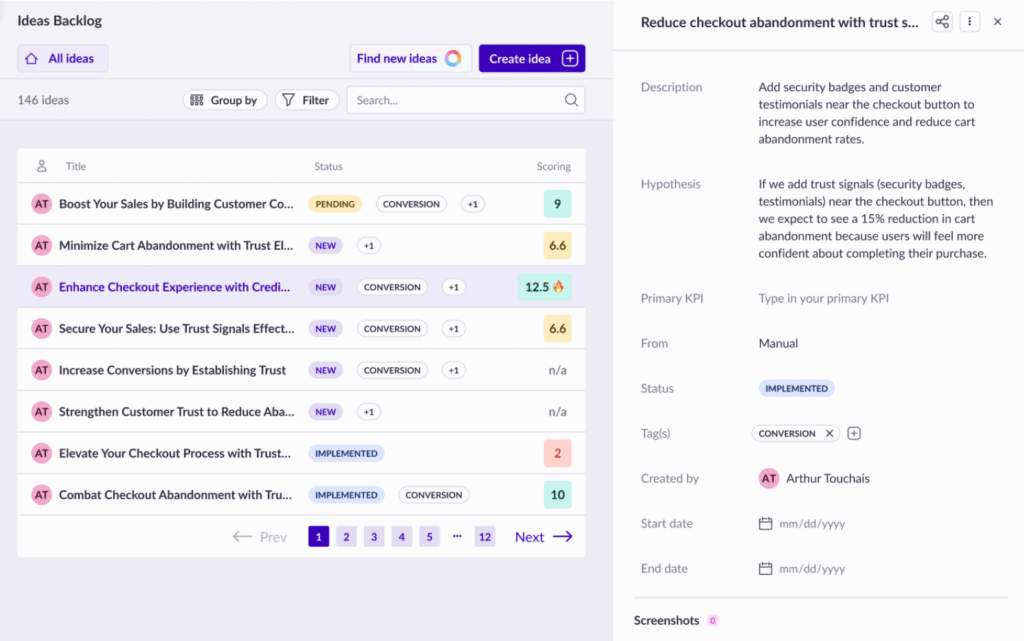
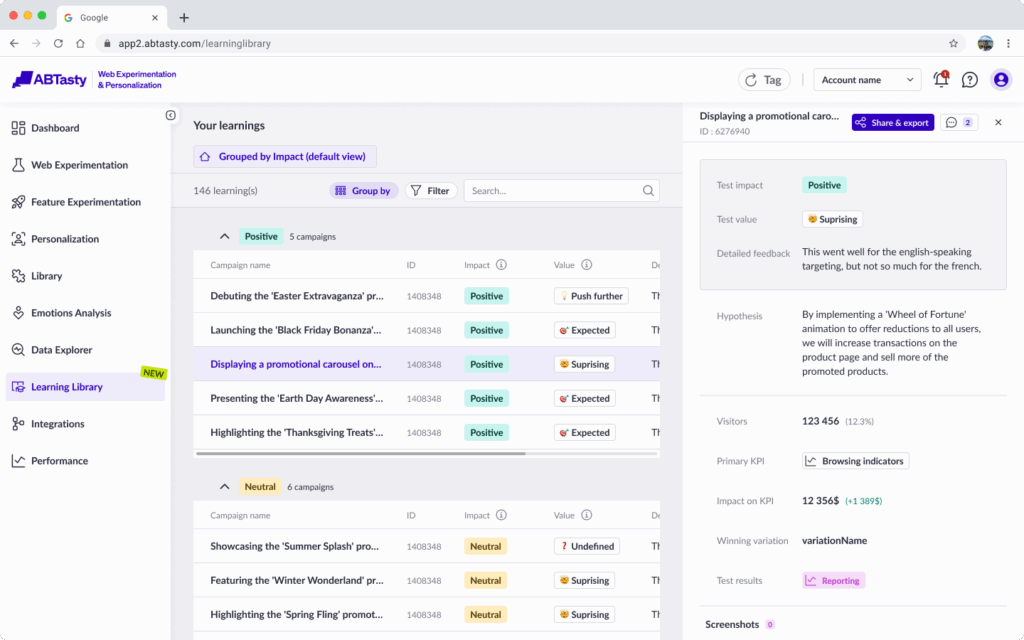
Teams use the Ideas Backlog to surface opportunities and prioritize them together, while the Learnings Library accelerates strategy by making past learnings accessible across markets—and ensures those insights are continuously built upon. Unlike static archives, the Learnings Library is designed to be iterative: every experiment, whether a win or a “failed” test, adds to a living repository that evolves with each new insight, helping teams refine and improve their strategies over time.
During a Campaign
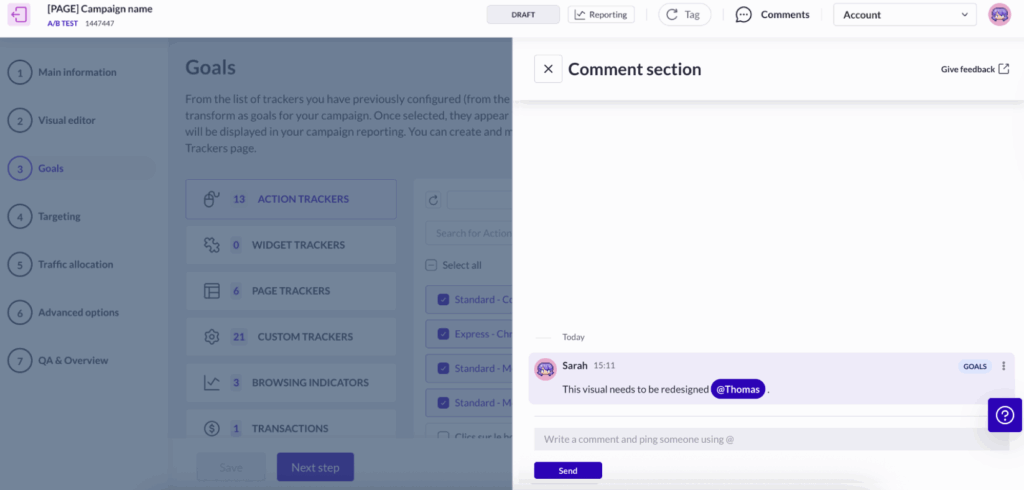
The no-code visual editor empowers marketers, while developers leverage VS Code. Comments can be added anywhere — in the editor, creation flow, or reports — with tagged users notified instantly. Preview and QA links make cross-team collaboration effortless.
After a Campaign
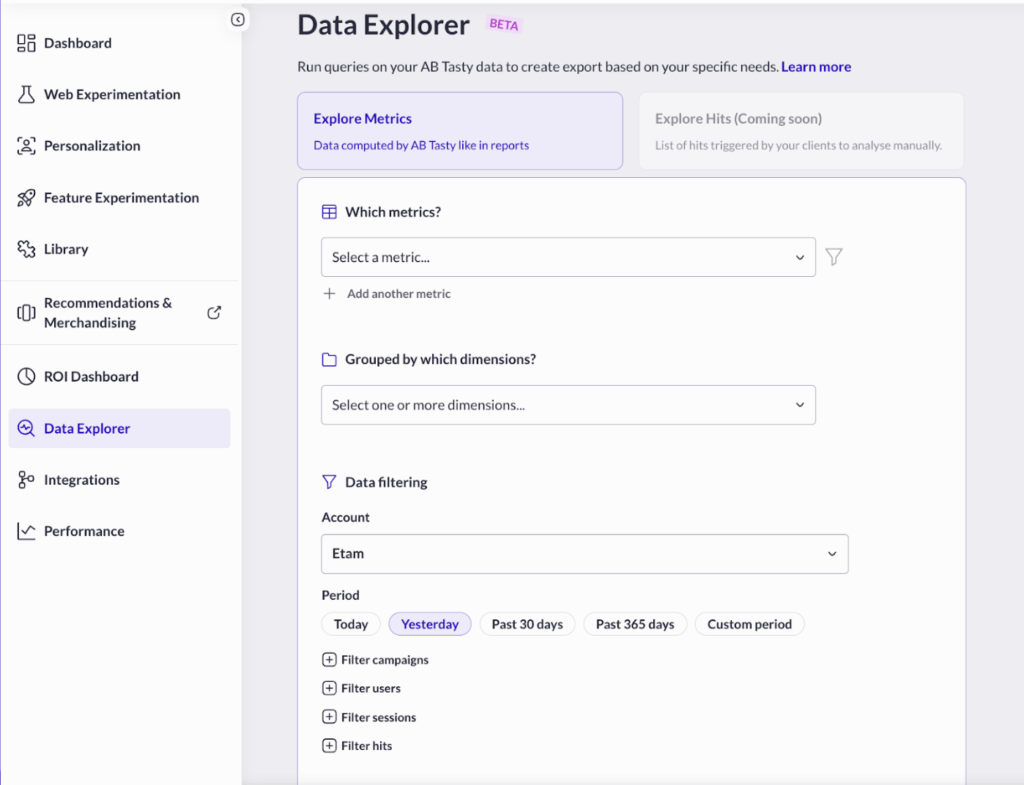
AB Tasty’s segmentation features and its powerful Data Explorer allow analysts to go deep, while marketing teams can still interpret results intuitively. Reports can be shared externally via secure links or exported automatically to Notion, BI systems, or Slack channels. Visibility becomes effortless and organization-wide.
After a campaign concludes, the true value of the Learnings Library comes into play. Instead of letting critical insights disappear with team turnover or get buried in forgotten files, the Learnings Library transforms every campaign’s results—both qualitative and quantitative—into a permanent, searchable company asset.
Teams can capture not just what happened, but why. This means that even as teams and agencies change, the knowledge stays put—enabling new hires to hit the ground running and decision-makers to build on a growing foundation of proven insights, campaign after campaign.
3. Deep Integrations Strengthen Collective Intelligence
Collaboration is not limited to the experimentation platform itself. AB Tasty integrates with tools teams already use daily:
Slack: receive notifications when campaigns go live or when new learnings are added
Notion: synchronize campaign KPIs and reports automatically into team workspaces
BigQuery, Looker, Metabase: power custom dashboards
GA4, Contentsquare, FullStory: enrich analysis with behavioral and analytics data
And with Microsoft Teams coming soon, AB Tasty is extending its collaborative reach even further.
4. A True “One Platform” for Experimentation, Personalization, and Feature Rollouts
Cross-team alignment is reinforced by AB Tasty’s unique combination of client-side experimentation and Feature Experimentation & Rollout (FE&R). Product teams and engineers can gradually deploy new features, run server-side tests, and secure releases through progressive rollout and rollback automation. Meanwhile, marketing and CRO teams continue to run client-side tests on the same unified platform.
Everyone operates within the same environment, driving shared KPIs and shared business outcomes. And this collaborative foundation is amplified by Evi — AB Tasty’s evidence-based AI agent.
5. How Evi Enhances Collaboration Throughout the Experiment Lifecycle
Evi acts as a shared intelligence layer that supports every role involved in experimentation — ensuring alignment, speed, and evidence-based decisions at every step.
Before launching a test
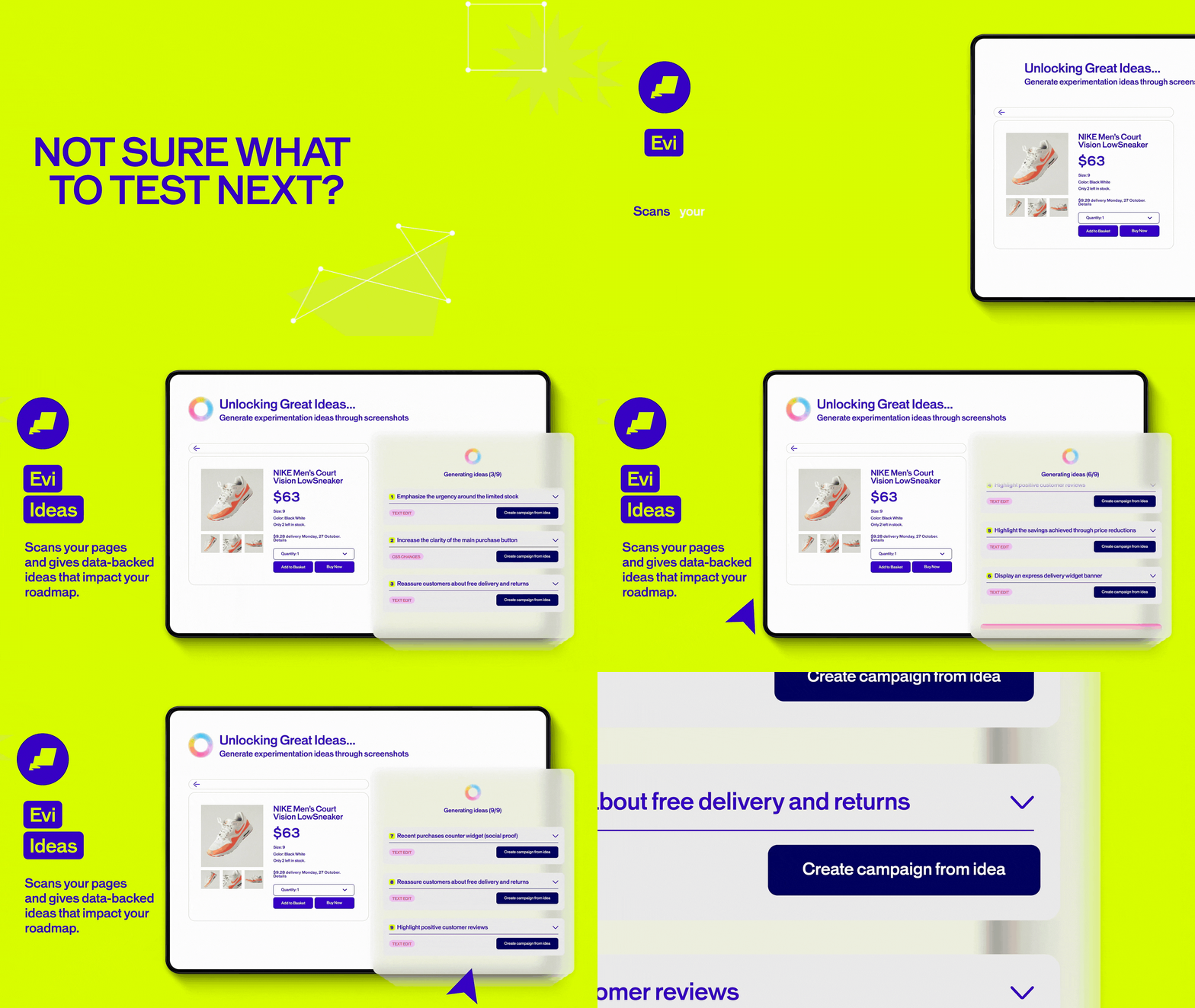
Evi Ideas generates new experiment opportunities
Teams align faster on hypotheses grounded in evidence
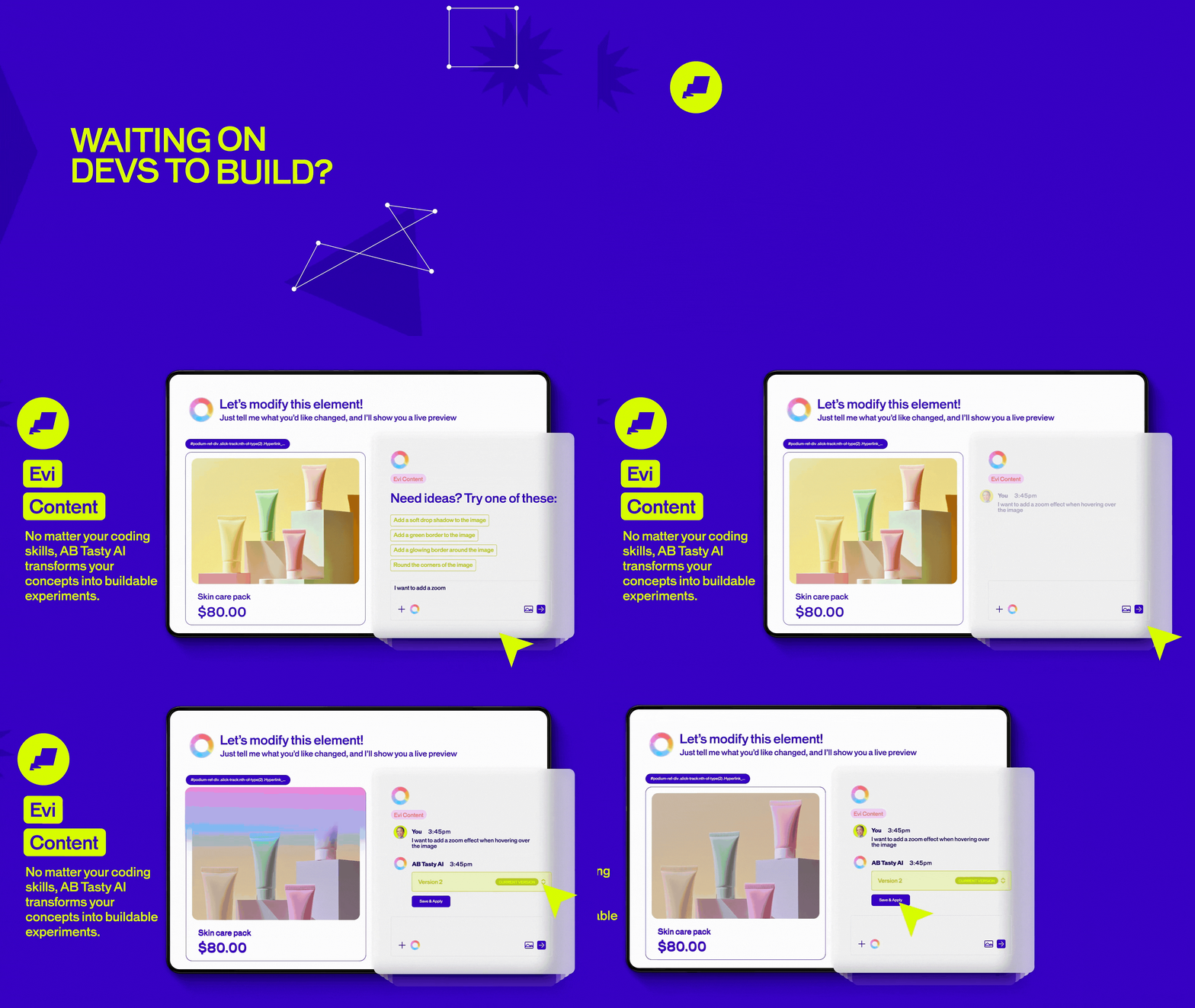
Evi Content creates consistent messaging across markets
During the campaign
Evi provides contextual guidance directly in the workflow
Teams can iterate faster and reduce dependency loops
After the campaign
Evi Analysis turns raw results into clear, actionable insights
Everyone sees the same interpretation of data
Learnings become easier to share and apply across markets
Result: A more autonomous, aligned, and collaborative experimentation program — powered by shared intelligence rather than siloed expertise.
AB Tasty continues to strengthen its collaborative features, with upcoming developments. Stay tuned! These improvements move AB Tasty closer to its long-term vision: a platform that not only enables experimentation but also unlocks organizational intelligence.
Conclusion: Collaboration Is the New CRO Advantage
Companies win with experimentation when they democratize it — when insights circulate openly, when accountability is shared, and when tools empower collaboration instead of slowing it down.
AB Tasty doesn’t just enable experimentation; it turns it into an organizational capability. A place where teams align faster, learn continuously, and make decisions grounded in evidence rather than intuition.
In a world where speed and cross-functional execution define competitive advantage, AB Tasty provides the collaborative foundation businesses need to accelerate growth.