

The Unopened Email & The “Close Enough” Offer
These days, with emails incessantly filling our inboxes, it’s increasingly challenging to not only capture someone’s attention – but to get them engaged with the subject matter of attractive mail.
Between email campaigns, newsletter, and social media stories – every marketer knows the feeling of spending days crafting an “extraordinary” email campaign, only for it to be met with low open rates or even unsubscribes.
The main challenge in developing dynamic email campaigns isn’t a lack of effort, but a lack of immediacy. Traditional email personalization relies on past purchases and slow-moving segments. These slow moving factors mean that by the time the email lands in someone’s inbox, they’ve already lost interest or their reason for subscribing in the first place has changed. This leads to “close enough” offers that feel average instead of attractive.
Luckily, there’s a way to bridge the gap between what a customer did yesterday and what they want right now – and that’s with real-time personalization through AdaptiveCX.
This article will explore quick, easy ways to move beyond static segments and use real-time, in-session behavioral data to create truly attractive email personalization that converts.
The Old Playbook: Where Traditional Email Personalization Falls Short
While the benefits of real-time personalization in email campaigns are indispensable, it’s important to remember the hallmark tricks and tips to traditional email marketing that have stood the test of time.
Here are some of the classic email campaigns tactics that still remain relevant today:
Purchase & Demographic Segmentation
A classic strategy that groups users by past buying behavior and traits like age or location. It was revolutionary for moving beyond one-size-fits-all marketing to deliver more relevant product recommendations and messages.
Basic Engagement Campaigns
Proactively re-engaging inactive customers with messages like “We miss you!” This tactic directly addresses customer churn and was a key step in focusing on customer retention instead of only acquisition.
Limited-Time Coupons & Discounts
Using time-sensitive offers to create a sense of urgency. This classic psychological trigger encourages immediate action and is highly effective at converting hesitant buyers by tapping into the fear of missing out.
Visual Engagement Tactics
Employing animated GIFs and flashing images to capture attention in a crowded digital space. This approach makes promotions more dynamic and memorable, cutting through the noise to draw the user’s eye to key messages.
However, there are several ways to improve upon these already impactful strategies to make not only attractive email, but messages that actually convert users.
Identify the Cracks
The first step in tailoring email campaigns to be more effective is to determine where improvements could be made. This is where stale data, based on what the user did, not what they are doing – is less useful.
For instance, someone who bought hiking boots last month might be browsing for running shoes today. There’s no way to know what a user is shopping for today using the data for what they shopped for months, weeks, or even days ago.
Tackle Anonymous Visitors
One of the main downsides of traditional email personalization is that it renders useless for the 90% of visitors that browse your website while logged out. Without their personal data, there’s no way to ignite interest until they sign up – and by then, the moment to pique their interest may have already passed.
Generic Campaigns
The best way to a shopper’s main motivation, and ultimately their conversion, is to spike curiosity in the exact thing they’re interested in buying.
This means that segments such as “interested in women’s fashion” are too generic to successfully convert users. It doesn’t differentiate between users looking for a discount on last season’s dresses, or one looking for new-in luxury handbags. The result of these basic, “batch-and-blast” emails posing as personalized, attractive messaging is audience feature and missed revenue opportunities.
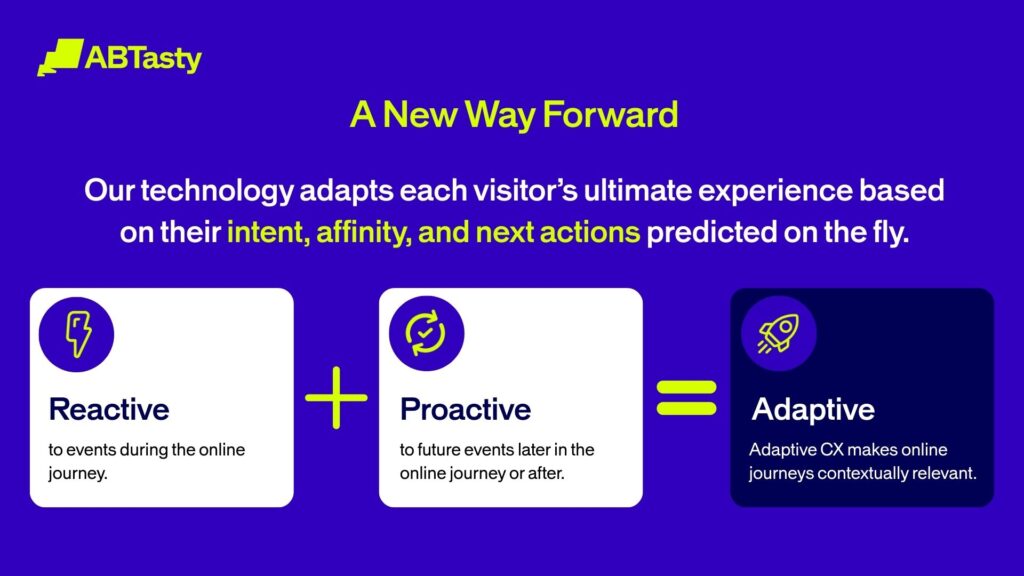
This is where AdaptiveCX can help to make your email personalization “pop” for readers and incentivize them to return to your website and proceed with a potential purchase.
The New Playbook: Real-Time Intent Signals
There’s an easy way to go from ordinary to outstanding email campaigns: and it’s with real-time personalization.
AdaptiveCX allows brands to gather information not just on what data they collect, but when you collect and act on it. With technology designed to track thousands of in-session “micro-behaviors”, brands can better understand their users’ intent in the moment and provide them with relevant content according to their interests in the moment.
What are Real-Time Intent Signals?
Here are some examples of how real-time intent signals collect useful information that traditional email platforms can’t see:

Hesitation
A user pausing on a specific product image signals interest mixed with indecision—a key moment to intervene.

Comparison Shopping
Switching between multiple product tabs is a classic sign of a user weighing their options and looking for the best deal.

Price Sensitivity
Immediately sorting a category by “Price: Low to High” reveals a budget-conscious shopper who will be receptive to discounts.

High Intent
Zooming in on product details or repeatedly viewing an item are strong indicators of a user close to making a purchase decision.

Affinity
Showing a preference for a certain color, brand, or style within a session allows for immediate, relevant product recommendations.

Contextual Awareness
Knowing if a user is on mobile vs. desktop or from a search engine vs. social media adds a crucial layer to other behavioral signals.
The magic of these moments is turning these microscopic signals into “intent profiles” for users on that same day. This tactic works for both known customers and anonymous visitors.
Remember, boosting engagement with email personalization is contingent on who the user is in a live-session today – not yesterday or two weeks ago.
Three Ways to Make Your Emails More Attractive with Real-Time Data
Going from bland to brilliant email campaigns doesn’t have to be tedious with real-time data.
Here are just a few of the ways email personalization can help your mailing campaign go from generic to golden:
The Hyper-Relevant Abandoned Cart Email
Reminding users that they’ve left something in their cart is a common tactic to incentivize them to re-engage with your website.
Imagine a user that showed price sensitivity (i.e., they used a coupon extension or sorted the products by price). An email tailored toward lower-prices, such as a small, one-time-use discount, could send them back to the site.
Here are some examples:
Average: “You left something in your cart!” (Shows the item).
Attractive (with AdaptiveCX): The email trigger knows not just what was in the cart, but also why it might have been abandoned – ”Don’t leave your cart empty during this one-time sale!”(shows the discount) .
The “We Read Your Mind” Follow-Up Email
In our fast-paced moving world, users often see items they like – but get distracted before proceeding to checkout. A great way to follow up is to remind them what they left in their cart.
For instance, a user might have been browsing three different black dresses but didn’t add any to the cart. The follow-up email’s subject line could be something along the lines of, “Still Thinking About the Perfect Black Dress?” with the content showcasing those exact three dresses, plus a “similar style” recommendation.
Another example is when someone browsed flights to Paris for specific dates, but never followed through with booking the trip. The “mind-reader” email to follow could include a real-time price drop alert for that exact route to grab their attention.
Here are some examples:
- Average: A typical “Top Picks for You” email sent 24 hours after a user visits the site.
- Attractive (with AdaptiveCX): An email sent minutes after a session ends that reflects the user’s true intent from that same session.
The Intelligent “Back in Stock” Notification
Nothing is worse than finding exactly what you’re looking for, only for it to be out of stock. This is where email notifications reminding previous visitors that a product they view in the past is now available could do wonders for conversions.
Here are some examples:
Average: A simple notification that an item is back in stock.
Attractive (with AdaptiveCX): The email will remember details such as how many times the user looked at the specific product, which images they zoomed in on, and more. With AdaptiveCX, these users can be placed in a priority queue to receive the notification before other customers. This sense of urgency could provide a sense of exclusivity that could motivate them to convert quickly.
Conclusion: Stop Predicting, Start Adapting
The future of email marketing isn’t going to be based on making better guesses from stagnant data, but about listening to what your customers are telling you right now through their behavior and adapting to their needs in a flash.
By connecting real-time, in-session intent to your email strategy, you can move past average, forgettable messages to attractive, can’t-miss moments that drive immediate conversions and long-term loyalty.
Ready for smarter email personalization strategies that will take your conversion levels from basic to bold?
FAQs
Still have questions about email personalization? Here are the answers you need.
What is email personalization?
Email personalization refers to the practice of tailoring emails to each individual recipient according to their personal preferences. Instead of generic messages, personalized emails deliver more relevant content recommendations or targeted offers.
How does real-time personalization improve email campaigns?
Real-time personalization helps email campaigns as it uses live data from the very moment an email is opened. This helps to curate content that is always up to date, making emails more relevant and timely – which improve engagement and conversions.
What data is used for email personalization?
Email personalization uses data such as names, purchase history, browsing behavior, and engagement patterns. Additional, advanced strategies may also include geographic location, preferences, and predictive insights to further improve content relevance.

About the Author
Kate Feng
Kate Feng holds a degree in International Business from SKEMA Business School, where she wrote her thesis, “Personalization with Principles: Ethical AI Strategies in Advertising.” Her research focused on how brands can leverage personalization responsibly — balancing performance, consumer trust, and ethical AI frameworks. Working on the AB Tasty team since 2024 as our Growth Marketer and Creative Strategist. Driven by blending her background in international business and art, Kate often links the gap between creativity and strategic thinking. Furthermore, Kate has experience developing her own business, a fashion company named KATE FENG PARIS – further demonstrating her skills in marketing, personalization, and international business. Kate often contributes to the blog to share her knowledge on growth marketing and personalization.