
If you’ve ever opened your company’s experimentation dashboard and felt overwhelmed by the sheer number of campaigns, you’re not alone. As businesses grow, so do the number of teams, projects, and experiments running at any given time. Suddenly, what started as a handful of tests can turn into a maze of overlapping campaigns, making it tough to find what you need.
That’s where Folders & Buckets come in. These two simple features can make a world of difference in how you manage, secure, and scale your experimentation efforts. Here’s how they work, why they matter, and some tips for getting the most out of them.
Too Many Experiments, Not Enough Organization
Picture this: your marketing, product, and development teams are all running their own experiments. Maybe you’ve got a few hundred campaigns live, or maybe it’s closer to a thousand. Either way, it’s easy for things to get messy. Important tests get buried, people accidentally edit the wrong campaign, and sometimes experiments even overlap – skewing your results or causing confusion.
This isn’t just a headache for your data team. It can slow down your whole organization and make it harder to get clear, actionable insights.
Folders: Your Experiment Filing Cabinet
Folders are exactly what they sound like: a way to group and organize your experiments in a way that makes sense for your business. But they’re much more than just a visual aid – they’re a powerful tool for access control and workflow management.
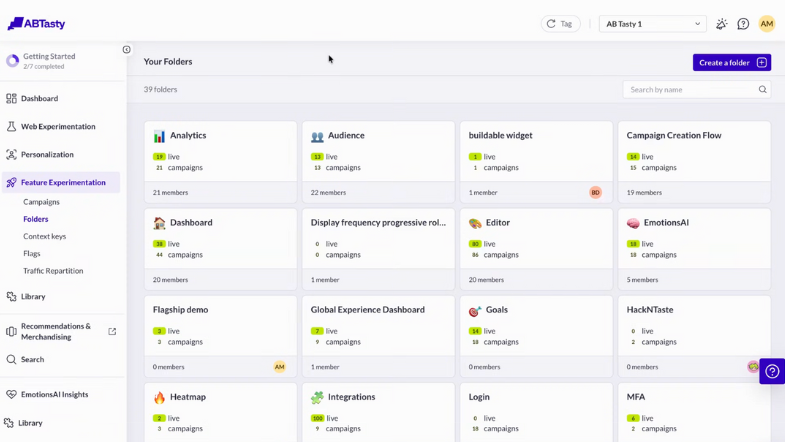
How Folders Work
- Custom Organization: Structure folders by team (e.g., Marketing, Product), by project or sprint, by product line, or even by page type (e.g., Homepage, Checkout). The choice is yours.
- Granular Permissions: Assign users to specific folders with different roles – viewer, editor, or admin. By default, new users see nothing until they’re granted access, minimizing risk and keeping sensitive experiments secure.
- Flexible Access: Users can be given access to multiple folders, with different roles in each. This is perfect for organizations where people wear multiple hats or collaborate across teams.
Why Folders Matter
- Clarity: Users see only the experiments relevant to them, reducing clutter and confusion.
- Security: Sensitive or high-impact experiments are visible only to authorized users.
- Agility: As teams grow or projects shift, folders and permissions can be reorganized on the fly – no need to start from scratch.
Pro Tip: Many organizations use folders to mirror their internal structure, but you can also get creative – organize by campaign type, business objective, or even experiment status.
Buckets: Keeping Experiments in Their Own Lanes
While folders help you organize and control access, Buckets (sometimes called “traffic repartition”) are all about managing how user traffic is allocated across experiments. Think of buckets as traffic lanes on a highway – each experiment gets its own lane, so there’s no risk of collisions.
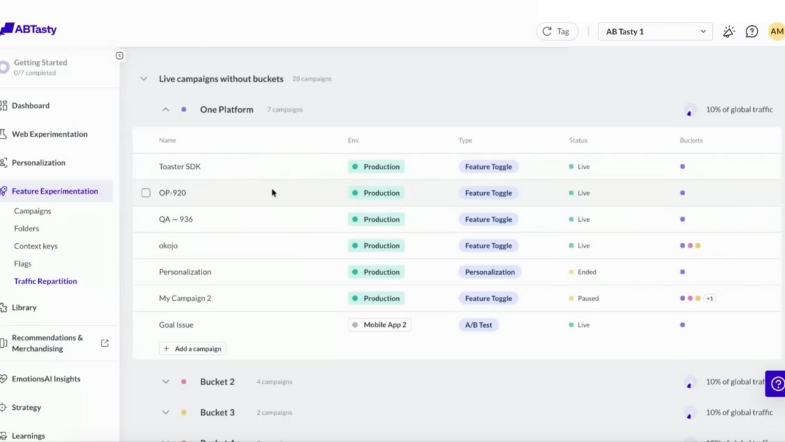
How Buckets Work
- Traffic Allocation: By default, you can create up to 10 buckets, each representing 10% of your total user traffic. Assign experiments to specific buckets to ensure they don’t overlap.
- Mutual Exclusivity: Experiments in different buckets never see the same users, so results are clean and reliable.
- Planned Flexibility: While the default is 10 buckets, future updates will allow you to customize the number of buckets and the percentage of traffic allocated to each.
Why Buckets Matter
- No Overlap: Run multiple experiments at the same time – on the same page or feature – without worrying about interference.
- Reliable Results: By keeping experiments mutually exclusive, you avoid skewed data and can trust your insights.
- Enterprise-Ready: Especially valuable for organizations with multiple teams running simultaneous experiments.
Why This Matters for Your Team
Folders & Buckets aren’t just “nice-to-have” features – they’re essential for any organization looking to scale experimentation without losing control. They help you:
- Stay organized as your program grows.
- Keep sensitive experiments secure and compliant.
- Empower teams to work independently without stepping on each other’s toes.
- Deliver reliable, actionable insights by preventing experiment overlap.
As digital experimentation becomes a core business function, tools like Folders & Buckets are what separate the leaders from the laggards.
Ready to Get Organized?
If you’re struggling with a cluttered experimentation environment or worried about experiment overlap, it’s time to explore what Folders & Buckets can do for you. Customer Success Manager for more information, and see how easy it is to bring order – and results – to your experimentation program.
Experiment boldly. Organize smartly. Grow faster.
Want to learn more? Check out our documentation (folders/buckets) or contact us for a personalized demo.
FAQs about experimentation organization
How can I stay organized when running lots of experiments?
AB Tasty is built for big teams running many experiments. We offer our users a clear folder structure to group experiments by team, project, product line, or page type, and apply granular permissions so people only see the campaigns relevant to them. This reduces clutter, limits mistakes, and keeps your experimentation environment manageable as you scale.
What are folders in an A/B testing or experimentation platform?
Folders act like a filing cabinet for your tests: you can group experiments in ways that match your organization (e.g., by team, sprint, product, or page type) and assign viewer, editor, or admin roles per folder to control who can see and edit each campaign.
What are buckets in an experimentation platform?
Buckets (or “traffic repartition”) are a way to divide user traffic into separate lanes. Each bucket gets a portion of traffic (e.g., 10%) and experiments assigned to different buckets don’t share users, which keeps tests mutually exclusive.
Which A/B testing solutions help teams stay organized at scale?
The most effective solutions offer both structural tools (like folders with role‑based access) and traffic management features (like buckets for mutual exclusivity), like AB Tasty. Together, these help large organizations keep experiments secure, organized, and analytically sound as their programs grow.

About the Author
Emily Healy
Emily Healy holds a Bachelor’s degree in Public Relations and Spanish from the University of Louisiana and a Master’s in Business from UC3M. She has worked in content and product marketing and holds PMA certifications in brand, positioning, messaging, and AI marketing.