
Generative AI is now creating a massive shift in how online buyers discover and compare products. That’s why we’ve put together a roadmap to help you understand the 2026 consumer in our e-book, The Spontaneous Shift: Consumer E-Commerce Trends for 2025. For e-commerce and travel brands this represents a real paradigm shift in how digital marketing works; one they will need to adapt to, and fast, if they want to survive.
Meet your customer’s new shopping assistant
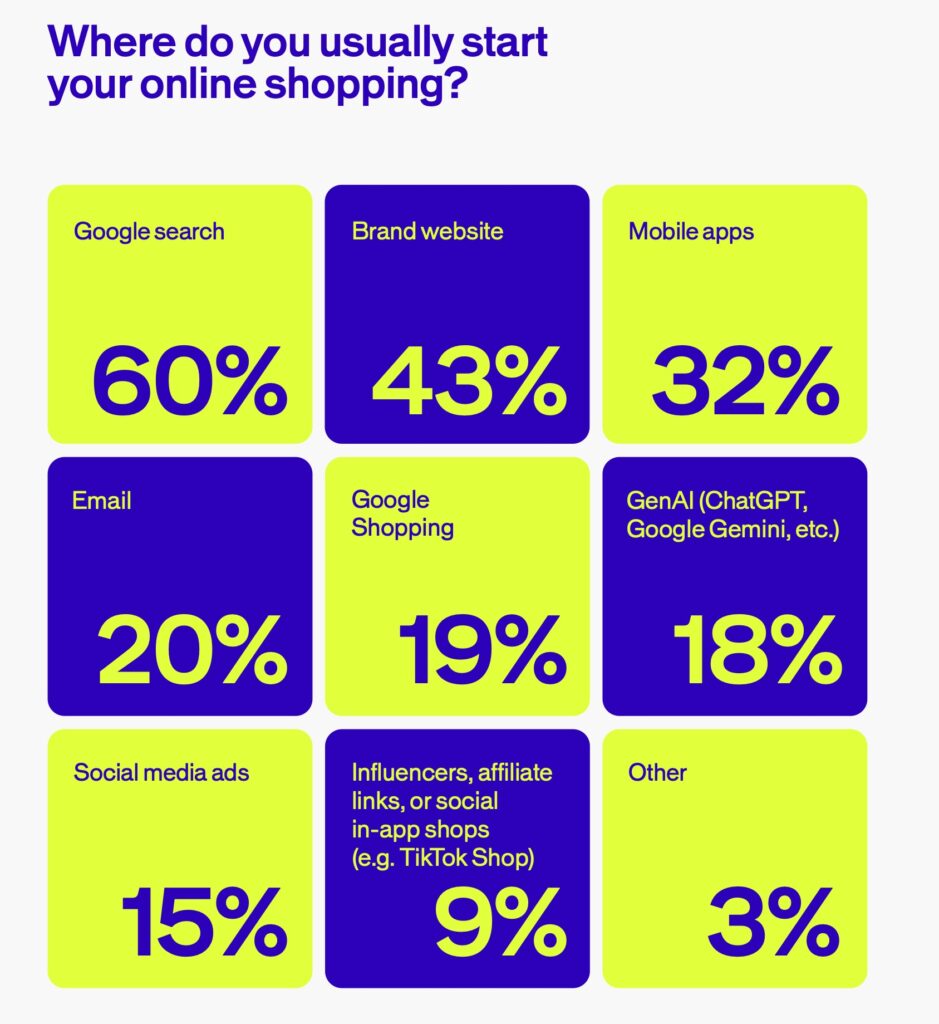
While Google search is still the dominant force in discovery, our research shows that other channels are rapidly gaining ground. And the fastest growing channel of all is Generative AI (like ChatGPT, Google’s Gemini, or Claude from Anthropic). Use of Gen AI tools by online shoppers in the discovery phase has grown 75% in just the last year, rising from 8% in 2025 to 18% as it quickly moves from a novelty to a utility.
But while more people are choosing to use AI, the level of uptake differs across generations. Perhaps not surprisingly, younger shoppers are more comfortable using AI tools to find what they need. 32% of Gen Z now say that they find AI helpful in their online buying journey. Millennials are not far behind, with 30% of them seeing AI as a helpful assistant, but this number falls to 13% of Baby Boomers.
Question everything about search
What’s clear is that the online behavior of consumers is changing and at pace. Younger generations especially are no longer content with scrolling through a list of blue links. Instead, they’re asking questions – and expecting answers. They aren’t just typing keywords like “red sneakers” into their browser; they’re giving AI prompts, like “Find me a pair of red sneakers that look cool and are under $80.”
This is a profound shift and one that has big implications for e-commerce and travel brands. Firstly, it means consumers no longer need to visit multiple websites to compare different products and services. They can do all of that and more by simply asking questions to an AI interface: “Is this sustainable?” “Will this work for my specific use case?” “How does this compare to their competitor’s offer?” The transaction is quickly becoming a conversation.
What this signals is a move away from carefully crafted product detail pages (PDPs) and towards much more dynamic interactions. If your brand can’t answer these questions in the conversational spaces where they’re being asked, either an on-site AI chatbot or a third-party platform, you’re effectively invisible. You don’t exist in an online consumer’s decision-making loop.
The new frontier of optimization
That in turn presents brands with a unique challenge. When online buyers perform a Google search or search directly on your website, you can see their query. But when they ask a question to a third-party AI platform, that happens inside a metaphorical “black box”. You can’t see what question they asked, and you can’t (currently) buy an ad to influence it.
This “invisible intent” requires a new kind of optimization. Because you’re no longer just writing for humans or typical SEO algorithms; you’re also writing for the Large Language Models (LLMs) of Generative AI. Fortunately, the core SEO principles of E-E-A-T (Experience, Expertise, Authoritativeness, Trustworthiness) can still provide brands with a competitive edge.
This is because LLMs are designed to recommend what they interpret as being the most credible answer, not just the one with the most (or best) keywords. If you want GenAI to recommend your products or services, you’ll have to give it proof that your brand is the authority.
To stay visible in this conversational future, that means your content strategy needs to move from volume to value. And if LLMs are to place any trust in your user reviews, they’ll need to be authentic. You also need to ensure that product data is structured with schema markup so it can be “read” by these new gatekeepers. It needs to be rich enough to answer the nuanced questions of online shoppers, not just fill a spec sheet.
Changing the face of travel
Human interaction has always been at the heart of the travel industry. And travelers have traditionally been happy to receive personalized recommendations or resolve any issues they might have by speaking with a real person. But this change in online buyer behavior from keyword search to asking questions of GenAI means the travel sector is perhaps even more exposed than most to this disruption.
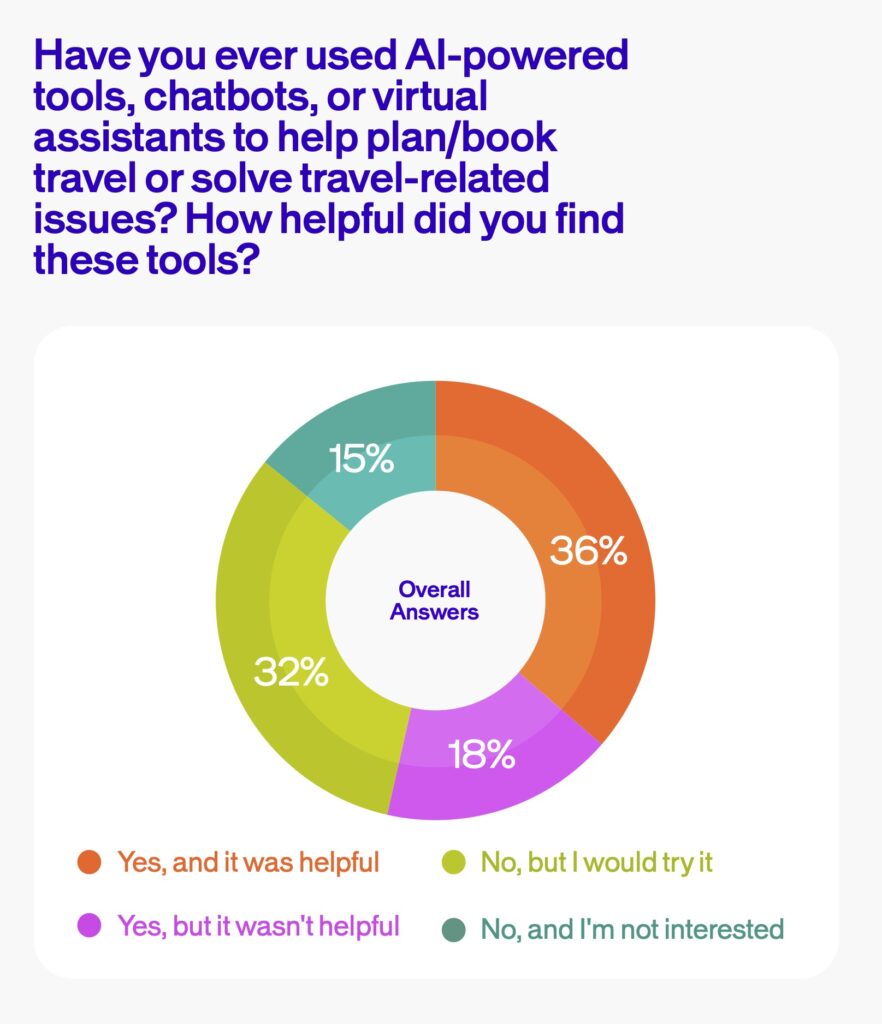
Our research shows that 36% of travelers have now used AI-powered tools, chatbots, or virtual assistants to book travel or solve issues and found them helpful. Another 32% haven’t tried using these yet but are open to doing so. Again, Gen Z are the most open to AI, with 49% saying they have used AI tools and found them helpful when booking travel. And while this figure is 41% for Millennials, it falls to 21% of Baby Boomers.
Focus on quality
This is good news for travel brands looking to embrace on-site AI chatbots to help visitors plan travel. But at the same time, there’s also nothing to stop those same online buyers from doing that on a third-party platform. A prompt like “Plan a 5-day family-friendly trip to Lisbon in May, staying near the city center with a budget of $2000,” can generate a complete itinerary with flight suggestions, hotel options, and activity booking links. All without visitors ever going near a brand’s website.
That means there’s a real possibility for travel brands of being reduced to a single item in an AI-generated plan. And if they lose the ability to showcase a unique brand experience on their website, travel companies like hotels and airlines risk being compared merely on price and basic features alone. Loyalty programs and creating exceptional customer experiences are likely to be more important than ever.
Travel is also time sensitive. A third-party AI platform is unlikely to recommend a hotel or a flight if it can’t access real-time availability, accurate pricing, and clear policies. This requires travel companies to be laser-focused on the quality and accessibility of their data. Again, the best way to ensure that GenAI recommends your brand to online buyers is to have rich, well-structured information that is instantly available.
Conclusion
The world of e-commerce and online travel is undergoing a real paradigm shift in how online buyers discover and compare products. And the rules are still changing in real-time. Ensuring that your data is as authoritative as possible and easily accessible to GenAI is currently your best bet to remain visible in this new environment. The only viable way to do this is to build a culture of continuous experimentation; testing, learning, and iterating towards your “better”.
Takeaways for e-commerce and travel brands
- Test your GenAI visibility: Go to ChatGPT or Gemini and ask questions about your product category. If your brand doesn’t show up, you have an optimization gap to fill.
- Develop AI-friendly product data structure: Implementing comprehensive schema markup across your site is no longer optional, it’s the price of entry.
- Create AI-friendly content: Develop clear, factual, easily digestible content that directly answers questions your customers might have. This makes it much more likely that it will be used by an LLM.
- Track GenAI adoption monthly: Monitor the amount of traffic to your website coming from third-party Gen AI tools and how this affects sales.

About the Author
Emily Healy
Emily Healy holds a Bachelor’s degree in Public Relations and Spanish from the University of Louisiana and a Master’s in Business from UC3M. She has worked in content and product marketing and holds PMA certifications in brand, positioning, messaging, and AI marketing.