
What is AI-Powered Optimization Really Doing in 2026?
What can AI agents do in 2026? It’s far more than you think – as AI is now playing an integral role in reshaping how optimization works.
The noise has never been louder for AI, with industries from food, fashion, to entertainment finding new ways to push the limits of what AI can do to optimize their success. No longer a futuristic concept, AI is now a daily component for teams across multiple industries to establish success in marketing, conversion, and more.
However, many people still remain wary of AI in 2026 — as some fear it could replace them entirely. This concern is one that resonates across many industries, and the world of optimization is no exception.
But when we look past the potential fear associated with AI, we can see that AI isn’t here to replace the optimizer – but to be used as a tool to amplify already existing strategies. This is because AI can automate tedious, analytical tasks and uncover new insights that the naked human eye might miss. In turn, this can allow teams to focus more on strategy and creativity – and leave the more mundane chores in the hands of AI.
We’re going to explore the tangible benefits of AI in optimization software today, how it is continuing to evolve, and address the common concerns regarding what the future holds for AI in Experimentation Optimization Platforms (EOPs).
The World Before: A Quick Look at Optimization Without AI
Things were different just a couple of years ago. College students didn’t have Claude to help write their papers. High school students didn’t have Chat GPT to finish their homework. Colleagues didn’t have Gemini to respond to emails.
The same goes for the EOP world before AI.
The overview cards below will show what traditional optimization process consisted of:

Manual data analysis

Time-consuming test ideation

Developer dependencies for simple changes

The challenge of interpreting complex results
Before AI, optimization heavily relied on statistical models to optimize. While these were effective, it remained challenging to choose the best hypothesis to test – which is the first step to achieving conclusive results in experimentation.
Luckily, this is where AI has stepped in – helping us to develop stronger hypotheses and consequently, more robust testing and results.
When brands dare to find growth in unexpected ways, such as with AI, you can leverage opportunities that would have otherwise gone unnoticed.
This is where AI can step in and bring expertise to make experimentation easier.
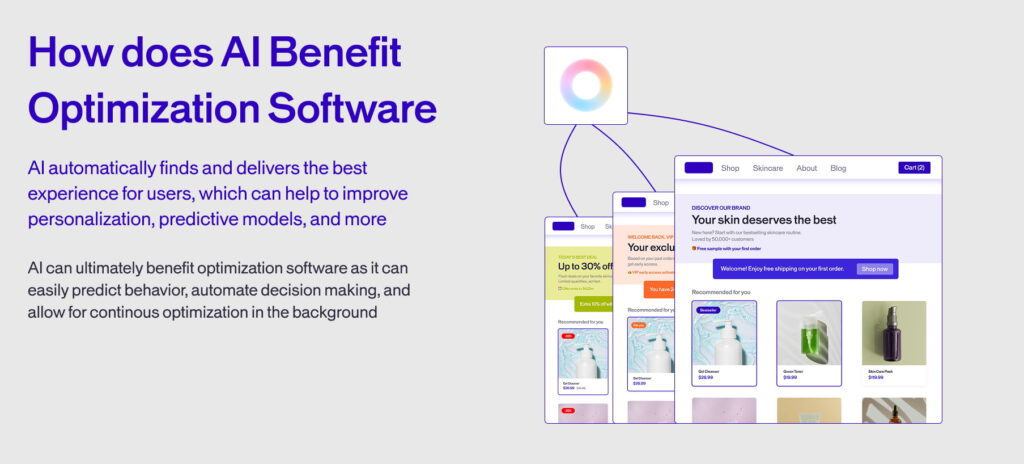
How AI Benefits Experience Optimization in 2026
There are several benefits to using AI for your Experience Optimization Platform (EOP) in 2026.
Here are some of the various advantages AI brings to optimization platforms:
- Manual Analysis to Proactive Insights: AI doesn’t just present data, but interprets with more conducive results. This reduces the chance of subpar results and makes testing more effective and concise. Tools like AB Tasty’s Report Copilot (Evi) analyze results, summarize key takeaways in natural language, and even suggest the next best action, turning reporting from a passive dashboard into an active “optimization engine”.
- Brainstorming to Data-Driven Ideation: AI tools like Visual Editor Copilot can analyze user feedback, competitor sites, and performance data to suggest high-impact A/B test ideas. This allows brands to overcome creative blocks and prioritize their roadmap.
- Code-Dependent to Code-Free Creation: Generative AI in tools like the Visual Editor allows marketers to make changes with simple text prompts, such as by suggesting to make a button blue or add a banner. This dramatically reduces reliance on developers and accelerates test velocity.
- Static Segments to Dynamic, Emotional Targeting: Perhaps the most pivotal benefit of AI in optimization software, AI tools can provide real-time, intelligent targeting as opposed to basic segments.

Addressing the Elephant in the Room: Will AI Replace Me?
Understandably, there’s a lot of uncertainty that accompanies the growing use of Artificial Intelligence (AI). Many people working across various industries worried that AI could replace them entirely.
According to National University, a whopping 52% of employed people are concerned that AI will be able to do their job and render their professional skills useless.
The overview cards below will reveal some key figures about the current use and future direction of AI:
35%
of companies around the world use AI in their business models
52%
of experts think AI will both replace and create jobs
77%
of companies are exploring the use of AI
It’s understandable that the near omnipresence of AI is overwhelming, especially with the looming apprehension that AI could make optimization roles obsolete. But if you think of AI as more of an assistant instead of a replacement, it could actually make your existing work easier. This can leave more room for more innovative ideas instead of time consuming data-analysis.
The problem with AI in fields like optimization is that many people tend to think of it as simply being on autopilot. In reality, AI functions as more of a co-pilot in EOPs – handling the “how” so humans can focus on creating goals for the “why” and the “what’s next”.
The table below will break down the differences between AI being on “autopilot” (what many consumers fear) and when AI works as a “co-pilot” :
| AI on “autopilot” | AI as a “co-pilot” |
| Uses AI to create content | Uses AI to make suggestions & spark ideas |
| Executes tasks end-to-end | Collaborates with humans to refine decisions |
| Prioritizes speed and automation | Balances speed with control and creativity |
How AI Can Boost Time Efficiency in Workflows
AI serves as more of an assistant rather than a replacement. In fact, 88% of creative professionals said that they felt generative AI could help them to produce content faster – without replacing them entirely (Adobe Digital Insights).
Think of a marketer staring at a blank hypothesis backlog. By using AI as a sounding board, they can quickly generate fresh test ideas, suggest high-impact page elements to experiment on, and even draft email subject line variations to A/B test — all in a fraction of the time it would take to do manually. AI isn’t replacing the marketer’s judgment, but avoiding an incessant blank page so they can spend more time doing what they do best: thinking strategically and acting decisively.
AI can serve as a way to enhance already existing human thinking, creativity, and brand understanding. This is because the best AI strategies blend automation with human oversight and expertise.
How Tools Like Evi AI & Emotions AI Boost Optimization Strategies
Sometimes it’s hard to believe in the power of AI until you see it in action.
At AB Tasty, we want optimization and AI to work together as a team – and that’s exactly what our software accomplishes.
Here are three different AI-powered software tools used in AB Tasty optimization platform:
- EmotionsAI analyzes in-session behavior to identify a visitor’s emotional needs (e.g., Need for Safety, Need for Immediacy) in just 30 seconds. This allows for personally tailored carousels, pop-ups, and more to boost conversion.
- AdaptiveCX uses predictive AI to personalize experiences for anonymous visitors based on their live intent, adapting the journey in milliseconds.
- Evi AI is an AI agent that transforms complex data into clear, actionable strategies for your experimentation program by automating the A/B testing journey. This includes generating data-backed ideas, hypotheses, and analyzing campaign results to help make smarter, evidence-based decisions.
AB Tasty, we want optimization and AI to work together as a team – and that’s exactly what our software accomplishes.
Our AI powered tools reveal that AI doesn’t have to work against you, but with you. When paired with daring ideas, AI can take you one step closer to the next level of success.
The Future is Collaborative: What’s Next for AI in Optimization?
The future of AI in optimization isn’t just making suggestions, but taking action. As AI agents become more autonomous, teams will be able to redirect their focus to achieving greater goals instead of spending additional time on tiresome tasks.
Here are just a few of the ways that AI could boost our collaborative efforts and make progress in personalization even more possible:
Agentic AI
Instead of just suggesting a test, an AI agent might propose an idea, build potential models, monitor performance, and even make suggestions for follow-up steps. This turns the platform into an intelligent, self-improving system – one that requires no extra work or a large team of coders.
Deeper Integration
Also, AI in optimization can help to bridge the gap between different platforms – such as between analytics, e-merchandising, and Customer Data Platforms (CDPs). This creates a unified, quick-witted optimization ecosystem that can respond to changes instantaneously.
Proactive Optimization
As AI becomes more authoritative, it will be able to not only report past activity – but actively make suggestions for the future.
This means that instead of redirecting optimization tactics toward potentially obsolete information, future optimizations can expand revenue or reduce catalog fatigue according to live data. This shows how AI can operate as an effective tool in supporting already existing personalization plans, predictive analysis, A/B testing strategies, and more.
Conclusion: Your New Teammate is an Algorithm
In 2026, AI is not a threat – but an essential teammate in your growth journey.
It makes optimization faster, smarter, and more human-centric by handling the machine-scale tasks that used to slow us down. Brands that are brave enough to try, iterate, and test the boundaries of what AI can do will be bound to be more successful than those who don’t take small steps forward with AI as their ally.
Remember, AI isn’t meant to replace raw, human talent – but amplify your power to make progress.
Let’s push past the limits and learn what AI agents can do for optimization, together.
FAQs
Still have questions about AI and optimization? Here are the answers you need.
What does “AI-powered optimization” mean in 2026?
AI-powered optimization refers to using machine learning models to automatically test, learn, and improve digital experiences in real-time. This means instead of relying only on manual A/B testing, using AI in the world of optimization can allow brands to quickly analyze user behavior, predict outcomes, and create robust personalization experiences.
How is AI different from traditional A/B testing?
Traditional A/B testing compares a few variations and waits for statistical significance. AI and optimization, on the other hand, can:
- Test multiple variables simultaneously (multivariate testing)
- Adapt experiences in real time
- Personalize content for different audience segments automatically (such as with AdaptiveCX or Emotions AI)
This makes optimization faster, dynamic, efficient – and better tailored to individual users while they’re still shopping on your website.
Is A/B testing still relevant in 2026?
Yes, A/B testing is still important in 2026 – as it’s especially useful for validating major changes, running controlled experiments, and building trust in the decision making. Remember, AI enhances A/B testing as opposed to replacing it – often working alongside it.
What data is needed for AI optimization to work effectively?
AI-powered optimization tools usually rely on behavioral data (clicks, sessions, navigation), contextual data (device, location, time), and historical performance data. The more high-quality data available, the better the AI can make accurate decisions.
How do I know if AI is being used ethically in optimization?
You can determine if AI is ethically being used in optimization software by seeing if they respect user privacy and consent, avoid biased outcomes, are transparent about data usage, and still follow regulations like GDPR.
Can small teams benefit from AI-driven optimization?
Yes, small teams can absolutely benefit from AI-driven optimization tools! This is because many modern tools are designed to be accessible, allowing smaller teams to automate testing, scale personalization tactics, and gain insights without the need for large data teams.
What are the biggest mistakes companies make with AI optimization?
Common mistakes companies in optimization make with AI include relying on poor-quality or insufficient data, over automating without a clear strategy, mitigating the initial and fundamental experiment design, and focusing on short-term wins over long-term learning.
How long does it take to see results from AI optimization?
Brands could see the impact of AI-powered optimization in as little as a few days to weeks. That being said, the more meaningful long-term gains of AI tools in optimization often aren’t seen for several months.

About the Author
Stephanie Safdie
Stephanie Safdie holds a bachelor’s degree in English Language and Literature from the University of Maryland, specializing in multimedia studies. She has worked as a social media video creator, freelance copywriter, SEO copywriter at Greenly climate tech, and runs a travel blog Destination Dreamer Diaries.