
You might also like...
Article
10min read


Article
7min read
 abtasty
Customer Experience (CX) is how people feel about your brand based on every interaction they have with you—online, offline, and everywhere in between. It’s the complete customer journey: from the moment someone discovers your business, through research and purchase, all the way to post-purchase support and beyond.
Every touchpoint matters. Every moment shapes whether customers will come back, recommend you to others, or move on to a competitor.
Customer experience isn’t just a nice-to-have—it’s what separates teams that grow from teams that struggle. Here’s the impact it makes:
When you deliver great experiences, people talk about it. At least, 79% of customers who had a positive support experience would recommend the company to others. That’s word-of-mouth marketing you can’t buy—it’s earned through every interaction that goes right.
After receiving a 5-star experience, consumers are nearly three times more likely to trust the brand, three times more likely to recommend it, and over twice as likely to purchase again. The numbers don’t lie: better experiences lead to better business.
Loyal customers aren’t just repeat buyers—they’re your biggest champions. They spend 67% more than new customers, cost less to serve, and actively promote your brand. When customers feel valued and understood, they build emotional connections that keep them coming back.
The connection between customer experience and revenue is direct and measurable. When you improve customer satisfaction by 20%, you can see a 15–25% increase in cross-sell rates and up to 30% higher engagement. Better experiences don’t just feel good—they drive sustainable growth, higher lifetime value, and stronger margins.
Digital customer experience (Digital CX) is the sum of every interaction someone has with your brand through digital channels—websites, mobile apps, social media, chatbots, and beyond. It’s not just about functional transactions. It’s about creating emotional connections, building trust, and making every moment feel effortless and personal.
As digital touchpoints multiply, so do customer expectations. People now expect experiences that are seamless, personalized, and frictionless—no matter where or how they engage with your brand.
Measuring CX means understanding how customers feel at every step of their journey—and using that insight to make things better.
You can measure CX in two main ways: ask customers directly through surveys, or track behavioral and support data to see how they actually interact with your brand. The best approach? Use both.
Here are the key metrics to track:
Learn more on how to measure CX here →
Improving digital customer experience isn’t a one-time fix—it’s an ongoing commitment to making every interaction better. From mapping customer journeys and personalizing content to optimizing UX, testing continuously, and ensuring omnichannel consistency, these strategies help you deliver seamless experiences that drive engagement and loyalty.
To elevate your approach, focus on the following:
See These 10 Digital CX Proven Strategies in Action! →
Customer Experience Optimization (EXO) is the ongoing, data-driven process of improving every customer interaction across all digital touchpoints. EXO is where strategy meets action—combining customer insights, experimentation, and continuous iteration to deliver seamless, personalized experiences that drive loyalty and business growth.
Start by gathering and analyzing data on customer journeys, behaviors, and feedback. This helps identify pain points, preferences, and opportunities for improvement.
Tools like journey mapping and behavioral analytics are essential for building a clear picture of your audience and their needs.
Use experimentation—such as A/B tests, multivariate tests, and personalization campaigns—to validate ideas and discover what resonates with your audience.
This approach allows you to optimize content, design, and functionality based on real user responses, not assumptions.
EXO is a continuous improvement loop. After each experiment, analyze results using advanced analytics and customer feedback. Use these insights to refine your strategies, address new pain points, and adapt to evolving customer expectations.
The goal is to create a culture of ongoing optimization, where every team is aligned around delivering better customer experiences.
Read more on Customer Experience here →
The customer journey is the complete set of experiences and interactions a person has with a brand, from initial awareness through purchase and post-purchase engagement.
It includes both online and offline touchpoints, such as visiting a store, calling customer service, or interacting with marketing materials, and represents the path a customer takes as they move from discovering a need to becoming a loyal advocate.
The digital customer journey is the path a customer takes with a brand exclusively through online channels—such as websites, mobile apps, social media, and email.
It encompasses all digital touchpoints and interactions, from the first online encounter to purchase and ongoing engagement, and is characterized by its non-linear, multi-device, and data-driven nature, enabling real-time personalization and optimization.
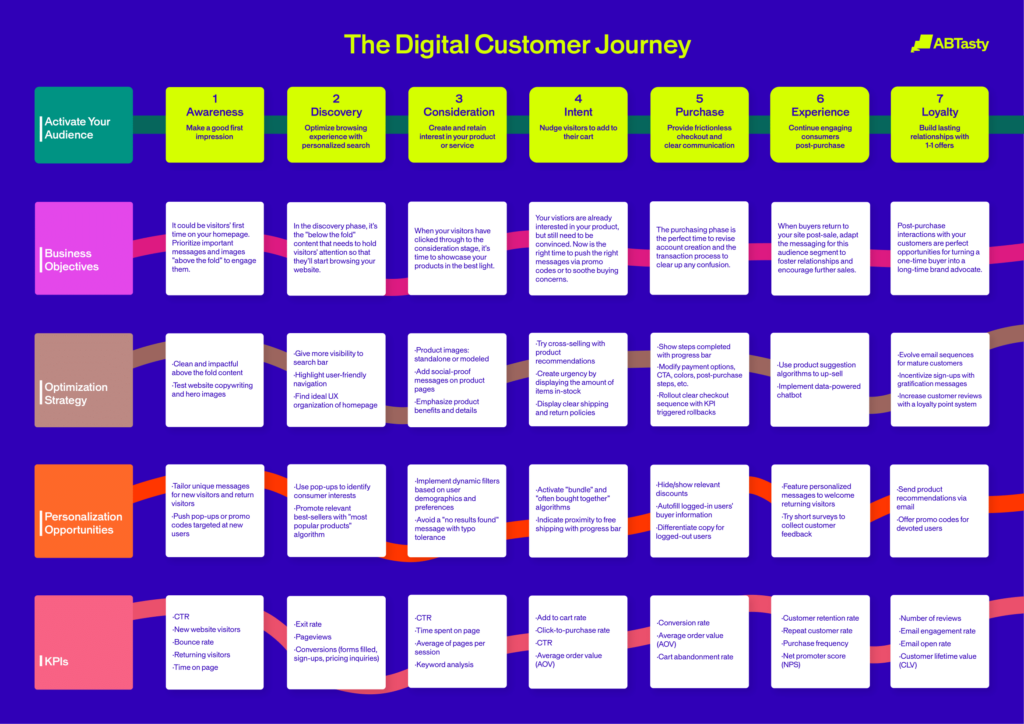
AB Tasty has mapped out seven distinct customer phases that are crucial for understanding and optimizing the digital customer experience. This comprehensive digital customer journey mapping represents a unique mindset, set of needs, and decision-making criteria that your visitors go through on their path to conversion.
When visitors land on your website for the first time, making a strong first impression with a visually appealing and intuitive page is crucial to capture their attention.
In this phase, customers are curious about your brand, so your website should offer an excellent and easy browsing experience, such as visible search and dynamic filters.
As visitors consider your brand and products, showcase your offerings in the best light to help them move closer to a decision.
When customers show readiness to purchase, use tactics like social proof and urgency messaging to encourage them to add items to their cart.
Ensure a seamless and frictionless checkout process to prevent drop-off and complete the transaction smoothly.
After purchase, maintain high-quality, personalized engagement to keep customers interested and encourage ongoing interaction.
Turn customers into brand advocates by showing appreciation for their loyalty through personalized offers, recommendations, and incentives.
By personalizing the experience of your customers during each phase of the digital customer journey, you can ensure an optimal shopping experience, boost purchases, increase customer satisfaction, and see more repeat customers.
Check out these templates to help you build your customer journey map →
Customer psychology (also known as consumer psychology) is the study of how emotions, perceptions, biases, and behaviors shape the way people buy and interact with brands. When you understand what drives your customers, you can design digital experiences that feel human, spark real engagement, and move the needle on conversions.
By using experimentation, behavioral insights, and thoughtful personalization, you can create experiences that resonate, build trust, and turn one-time visitors into lasting relationships. It’s not about manipulation. It’s about understanding—and showing up in ways that matter.
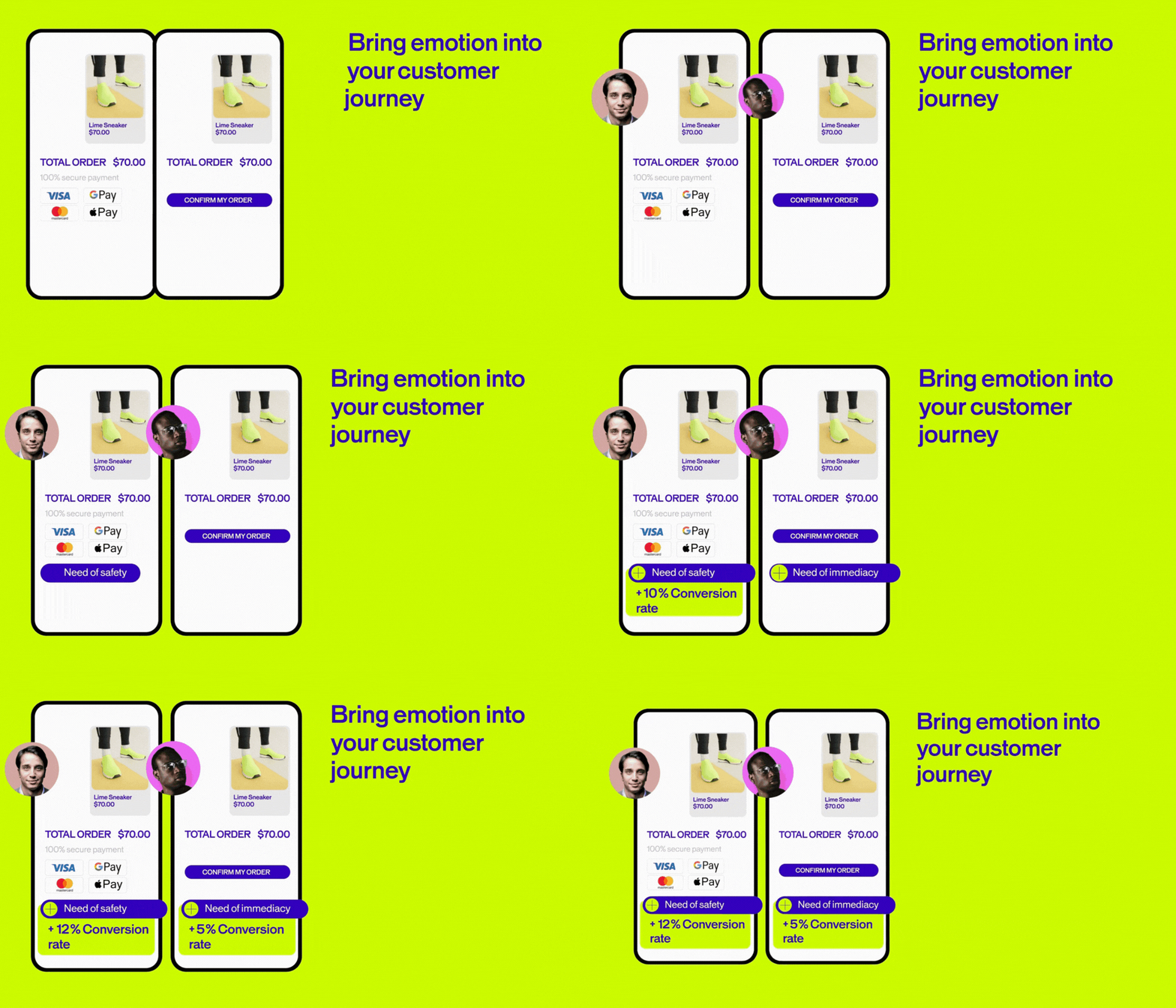
Simply put, emotions are the driving force behind every purchase. People don’t buy from a brand because they need a product they could easily find elsewhere—they buy because they feel an affinity, a sense of trust, well-being, inclusion, or loyalty to that brand.
In today’s crowded market, forging deep emotional connections with customers is essential for marketers to attract and retain customers. Marketers can’t merely “appeal to emotions”—they need to move toward emotional personalization. This means they must understand customer behaviors and motivations and ensure that their missions and messages align with customers’ emotions and needs, creating a unique and deeply relevant experience for each individual.
Learn more on how to create emotional connections with customers →
AB Tasty’s resources identify several powerful psychological triggers that influence customer behavior:
Urgency is a psychological trigger deeply rooted in our brain—it relates to human loss aversion or the “fear of missing out” (FOMO). Scientifically speaking, urgency is a time-based concept that prompts us to act quickly. When faced with a limited-time offer (like a discount), we automatically start to evaluate if we’re comfortable letting this opportunity get away.
This is a psychological trigger that uses quantity to compel us to act quickly. Scarcity triggers a thought that pushes us to place a higher value on objects that are scarce or rare, also activating our FOMO instinct.
People’s tendency to do something merely because others are doing it is what psychologists call the Bandwagon Effect. One of the best ways to harness its conversion optimization benefit is by using social proof on your website—positive testimonials, reviews, and user-generated content that create trust and credibility.
Anchoring is the fact that people tend to cling to the first piece of information (or anchor) they encounter, and let their subsequent actions—such as estimates, arguments, and conclusions—be made in relation to it. It’s an excellent psychological tactic to boost your product’s perceived value and influence buyers’ decision-making journeys.
Reciprocating an offer is naturally part of human nature—people have a natural want to repay favors or gifts. By providing value upfront or offering free samples, you can tap into this trigger.
The Barnum Effect (also called the Forer Effect) occurs when individuals believe that personality descriptions apply specifically to them, despite the fact that the description actually applies to everyone. You can trigger this bias by personalizing user experience—your prospects will feel unique and heard when, in reality, you’re appealing to a whole segment, not one person.
See these Psychology Hacks for Experience Optimization →
Great customer experiences don’t happen by accident—they’re built through bold experimentation, continuous iteration, and a deep commitment to understanding what customers truly need.
Whether you’re mapping digital journeys, testing new features, or tapping into emotional triggers, the goal is the same: show up in ways that matter. Make every interaction easier. Make every moment count.
Start small. Test often. Learn fast. And remember—you’re not in this alone. With the right tools, mindset, and team behind you, you can turn curiosity into progress and progress into lasting loyalty.
Ready to go further? Let’s build better experiences together →
Customer experience management (CXM) is the practice of tracking, analyzing, and improving every interaction customers have with your brand—from first click to post-purchase support. It’s how you turn scattered touchpoints into a cohesive, optimized journey that builds loyalty and drives growth.
Expect hyper-personalization powered by AI, seamless omnichannel experiences, proactive customer engagement, and smarter automation through agentic AI. Voice commerce, immersive AR/VR experiences, and community-driven loyalty programs are also on the rise—all focused on making interactions faster, more personal, and more human.
The 5 C’s are: Connection (building strong relationships), Culture (fostering a customer-first mindset), Communication (setting clear expectations), Consistency (delivering reliable experiences), and Confidence (bringing value with conviction). Together, they create the foundation for world-class CX.
Digital customer experience (DCX) is how customers perceive your brand based on every online interaction—across websites, apps, social media, email, chatbots, and more. It’s a subset of overall CX, focused exclusively on digital touchpoints, where personalization, speed, and seamless navigation matter most.
Customer journey is a complete series of experiences and interactions someone has with your brand—from discovery and consideration, through purchase, to post-purchase engagement and loyalty. Understanding these journeys helps you identify pain points, optimize touchpoints, and deliver better experiences at every stage.
No. While both prioritize great experiences, B2B journeys are longer, involve multiple decision-makers, and focus on ROI and long-term partnerships. B2C experiences are faster, more emotional, and often driven by individual needs and social proof. The strategies differ, but the goal is the same: build trust and deliver value.
Customer experience (CX) focuses on external satisfaction and loyalty—how customers feel about your brand. Employee experience (EX) focuses on internal engagement—how employees feel at work. The two are deeply connected: engaged, satisfied employees create better customer experiences. Invest in both, and you’ll see the impact on retention, loyalty, and growth.

Subscribe to our Newsletter