Article

8min read

Building Customer-Centric Cultures With Data

We invite you to also read our previous article in this series, Measuring Your Digital Impact, or the series introduction.

This is the fifth part of our series on a data-driven approach to customer-centric marketing. We met with our partner Sophie D’Souza, Vice President of Optimization at Spiralyze, and Rémi Aubert, Co-CEO & Co-Founder of AB Tasty, who talk about what a customer-centric culture really means, why it’s so important for companies to foster one, the data that enables such a culture, and the challenges and benefits involved.


How would you define a customer-centric culture?

In this data series, we’ve discussed ways to use and analyze data, metrics, and experimentation to better understand your customers, meet their needs and forge emotional connections with them. All of these things contribute to the ultimate goal of building a customer-centric vision and culture for brands.

But what defines a customer-centric culture? For Sophie, “Being customer-centric means that the customer is at the nucleus of the business – the shared collection of values, expectations, practices, and decisions that guide and inform team members are centered around the customer and the needs of the customer. And a big part of achieving that is ensuring data isn’t siloed – it’s not segmented to any one department like upper management or customer success; it permeates every aspect of the company; formal and informal systems, behaviors, business decisions and values all revolve around the customer.”

In Rémi’s opinion, customer-centricity is also very much about “Prioritizing customers above prospects in your day-to-day work. It’s easiest when you’re a small business, but it’s vital to keep this spirit while you grow. Acquiring new customers is important, but we need to remember that our existing customers have already given us their trust. It’s our job to repay them for that with positive experiences, or at least excellent customer support so we can maintain positive experiences and turn any negative experiences into positive ones to ensure we retain them.

“Above all, being customer-centric means not being mercenary: it’s the foundation of organic growth, where word-of-mouth from satisfied customers spreads and turns prospects into new customers.”


Why is the democratization of data important?

“Data democratization is essential for building a customer-centric culture,” explains Sophie. “Shared, accessible data that isn’t siloed to any one department is the best way to gain customer knowledge. Equally important is a system for gathering, storing, interpreting, and acting upon this data whenever possible.”

“Constant product and website experimentation has shed light on the value of feedback – both qualitative and quantitative – and proven its value for providing insights to the organization. Companies now understand the meaning of a data-driven culture, and the dissemination of these insights across the entire organization is what drives customer-centricity.”

Rémi notes that during the last ten years, the emphasis has been on collecting data. “But today, we’re in a phase of interpreting data in order to act upon it – and this is a mature phase, we know the right KPIs to use to bring value; tomorrow, we’ll be able to automate this data, but few organizations have attained that capability yet.”


What types of data are needed to build a customer-centric culture?

“A customer-centric culture is a data-led business model, where both qualitative and quantitative data are essential – and experimentation plays a vital role,” says Sophie. “Quantitative data gives us brilliant direction. It’s often dictated by product centricity – how customers are interacting with products, and the actions they’re taking. Qualitative data, on the other hand, is dictated by customer needs. Pairing them will provide tons of valuable information. You can gather this from many different sources: engagement and community building (e.g., encouraging customers to leave reviews, asking questions on social channels, etc.).”

“But experimentation is a core part of this, allowing us to directly measure how individuals coming to our product or our website are interacting with us and what actions should accordingly be taken.”

Rémi agrees: “Even if we understand the quantitative aspect or the qualitative aspect of our data, we won’t be able to measure the impact of customer behavior if we’re not able to change those behaviors. This is where testing and personalization come into play.

“It’s fine to identify issues, but if we can’t propose solutions and measure their efficacy, we won’t be able to adapt our culture of customer centricity to new needs. The complementarity between quantitative and qualitative data is essential. Quantitative data helps us identify problems, while qualitative data usually helps find solutions.”

Sophie’s on board: “Experimentation lets us put the customer first because we can test different solutions based on the problems we’ve identified. So rather than rolling out an idea we’ve deemed internally to be the best, experimentation lets the customer guide our actions, and in that way, we know we’re responding to real needs.”
 

Are there problems associated with acquiring the necessary data?

Rémi says the main problem is related to faulty data collection: “We sometimes see biased data due to incomplete data collection. Biased data is useless. Another issue we often see is that of overcollection: people collect far more data than they need, then find themselves lost in a data deluge that’s impossible to analyze and from which they can’t extract insights. The enemy of good data is too much data because you can’t orchestrate it.”

“We’ve learned that too much data equals clutter and distraction,” says Sophie. “There’s a lack of central systems in place that are efficient enough to process that much data and make it actionable. Designing systems to capture the information we need at scale and disseminate it while minimizing variance by individual interpretation is the objective for businesses today.”


What are the challenges to achieving a customer-centric culture?

Rémi tells a story about a client from a top-tier luxury jeweler. “It’s very difficult for brands like that, which have strict graphic charts and editorial guidelines, to be customer-centric, as they have little flexibility for testing. These brands are very powerful: you can’t make the slightest modification without validation by the entire brand team. So even if you know you can improve the customer journey or experience on the website, you can’t implement any changes because brand policy prohibits it. The result? Even if you have data proving a given change will improve their customer satisfaction, brand ‘integrity’ won’t allow it.”

Sophie sees a lot of progress being made, but certain barriers remain. “To be a data-driven organization, you need an open mind and an experimentation mindset, because a customer-centric culture is premised on innovation and constant change to meet customer needs. A big challenge today is that not everyone in a given organization has a data-driven mindset, although website and product experimentation and personalization are paving the way to its adoption.”

Rémi and Sophie agree that in a data-driven organization, people at every level are empowered to contribute, because it’s data, not experience, that matters. A new hire can propose a test hypothesis just as valuable as one suggested by a CEO. This kind of democratization is happening at Hanna Andersson, a children’s clothing manufacturer where all employees have a voice and are encouraged to submit test ideas. The best ones are acted upon, as in this AB Tasty case study where a small change in product image led to big impact.  


How does a customer-centric culture benefit businesses/brands?

According to research by Deloitte and Touche, customer-centric businesses are 60% more profitable than their product-focused counterparts. Companies that put the customer at the center of their organization enjoy increased customer lifetime value and reduced churn.

“There’s a plethora of concrete benefits, including increased retention, customer loyalty, referrals… Operational efficiency is a major benefit, and it’s fueled by experimentation. This means that we’re not just guessing, but spending our time where it’s most valuable: on meeting real customer needs.

“Then there’s innovation. When we receive customer feedback, whether online or off, the products are iterated upon accordingly. It allows us to be more creative with solutions for customer problems rather than small iterations.”

Rémi adds that there’s also an important internal benefit to being customer-centric. “When your experiments have been successful and you’ve increased customer satisfaction, your clients are happy and so are your teams. That boosts their confidence in the product they’ve developed. It’s very rewarding.”

Sophie enthusiastically agrees: “It rallies everyone around the customer. No matter what role you play in an organization, you can see the benefit of your work.”


Article

10min read

Measuring Your Digital Impact

If you’d like, you can review our introduction to the Customer-Centric Data Series here or read the previous installment, Creating Emotional Connections with Customers Using Data.

For the fourth installment in our series on a data-driven approach to customer-centric marketing, we got together with Filip von Reiche, CTO of Integrated Customer Experiences at Wunderman Thompson, and Gaetan Philippot, Data Scientist at AB Tasty. We discussed the pros and cons of vanity metrics, how they’re different from actionable metrics, and the roles all types of metrics play when measuring a brand’s digital impact.


Let’s begin with digital transformation. What is it, and why have companies been so focused on it over the past few years? 

Digital transformation, as defined by Salesforce, is the process of using digital technologies to create new – or modify existing – business processes, culture, and customer experiences to meet changing business and market requirements. It began in the late 20th century and underwent rapid acceleration in the first two decades of the 21st century, spreading across almost all industries.

Resisting digital transformation is risky. TechTarget tells the fateful story of Blockbuster LLC, a once-global entity with video rental stores throughout the US and the world. But its presence and relevance precipitously declined from about 2005, as Netflix harnessed emerging technologies and capitalized on consumer appetite for on-demand entertainment delivered by the then newly-available streaming services.  

But digital transformation can also be seen as a buzzword, says Filip, “in the sense that people think it’s something they need to do. The original impetus behind digital transformation was that brands were trying to be more competitive – in how they grew their market share, how they were perceived, and so on. And digital transformation was the engine that enabled them to achieve these things, to react faster, and to be able to measure their impact.

“Initially, it was focused on giving brands an online presence, and of course, it has achieved that, but over time, it has acquired new uses. Its latest purpose is to help brands create personalized experiences by providing them with the right content and flow which allows them to have better conversations with their customers, and that leads to more conversions.”

For Gaetan, “Part of it is imitative: people say ‘Amazon is doing a thousand experiments a year, so we have to do the same,’ but not everyone has the vast resources of Amazon, or can hope for the same results.”

But if the objective is to have personalized brand experiences, Amazon isn’t a website where people want to spend much time. “On the contrary, people go to Amazon because they can get in, buy what they want, and get out fast. It’s totally impersonal,” explains Filip. “However, the reason I spend more time with a brand is because I want a specific product or service they offer, and I expect personalization from brands I’m engaged with.”

For personalization to be successful, there must be constant validation of your perceptions before going live with any website or campaign.“More than half of all campaigns that customers perform using AB Tasty have to do with personalization or experimenting with personalization,” remarks Gaetan.“They’re the foundation on which everything else is built.”


What are the differences between vanity metrics and actionable metrics?

The use of vanity metrics varies across different verticals at different levels and from client to client. The one constant is that vanity metrics are very alluring because they provide what Filip calls “A dopamine rush that lights up your brain – and in some cases, depending on what you’re trying to achieve with your personalization, that ‘rush’ might be sufficient. But ideally, you want to know what the long-range impact will be.”

The problem is that the impact is not always easily attainable. “Let’s take real estate as an example. It’s unfortunately not as simple as the target sees a personalized message, the target clicks, the target purchases a house. Wouldn’t that be great? But in reality, the lapse of time between that initial personalization and the purchase might be 30, 60, 90 days, or even longer. In some cases, you do need a vanity metric such as page likes, favorites, shares, etc., as an indicator to tell you where things are going, but it’s always better to have a conversion metric in the background to tell you what it all really means,” explains Filip. 

“This is where more in-depth analytics come into play. If you have a customer who is engaged but not converting, you need to find out what the barrier is and find a way to get around it. If you can propose a solution using personalization that meets the consumer’s needs and knocks down that barrier, great. But you always have to respect the trust the consumer has placed in you by giving you the data you need for personalization. You can’t just pop out and say “Hi! We see you’re looking at our website! That’s creepy. But you can indicate that you, as a brand, are present and listening to your consumers’ needs. It’s a delicate balance.”


Can vanity metrics be transformed into actionable metrics?

It should be emphasized that the use of a “superficial” or vanity metric is always justified when there is a notable response, whether positive or negative, because it may prompt a company to want to dig deeper and analyze further; to do so, they turn to actionable metrics for answers.

Gaetan remarks, “But it’s important to remember that not everything is actionable immediately: sometimes the payoff will be further along. The value of each type of metric varies according to industry and also according to client maturity. For example, e-commerce clients that are just starting out will test all sorts of things before they learn which key metrics are the most useful and offer the best results for their businesses.”

“The entire metric discussion needs to begin as soon as you devise your personalization or testing strategy,” says Filip. “You’ll have a goal in mind: to achieve a certain type of awareness or engagement or a certain number of conversions, etc. Everything you test that you want to use as a measure of success must align with that goal. If a vanity metric can support that goal, then it’s sufficient. If the final conversion is needed to prove my point, then we need to figure out how to get it. Sometimes that can be more complicated and involve offline integrations, but that’s usually how it works.”


What questions should companies ask to find the right metrics to track?

For Filip, a vital question concerns the scope of the project you’re undertaking. Are you measuring an entire campaign or are you breaking it down into individual parts? A high-level scope is easier to measure, meaning fewer metrics are needed, generally speaking. A detailed scope is more complex, as measuring on an individual basis raises questions of how to determine identity, how to relate conversions back to specific individuals, etc., especially when using data from a Customer Data Platform (CDP).

But the most fundamental question is: ‘Should I be testing and personalizing my experiences?’ And Filip’s answer is “Hell yes! But there are lots of different paths to take to do these things. One way is to ask a company like Wunderman Thompson to help you in doing analysis, acting as a consultant to show you what’s working and what isn’t, where there are blockages, places for improvement, etc. (Sorry for the sales pitch).

“But if you’d rather appeal to consumers on your own, from a consumer experience point of view, you need to test to discover what the best way is to have a conversation with them. How can you show them you want to help them without being intrusive? It may help companies to think of this in terms of a retail store experience by asking themselves, ‘How do I, as a customer, want to be welcomed, assisted, guided?’ Understanding this is the best way to start their personalization framework.”


How is Customer Lifetime Value measured?

Customer lifetime value (CLTV) is the profit margin a company expects to earn over the entirety of its business relationship with the average customer. A CleverTap article explains further: “Because CLTV is a financial projection, it requires a business to make informed assumptions. For example, in order to calculate CLTV, a business must estimate the value of the average sale, average number of transactions, and the duration of the business relationship with a given customer. Established businesses with historical customer data can more accurately calculate their customer lifetime value.” A bit blunt, but that’s how it works.

A visual example of calculating customer lifetime value using sale, transactions, and retention metrics – all of which can be impacted by experimentation.

Customer Lifetime Value: What is it and How to Calculate | CleverTap

Source: CleverTap

Now, where to find this precious historical customer data?

“CDPs play an essential role in measuring CLTV because they can combine data from dozens of sources to retrace a customer’s entire history of interactions with a brand, from their web and mobile experiences to their in-store and support experiences. And with this data, you can measure how long you’ve been engaging with that customer, what the value of that engagement has been, what things you offer that they’re interested in,” says Filip.

“Obviously, if a consumer has been engaging with a particular brand for a very long time, they’re going to expect a certain level of personalization from you. They’re going to expect the warm embrace and friendly conversation you have with someone you’ve known for years, not just the quick hello and small talk you’d offer to someone you just met. And it’s worth offering this level of personalization because the better you know your customers, the longer you can continue your conversation with them, which results in loyalty and retention and hopefully, referrals.”

There are techniques to maximize CLTV, including segmenting, personalization, increasing marketing channels, cross-selling, and up-selling, to mention but a few.

In today’s economy, where the markets are crowded with competitors vying for the same customers, engagement and conversion are crucial to the success of any business.


Watch for the fifth installment in our Customer-Centric Data Series in two weeks!

Article

8min read

Creating Emotional Connections With Customers Using Data

Be sure to check out the series introduction, part 1 with Zion & Zion, and part 2 with Cro Metrics if you haven’t read them yet.

For the third blog in our series on a data-driven approach to customer-centric marketing, we talked with our partner Matt Wright, Director of Behavioral Science at Widerfunnel, and Alex Anquetil, Manager of North America Customer Success at AB Tasty, who discuss what emotional connection means in a marketing context, why it’s critical for brands to forge emotional connections with their customers, and how data can be used to both build and measure the efficacy of these connections.

What do we mean when we talk about creating an “emotional connection” in a marketing context?

Simply put, emotions are the driving force behind every purchase. People don’t buy from a given brand because they need a product they could easily find elsewhere, but because they feel an affinity, a sense of trust, well-being, or inclusion with or loyalty to that brand.  

In such a crowded market, forging deep emotional connections with customers is essential for marketers to attract and retain customers today. Marketers can’t merely “appeal to emotions,” but need to understand their behaviors and motivations and ensure that their missions and messages align with customers’ emotions and needs.

Matt asks to reframe the question, “What’s the role of emotional decision-making in marketing? People build mental models around their emotions, experiences, and cultural associations. They think of some as ‘good’ or ‘bad’… they tie emotion to them. The key for marketers is to understand which emotions resonate with which group of people. And this is where A/B testing can help you find clues as to what works and what doesn’t. Creating strong emotional connections is paramount, and through experimentation, you can create them all throughout your sales funnel.”

Our brains have limited bandwidth,” remarks Alex, “so we tend to save our resources for the important things. When we make a simple purchase, we take shortcuts. We grab what’s available from the wheel of our basic emotions – happiness, anger, surprise – to enable us to make quick decisions. If brands can leverage these emotions, whether positive or negative, and align their sales tactics to them, they can create frictionless experiences. The fact that every purchase is emotional is the reason why we don’t have ‘one perfect user interface,’ or ‘one ideal sales funnel:’ every brand, product, and user is different.”

Matt says, “That’s a great analogy. Usability is the foundation, but you need to build upon it. Even if your UI is ugly, in the right circumstances, it will convert. For example, if your website is for a charity, people don’t want you to spend your money on making it look beautiful. They want the money to go to the cause – so they may negatively judge you if you have a digital masterpiece for a website. But if you’re designing for a chic brand, people want it to look and feel exclusive. This is what A/B testing teaches us: it’s not about win or lose, it’s about gathering insights, which I think is often overlooked at a base level of experimentation.”

Why are emotional connections with customers so important for brands?

For Matt, emotion is especially important for positioning. “It’s not something people typically do experimentation around – I wish they did – because the data you can glean from testing things like value propositions or copywriting is extremely valuable for successfully positioning a product. Also, as customers move through their journeys, they’re going to have different emotions at different moments, including doubts, so give them signals to reassure them they’ve made the right decisions. By doing that, you’ll strengthen their loyalty to you.”

Alex thinks that first impressions matter, and if you don’t connect on the first day, you may not get another shot. “People look for meaning in what they buy, even when it’s something as banal as a pack of batteries. Utilitarian products can have ‘the right’ signals attached to them (think of the Energizer bunny, and the tradition and reliability attached to it). No one wants to buy products that have negative connotations. When it comes to clothing or luxury items, these are 100% emotional, and it’s essential for marketers to confer the correct image and status by selling to the right groups (because, of course, there are in-groups and out-groups by the brand’s standards) and by attaching the right emotions and motivators specific to each brand and product.


Should brands create different types of emotional connections for different audiences?

Again, Matt has a preliminary question to reposition how we approach the subject: “Is it worth it to build multiple experiences? The best way to decide is to start small then go deeper, and keep testing until the data leads you to a value proposition. If the data shows you it’s worth it, then build different approaches, yes.”

But Alex, who’s familiar with both the French and US markets, says yes right away. “When looking at short term and long term outcomes, I think there have to be different types of emotional connections for different cultural or geographical audiences. The question is, do you want the emotions to serve sales or marketing at all costs? In other words, do you want your value proposition to associate your brand with specific emotions? When brands expand to new markets, they may require different approaches. For example, certain French luxury brands sell product collections only in France and entirely different ones in the US. With perfume, US customers tend to buy larger bottles, while the French buy smaller ones, due to different cultural priorities and motivators.

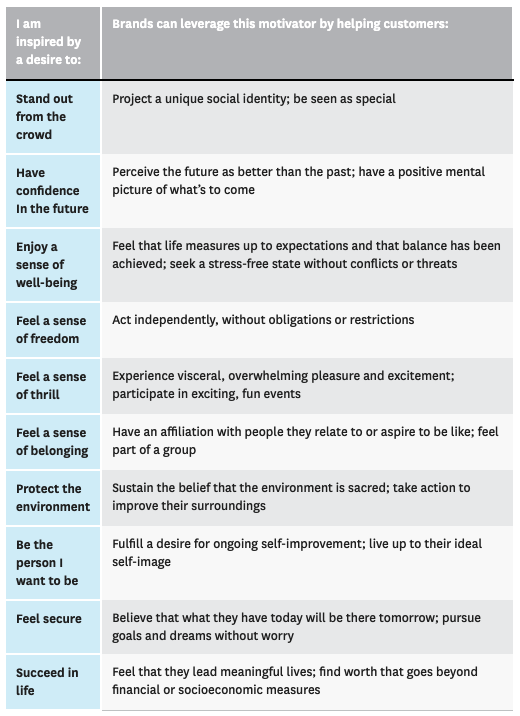
Examples of motivators and leverage:
 

Source: HBR.org, “THE NEW SCIENCE OF CUSTOMER EMOTIONS,” NOVEMBER 2015, SCOTT MAGIDS, ALAN ZORFAS, AND DANIEL LEEMON

“You can analyze your own market data to find out what your highest-value group is and what their motivators are, then push that to the market and take everyone on your journey, or you can do it the other way around, and make sales your ultimate objective.”  

Matt thinks the brand will usually lead and cites the example of Netflix. “There’s a debate going on right now to decide whether, in order to keep growing, Netflix should sell ads. Now, they can probably run an A/B test and find out they’ll make more money if they do sell ads, obviously. But how will that affect their brand image in the short, medium, and long term? They might not lose money, but on an emotional level, they might lose a lot of their historical appeal.

“When dabbling with emotions, it’s not as simple as just an A/B test. When making strategic decisions, experimentation can certainly help incrementally optimize things, but it can do bigger things, including help you make key decisions, better understand your customers, innovate, take risks… Not enough people realize the power of advanced testing. Companies that use them see exponential improvements.”

Talking about experimentation tools, Matt explains: “Early on in the industry, we talked about A/B testing in pretty much only an optimization win-or-lose mindset. And it’s so much more than that. When you make this investment, it’s going to help you make decisions, not just find tiny, incremental bits of revenue for your company. There’s a resourcing problem: conversion rate improvement isn’t the only thing you can do, there’s a huge range of other things you can achieve, and teams need more than a CRO manager to effect the full capabilities. It’s a key competitive differentiator.”

How can data be used to create emotional connections in marketing?

It’s a lot harder to target audiences today due to cookie policy changes and new regulations. But as Matt says (and everyone else agrees), “First-party data will lead to strong positioning and really good ads that connect with users. Because it’s owned by brands, it’s going to be the best quality data for testing hypotheses and segmenting data so brands can offer personalized, exclusive experiences.”

Alex puts it this way: “At the end of the day, you’re still going to be tracking conversions and clicks, so you need to do the groundwork in marketing. It’s more advanced than usability testing. To test for emotions, you have to do some groundwork and some guesswork. You need to know your brand; you need to work with market research. And when you find an emotion aligned with what you want your brand to represent, you need to identify a segment of high-potential customers. Then you find the motivators you associate with that segment, thanks to qualitative research and feedback; then you need to quantify all of that to see if you’re correct. Then you push motivators, measure results, see what boosts efficiency, retention, loyalty, customer lifetime value… and discover whether you’ve got a winning proposition.”

Matt grins: “I wouldn’t call any part of that approach ‘guesswork’. You’re simply combining qualitative with quantitative to come up with better hypotheses for testing. It’s the heart of good experimentation.”


The next installment in our Customer-Centric Data Series will be out in two weeks. Don’t miss it! 

Article

7min read

Using Experimentation Data to Uncover Customer Needs

For the second blog in our series on a data-driven approach to customer-centric marketing, we talked with our partner Ryan Lucht, Director of Strategy at Cro Metrics, and AB Tasty data expert Hubert Wassner, who explore the evolution of customer needs, why understanding them is so important for brands today, and the role experimentation plays in meeting those needs. Be sure to check out the series introduction and part 1 if you missed those.


What do we mean when we say “customer needs”?

Today’s savvy customers expect a lot from brands: connected journeys, personalization, innovation, data protection. They’re used to seamless online interactions. They want to find products easily. They want a frictionless experience and flexible payment methods. And if a brand doesn’t deliver, they’ll switch to one that does.“It’s a good thing, it’s forced us to become a lot more customer-centric and make our websites easier to use,” says Ryan.

And it pays to meet customer needs and deliver great customer experiences. In a 2020 CX poll, 91% of respondents said they were more likely to make a repeat purchase after a positive experience, and 71% said they’d made a purchase decision based on experience quality. 

Why is it important for businesses and brands to understand customer needs? 

Ryan believes it’s vital to offer customers the right information at the right time. “Customer needs look different at different stages in the customer journey. When you’re running an experimentation program, the order in which information is presented matters. If you dive into the details too soon, you risk overloading or boring your visitors, but if you wait too long to introduce core information like a refund policy, or a piece of your value proposition, you’ll lose business.

“One of our clients, a leading chain of gyms in the United States, is a good example. A crucial part of their strategy is reassuring customers they’ll feel comfortable in their gyms – that their gyms are inclusive, body-positive, and everyone fits in. It’s an important customer need. But on their homepage, the first thing people wanted to find was ‘Where’s the closest gym to me?’ So they shifted to putting location-centric information first, and establishing their brand afterward: It increased subscriptions immediately. It’s bottom-line revenue impact: if you’re not solving for the right needs at the right time, you’re leaving money on the table.” 

Hubert adds, “In online business, your competitors are just a click away, so if users get bored on your site, or it takes them too long to find what they need, they’ll simply go elsewhere. The experience you offer needs to be frustration-free. There are growth results to be found at every stage of the purchase journey, so always think competitively, someone else is surely doing it better somewhere.” 

Ryan agrees: “When it comes to understanding your customers’ needs, the more you leverage experimentation and advanced forms of data science, the better your competitive advantage. The reason is that customer needs are unique from one brand to another. An established brand can sell itself differently than a niche brand or a newcomer brand.” 


Where can the most valuable data about customer needs be accessed?  

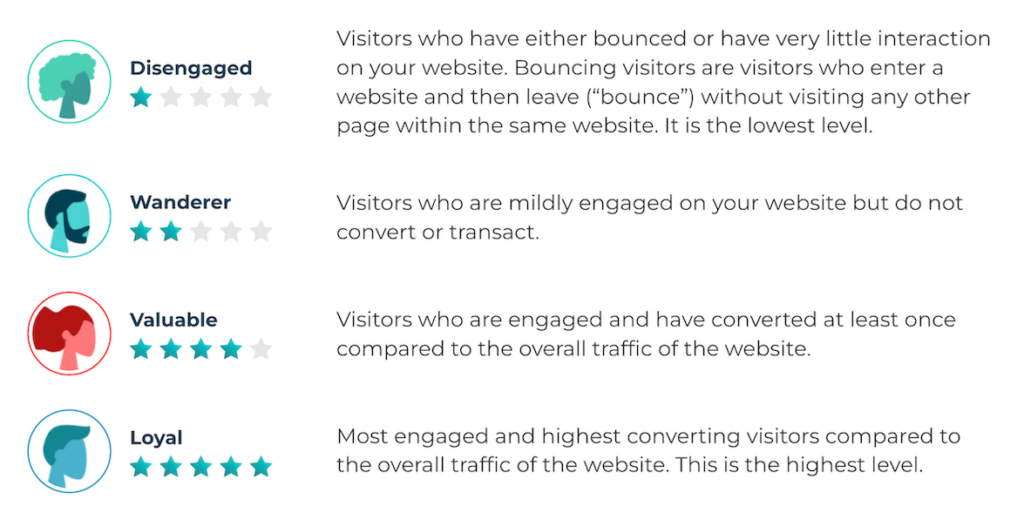
There are tools that automate data access. “At AB Tasty,” says Hubert, “we’d begin by installing a tag to gather transaction information for developers to see, for example, when users visit sites and when they leave, to measure bounce rate. Agencies can also gather information about products and purchases, as well as metrics like conversion rate, access to the cart page, dates of sale, and how much conversion rates change within engagement levels (see chart). Once you have enough data, you can begin to test different metrics to see which ones increase the engagement levels of different audience segments.” 

Does your site adapt to frequent users or does it treat them as new each time? 

Ryan likes to ask executives, “Do you think someone coming to your website for the very first time has the same needs as someone coming for the fifth time? And of course, the answer is ‘no.’ But think ‘new’ vs ‘returning’, or traffic sources – people come to the website from different places: email, advertisements, Facebook, TikTok, Google. All these people have very different contexts, and this gives us a hundred different test ideas. When he asks that same group whether or not they treat a new visitor differently than a returning visitor, unfortunately, the answer is still usually ‘no.’ This is just one of the countless opportunities for brands to use even the most basic data points to start to differentiate experiences.

“It can get very complex very quickly. If you’re going to do an AI or an ML model, it’s important to understand which of the variables we’re asking the model to look at are actually correlative and which are just noise.”

How can data from disparate sources be organized/prioritized for testing?

To combine data in order to act on it in a meaningful way, Hubert explains that the most common tools are CRM plug-ins. “If your user is identified, you can automatically gather more first-party information to save along with the customer journey, which can help you to segment for experimentation a posteriori.”

For Ryan, using disparate data sources isn’t just about prioritizing test ideas, it’s about better understanding test outcomes. “I’ve never met anybody who can use data to predict which test ideas will win. If they could, everyone would have staggering win rates, but even when you look at Microsoft, Google and Netflix, only one in ten ideas pans out. The more impactful side of using disparate data sources occurs after you run an experiment, because experiment results are really only one specific learning; it’s how you tie those results back to other sources of customer data or analytics to piece together a narrative you think might be true and how you use those results to inform your next test idea.”

How can experimentation help you gain insight into customer needs? 

For Ryan, insight can be gained on two levels. “An individual experiment can tell you whether you’re getting closer to or further away from fulfilling customer needs, based on if they’re doing the thing you hoped they’d do, but there’s also a meta-analysis level, where once you’ve run a lot of experiments, you start to recognize the patterns. For example, every time we emphasize pricing and make it clearer, we get better outcomes, so perhaps one customer need is better price understanding. Individual experiments help us, but we really learn the broader themes once we’ve run a lot of experiments.” 

Hubert adds, “In my mind, when you build the test, you have to answer a question, not focus on making an improvement, because maybe you won’t improve anything, but you will learn something, you’ll increase your knowledge, and that’s the real goal.” 


How can insights about customer needs contribute to a better customer experience? 

The better and more granularly you understand your customers and their needs, the more it will seem to them that you’re able to read their minds; you’ll please them and win their loyalty and win in the marketplace. The businesses that are doing this – doing a lot of experiments and doing them well – are the businesses that win. It’s as simple as that”, states Ryan. 

When testing, we shouldn’t be asking business questions, but user questions and only then adding business KPIs,” says Hubert. “It’s vital to ask customer-centric questions first, not business-centric ones. This way, you can boost your business while better satisfying your customers.” 

Ryan agrees: “It’s a very positive way to frame it. This is how we win with our customers because if we’re better at meeting their needs, everyone wins.”


Want more coverage of data topics? Be sure to come back in two weeks for the third installment in our Customer-Centric Data Series!

Article

6min read

Maximizing the Value of Customer Data Through Experimentation

Check out the introduction to the Customer-Centric Data Series here.

For the first blog in our series on the different ways you can utilize data to help brands build a more customer-centric vision, our partner Aimee Bos, VP of Analytics and Data Strategy at Zion & Zion, and AB Tasty’s Chief Data Scientist, Hubert Wassner, delve into how experimentation data can help you better understand your customers. They explore the who, what, and when of testing, discuss key customer insight metrics, the importance of audience sizes, where your best ideas for testing are lurking, and more. 


Why is experimentation important for understanding customers? 

Put simply, experimentation enables brands to “perfect” their products. By improving upon the value that’s already been developed, the customer experience is improved. And each time a new feature or option is added to a product, consistent A/B testing ensures consistent customer reactions. Experimentation operates in a feedback loop with customers, moving beyond conversions or acquisition, improving adoption and retention, eventually making your product indispensable to your customers.


Which key metrics deliver the best insights about customers? 

Hubert says, “Basically, the metrics that deliver reliable customer insights are conversion rate and average cart value, segmented on meaningful criteria such as geolocation, or CRM data. But there are others that are interesting, such as revenue per visitor (RPV). It’s a low-value metric but important to monitor. 

“And average order value (AOV) is another. This metric will vary enormously over time so it shouldn’t be taken as fact. Seasonality (think Christmas or Black Friday, for example), or even one huge buyer can skew the statistics. It needs to be viewed in multiple contexts to get a better understanding of progress – not just Year over Year but Month over Month and even Week over Week to be effectively computed. 

“AOV and RPV are important because their omission can lead to data bias. People often forget to analyze metrics about non-converting visitors. Of course, AOV only gives you data about those who actually make it fully through the purchase cycle.” 

And Aimee agrees, “Well, win rate, of course. For e-commerce it’s conversions, value, RPV, how they’re moving the needle, are they increasing the value of the average order? We want as much data as possible at the most granular level possible for lead generation, gated content, and micro-conversions… These smaller tests can be tied to more customer-centric metrics, as opposed to larger business-level metrics such as revenue, growth, number of customers, ROI, etc.”


Where are the best sources for experimentation ideas?

Aimee has her own process. “I start by asking myself what my business objectives are (micro/macro). Then I check Google Analytics and ask myself ‘Where are conversions not happening?’ For experimentation ideas, I check tools like HotJar, voice-of-customer data (VoC), Qualtrics data, see actual customer feedback, user panelists: give them choices, ask what they prefer. Always hypothesize friction points, these will give you your best ideas for testing!”

Hubert likes to get his ideas from NPS scores. “Net promoter score (NPS) has useful information and comments and can be a good starting point for fact-based rather than random hypotheses, which are a waste of time. NPS can add some real focus to well-designed tests. It’s based on a single question: On a scale of 0 to 10, how likely are you to recommend this company’s product or service to a friend or a colleague? NPS is a good way to identify areas that need improvement, but as a signifier of a company’s CX score, it needs to be paired with qualitative insights to understand the context behind the score.”


How do I pull everything together? What do I need to carry out my tests?

Obviously, you need a tool to run your AB tests and collect the data necessary to make good hypotheses, but a good way to add a big boost to your testing program – and help drive more ROI – is with tools like Contentsquare or Fullstory which offer more data on customer behavior and experience to focus your testing data. Designed to bridge the gap between the digital experiences companies think they’re offering their customers and what customers are actually getting, analytics platforms can provide real opportunities for useful testing hypotheses by offering more educated guesses about variables for testing to improve CX. 

Aimee has an important note about initial data collection, too.  “You also need three months of data before you begin testing if you want reliable results, and you need to be sure it’s accurate. Most people rely on Google Analytics (GA). That’s a lot of data to handle and organize. A Customer Data Platform (CDP) represents a significant investment, but centralizing your data in one is extremely useful for customer segmentation and detailed analysis. The sooner you can invest in a tool like a CDP, the better for a sustainable data architecture strategy.


I’m ready to test, but I have several hypotheses. How to begin?

According to Aimee, “when that happens, we break large problems into smaller ones. We have a customer that wants to triple their business and also wants a CDP this year among other goals. It’s a lot! To help them, we build out a customer journey roadmap to see what influences the client’s goals. We select five or six high-level goals (landing page, navigation measured against click-through rate, for example), then test various aspects of each of these goals.”

Hubert notes, “it’s possible to test more than one hypothesis at once if your sample size is big enough. But first, you need to know what the statistical power of your experiment is. Small sample sizes can only detect big effects: it’s important to know the order of magnitude in order to carry out meaningful experiments. It’s always best to test your variables on a large audience, with varied behaviors and needs, in order to get the most reliable and informed results.”


Is there value in running data-gathering experiments (as opposed to improving conversion / driving a specific metric)?

Hubert is a full believer in testing no matter what you think may happen. “Testing is always useful because a good test teaches you something, you learn something, win or lose. As long as you have a hypothesis. For instance, measuring the effect of a (supposed) selling feature (like an ad or sale) is useful. You know how much an ad or a sale costs, but without experimenting you don’t know how much it pays. 

“Or say you have a 100% win rate. That means you’re not learning anymore. So you test to gain new information in other areas, you don’t just stand still. You minimize losses to maximize wins.”


Enjoy what you read? Be sure to read part 2 of the Customer-Centric Data Series here.

Article

5min read

A Data-Driven Approach to Customer-Centric Marketing

At AB Tasty, we think, breathe, eat, drink, and sleep experimentation – all in the name of improving digital experiences. Over the coming months, we’re going to peel back a layer to take a closer look at what’s under the hood of experimentation: the data. Data drives the experimentation cycle – all of the ideation, hypotheses, statistical management, and test-result analysis. It’s no secret that today’s world runs on data, and the development of your digital experience should be no different.

Customers today – whether speaking of a business buyer or an everyday consumer – prioritize experience over other aspects of a brand. Over the coming months, we’ll be talking with some of our partners and data experts at AB Tasty to explore how brands can use data to better profile customers, understand their needs, and forge valuable emotional connections with them, as well as to measure overall digital impact and build a data-based, customer-centric vision.


Before we jump right in, let’s take a moment to center our discussions of data within a privacy-conscious scope.

Every marketer knows that nothing is more precious than customer data, but acquiring it has become increasingly thorny. Europe’s far-reaching General Data Protection Regulation (GDPR), enforced in 2018, was a game-changer, requiring companies to get consent before collecting personal data. The California Consumer Privacy Act (CCPA) soon followed, giving consumers the right, among other things, to opt-out from the sale of their data.

Even if you think your business isn’t subject to such regulations, you might need to consider compliance anyway. E-commerce has erased national borders, allowing goods and services to be purchased with little regard for their origin. The globalization of brands means that an influencer in Pennsylvania who posts about your products could drive Parisian customers to your site, and suddenly you’re collecting data subject to GDPR guidelines – which require customer consent for use.  


Leveraging the right customer data

Understanding your customers and their needs and changing behaviors is key to delivering timely, relevant messages that boost loyalty and drive revenue. Whether your company sells yoga mats, yams, or yacht insurance, you need data to enhance their experience with you and strengthen your relationship with them.

But how can you leverage the data you need while ensuring your customers continue to trust you? In recent years, consumers have grown skeptical of handing over their personal data. According to a 2021 survey by KMPG, 86% of consumers questioned said they feel a growing concern about data privacy. And they should be: the same survey showed that 62% of business leaders felt that their companies should do more to protect customer data.

Thanks to the well-deserved death of third-party cookies, marketers are now seeking the data they need by forging consent-driven first-party relationships with their audiences. While this is a step in the right direction, data privacy needs to go further.


Enhancing brand value through consent- and privacy-oriented processes

Consumers are more likely to buy from companies with transparent privacy practices that clearly explain how personal data is collected, used, and stored. Giving or withholding consent for the use of their data should be effortless, and if requested, customers should know that brands will not only delete all the data they’ve stored, but also remove any access privileges they may have granted to partners or third parties.

By making consent and preferences easily manageable, a multitude of data can be shared at every customer touchpoint, revealing customer behaviors, preferences, attitudes, and values. To deal with this omnichannel data, a Consent Management Platform (CMP) can help you collect and handle personal information in a privacy-first way. A CMP enables you to maintain consent logs across all customer-facing channels, ensuring that the personal data processing is always in line with the data subject’s preferences, adding an ethical dimension to the customer experience.

Ethical handling of customer data is mission-critical if brands are to succeed today. From big tech to retail, companies of every stripe are taking an ethical and privacy-centered approach to data, because, as an article in the Harvard Business Review aptly put it, “Privacy is to the digital age what product safety was to the Industrial Age.”

Customer data can help you deliver relevant, personalized, and innovative experiences. 

It can build your brand by generating new leads, predicting sales and marketing trends, and enabling you to create the personalized messages that customers love. But unless your data is protected and unbreachable, your customer base is at risk.


At AB Tasty, we’re actively committed to ensuring compliance with all relevant privacy regulations and to being entirely transparent with our users with regard to the consensual first-party and impersonal statistical data we collect when they visit our site. We strive to ensure that our partner agencies and SMEs take accountability and responsibility for the use of their customers’ personal data and respond rapidly should customers want to opt-out or be forgotten.


In this series of articles, we’ll be looking at using data to get value from anonymous visitors, using experimentation to discover customer needs, creating emotional connections to customers with data, and using data to measure your digital impact – all of this featuring data experts from the industry to guide us on our journey. See you soon!

Article

5min read

Data Privacy and Driving High-Converting Traffic to Your Brand

AB Tasty Partner guest post from

Sarah Davis

Content Marketing Specialist at ROI Revolution

Noel Liotta

Business Development Manager at ROI Revolution


As digital practices have evolved, the ability to personalize and target messaging to the individual consumer has become increasingly accurate and powerful. 

If a brand can understand their audience and deliver the right message through the right channel at the right time, they can introduce their products to exactly the person who is intended to use them without cluttering the screens of users who will never be relevant (hence why the algorithms know to venture away from my screens with their sports balls and hockey merch). 

But this advertising strategy has a dark side effect: The increased ability to personalize could provide for personal data compromise.  Constant updates to privacy regulations has led to many advertisers taking two steps forward and one step back in the granularity of their marketing campaigns over the last few years.

Obstacles Increasing for Ecommerce Brands: New Privacy Initiatives Complicate Tracking

The latest privacy initiative from Apple calls on users to provide explicit permission for apps to collect and share data by enforcing a Tracking Transparency Prompt (ATT) in the App Store. Apps that do not adopt the prompt will be blocked from the App Store. Long-term impacts will include reduced tracking capabilities and reduced personalization opportunities for users. 

It is expected that this major privacy initiative means that the percentage of iPhone users sharing their unique Identifier for Advertisers with apps will drop from 70% to as low as 10%. 

Right now, the core area of the customer journey that will be affected is at the top of the funnel. The limitations that will be put in place most aggressively affect our ability to retarget consumers and to receive data back about demographic targeting. There is still a lot of uncertainty around the impact that it will drive.

Apple isn’t the only company taking steps to give users more control over how their data is used, Google announced earlier this month that they will not be exploring a third-party cookie alternative with the depreciation of the cookie next year. Third-party cookies will be phased in 2022. Instead, interest-based advertising cohorts and privacy-preserving APIs will “Prevent individual tracking while still delivering results for advertisers”. 

With consumers’ paths to brands becoming more restricted, it’s more important than ever to deliver a great experience to users on your site. At ROI, we often use the adage that a rising tide lifts all boats when it comes to implementing a conversion optimization strategy for websites.A site that converts well will not only make each dollar you spend on advertising more effective but also help your brand turn visitors into brand fans so you can earn more first-party data. 


On April 21st at 2pm, join conversion experts from AB Tasty and ROI Revolution as they unravel the complexities of elevating your customer experience through conversion rate optimization. In this live webinar, you’ll uncover:

    • Key personalization tactics to help you stay ahead of changing consumer behaviors.
    • How to structure your optimization strategy to fuel brand growth.
    • 3 ways to improve the user experience on your website.

Optimizing your website for conversions takes time, effort, and the right strategic partners. Register today for this webinar to kickstart your optimization journey.


2 Strategies for Testing Personalization

The brands that will thrive in data privacy compliance will be the brands that are able to earn trust and deliver great customer experiences – a process that can only be accomplished through an intentional customer experience strategy. 

Because site personalization relies on first-party cookies to understand who is viewing the webpage, AB Tasty is currently already in compliance with the new regulations and protected from the hurdles that advertisers face. As a shopper, my path to purchase becomes easier when that ad takes me to a new site and I’m able to easily find what I’m looking for. Conversion optimization has never been a more important part of your advertising strategy than today. Thankfully, there are a number of ways to introduce a spirit of testing and personalization into your customer acquisition strategy. 

Strategy 1: Add a prominent “Email Cart” feature for high consideration purchases. This will help you earn that email address for multi-channel marketing. When we tried this with one of our clients at ROI, we saw a 19.2% lift in conversion rate at a 93.8% confidence level.

Strategy 2: Try a featured testimonial on your mobile cart. Adding a future customer for marketing purposes is a great way to improve conversions someday, but improving conversions is a great way to improve revenue from your advertising today. By improving customer confidence with a strong testimonial at the cart layout, ROI increased one brand’s conversion rates by 6.43% at a 96.5% confidence level. 

While advertisers still have opportunities to be relevant and respect user privacy restrictions, it is expected that changes will continue to roll out with relatively no end in sight. But who ever got into the ecommerce business because they didn’t like change? 

Article

4min read

Building an ROI-Driven Testing Plan with AB Tasty Partner, Roboboogie

After our amazing digital summit at the end of 2020, we wanted to sit down with Matt Bullock, Director of Growth at Roboboogie to learn more about ROI-driven design.


Tell us about Roboboogie and your session. Why did you choose this topic?

Matt: Our session was titled Building an ROI-Driven Testing Plan. When working with our existing clients, or talking with new potential clients, we look at UX opportunities from both a data and design perspective. By applying ROI-modeling, we can prioritize the opportunities with the highest potential to drive revenue or increase conversions. 


What are the top 3 things you hope attendees took away from your session?

Matt: We have made the shift from “Design and Hope” to a data-backed “Test and Optimize” approach to design and digital transformation, and it’s a change that every organization can make.

An ROI-Driven testing plan can be applied across a wide range of conversion points and isn’t exclusive to eCommerce.

Start small and then evolve your testing plan. Building a test-and-optimize culture takes time.  You can lead the charge internally or partner with an agency. As your ROI compounds, everyone is going to want in on the action!


2021 is going to be a transformative year where we hope to see a gradual return to “normalcy.” While some changes we endured in 2020 are temporary, it looks like others are here to stay. What do you think are the temporary trends and some that you hope will be more permanent?

Matt: Produce to your doorstep and curbside pickup were slowly picking up steam before 2020. Before the end of the year, it was moving into the territory of a customer expectation for all retailers with a brick-and-mortar location. While there will undoubtedly be nostalgia and some relief when retailers are able to safely open for browsing, I do think there will be a sizable contingent of users who will stick with local delivery and curbside pickup. 

There is a lot of complexity that is added to the e-commerce experience when you introduce multiple shipping methods and inventory systems. I expect the experience will continue evolving quickly in 2021.


We saw a number of hot topics come up over the course of 2020: the “new normal,” personalization, the virtual economy, etc. What do you anticipate will be the hot topics for 2021?

Matt: We’re hopeful that we’ll be safely transitioning out of isolation near the end of 2021, and that could bring some really exciting changes to the user’s digital habits. We could all use less screen time in 2021 and I think we’ll see some innovation in the realm of social interaction and screen-time efficiency. We’ll look to see how we can use personalization and CX data to create experiences that help users efficiently use their screen time so that we can safely spend time with our friends and family in real life. 


What about the year ahead excites the team at Roboboogie the most?

Matt: In the last 12 months, the consumer experience has reached amazing new heights and expectations. New generations, young and old, are expanding their personal technology stacks to stay connected and to get their essentials, as they continue to socialize, shop, get their news, and consume entertainment from a safe distance. To meet those expectations, the need for testing and personalization continues to grow and we’re excited to help brands of all sizes meet the needs of their customers in new creative ways.

Article

3min read

Using a Deep Understanding of User Journeys through Heap to Fuel Optimization in AB Tasty

We’ve spent the past couple of months at AB Tasty developing our product integrations with the leading Product Analytics providers. In this post, I’m excited to highlight Heap. Not only does Heap feature my favorite color (dark purple) in its branding, it offers its users an unbridled view for product managers and marketers to see how their customers engage with and move through digital journeys.

We think that’s quite a feat, and we want to showcase how our customers can create actionable programs to capitalize on the insights provided by Heap.

Without having a full understanding of your basic user journey and the various offshoots that customers may take along the way, marketers and product teams are forced to guess or rely on qualitative feedback to improve, optimize, or build on digital experiences.

Evolution, rapid iteration, and growth begins with understanding precisely how your users behave and why.

You need to have a clear picture of your user experience to understand their frictional moments and have the ability to quickly and efficiently test different hypotheses and action plans to find the best way to resolve those pain points.

On the other hand, while experimenting to identify potential solutions, you need to have insights into their impacts and how they resolve a frictional experience.

Measure everything along the customer journey with Heap. Plan actions and set up experimentation and personalization campaigns to optimize your user experience with AB Tasty then analyze the results of your campaigns.

Allow me to take you through an example, which may hit home for many readers. I know it hits home with me, personally, although I am a proud member of #teamhotleads scrapping for the coveted demo request as opposed to shopping cart conversions. Anyway…

The journey starts with Heap. Within the Heap platform, you can track all aspects of your users’ digital experiences, identify critical drop-off points in the clickstream that prevent conversions while identifying ways to simplify and clarify steps for customers.

Maybe you have a snazzy new checkout page that has increased your purchase rate. How can you be sure you’re funneling the maximum amount of traffic to that snazzy new page to reach your full purchase potential? Enter Heap.

Use your Heap platform to pin-point exact moments in your users’ journeys that result in drop-offs or, spinning it as a positive, as we like to do, “areas for improvement.” Once you’re able to identify these less-than-optimal moments in the journey within Heap, you need to formulate a game plan to take action to improve your traffic flow to your snazzy new checkout page. How? Enter AB Tasty.

Within AB Tasty you can craft experimentation programs ranging from changing your button colors to targeting hyper-specialized segments of visitors with powerful personalization campaigns. Using your experimentation results, create optimization roadmaps that allow you a path to realizing your full traffic potential on that checkout page that you spent so much time developing.

Formulate hypotheses and create an action plan, then conduct precise personalization and experimentation campaigns with real-time and retroactive data with the AB Tasty optimization platform. Once you’ve taken action, you can measure the impact and track the success in the Heap platform.

This seems pretty tactical, right? Let’s take it up a few levels to understand where this can provide strategic value.

Running ad hoc experiments can sometimes yield surprising and valuable improvements in certain metrics. An experimentation roadmap can bring you even more impact to those improvements.

By focusing your experiments on targeted points within the customer journey and building a roadmap of your experimentation plan, you can achieve compounding improvements to your customer experience, and, as a result, your revenue goals.

To learn more about how to set up your AB Tasty campaign data with Heap, check out our knowledge base article.