Case Studies

How Motorpoint Drives Smarter Experiences

Introduction

At Motorpoint, delivering a smooth and seamless experience for car buyers is a top priority. As the UK’s leading independent retailer of nearly new and used cars, the company is focused on making every part of the journey, both online and offline,  as simple and stress-free as possible.

We spoke with Razvan Ghica, Head of Design at Motorpoint, who oversees the online experience and leads the company’s optimization and research efforts. He shared how the team is using AB Tasty to improve digital journeys, support smarter decision-making, and move faster with confidence.

Q1: What led you to start using AB Tasty?

Razvan: We take a lot of care when building new features or user journeys, but no matter how thorough we are, there’s always room for improvement. AB Tasty allows us to fine-tune experiences after launch. That’s important because if the website better supports the user journey, it leads to a stronger experience overall, and ideally, better performance in our key metrics.

Q2: What types of experiments have you been running?

Razvan: Most of our tests so far have been simple, things like repositioning content, changing button labels, or making UI adjustments. They don’t require much setup but can deliver meaningful results. These smaller experiments have proven to be very effective, and they’ve shown us that even small changes can lead to measurable improvements.

Q3:Are there any specific experiments that stood out?

Razvan: Yes, a couple come to mind. One was on the product page, where we moved the car specs and features higher up. That small change resulted in a noticeable increase in leads.

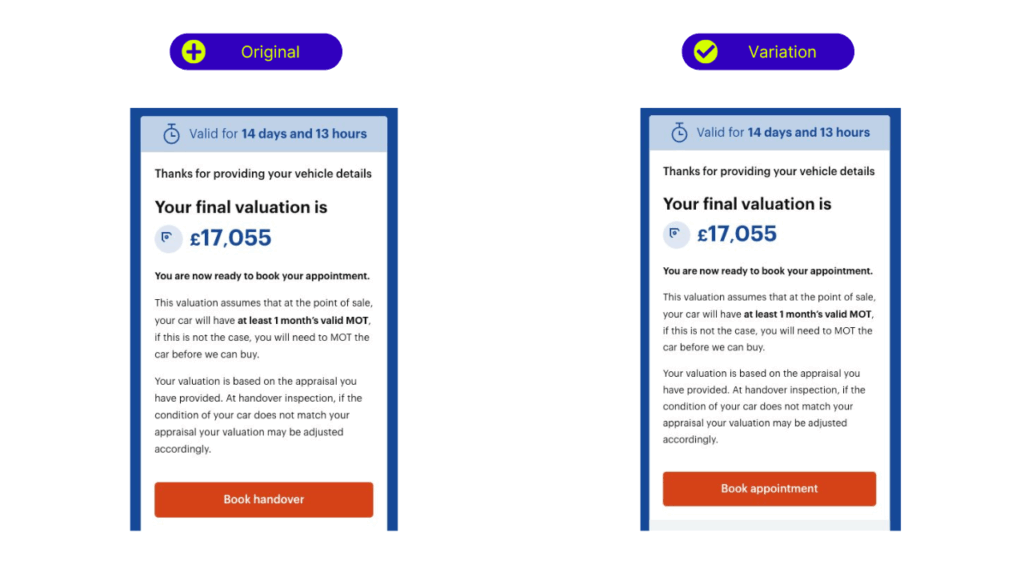
Another example is from our Sell Your Car experience. We changed the label on a button that takes users from one step to the next. The original term wasn’t very familiar to users, and just updating the language improved conversion through that part of the funnel.

Q4: Have you explored personalization yet?

Razvan: We’re starting to. We’re currently considering testing variations of our user journeys for different segments, based on things like location, device type, or whether the user is new. We want to understand how we can personalize the experience further for them, and AB Tasty is well-suited for that.

Q5: Beyond performance improvements, how has AB Tasty impacted your internal processes?

Razvan: It’s helped reduce uncertainty in the design phase. If we’re considering two different approaches and can’t decide, we now have the option to test both from the start. That removes a lot of back-and-forth and speeds up decision-making.

We can even test during the design phase when it makes sense. It saves time and helps us work more efficiently. Overall, we’ve seen an increase in lead generation and improved funnel performance, thanks to the ongoing optimization work we’re doing with AB Tasty.

Q6: How easy is it for teams without technical backgrounds to get involved?

Razvan: The test builder interface has been really useful. It’s intuitive and allows non-technical team members to build and launch tests on their own. If needed, someone with more technical experience can jump in and build on what’s there, but in most cases, the builder is accessible to everyone.

Q7: How is the tool used across different teams at Motorpoint?

Razvan: The design team leads most of the activity, but we’ve also seen involvement from our content and merchandising teams. Because the tool is user-friendly, they’ve been able to build tests around things they want to explore, without needing help from developers. That’s important for us, because our engineering team has its own dedicated backlog. They’re not involved in building these tests, and that keeps things more efficient.

Q8: And how does experimentation impact other teams or departments?

Razvan: One of the biggest benefits is the learning it brings. It’s not just about knowing what works; it’s also about understanding what doesn’t. That’s equally valuable. The insights we gain from testing help shape future decisions. We can start from a small observation, go through our workflow, and end up with answers to key questions. It’s a continuous learning loop that improves how we support users across the site.

Q9: How does experimentation fit into your overall digital strategy?

Razvan: Our team is relatively small, especially on the design and engineering side. So our time is valuable, both when building new experiences and when optimizing existing ones. AB Tasty allows us to do both in parallel. We can keep developing new features while also refining what we already have, without taking time away from our engineers.

Q10: Looking ahead, what’s next on your roadmap for testing and optimization?

Razvan: We want to increase the volume of tests we’re running and expand them across more of our journeys. We also want to spend more time identifying user segments we can personalize for. That’s something we haven’t fully explored yet, but we see a lot of potential there.

Overall, AB Tasty allows us to do a lot with relatively low effort,  and the results speak for themselves. We’re excited to build on that and keep improving.


Final Thoughts

Thank you to Razvan Ghica and the Motorpoint team for sharing their insights. Hearing how experimentation supports their decision-making and improves the customer journey offers a clear view of the impact ongoing optimization can have. We’re proud to support their work and to see how these efforts continue to shape a smoother, more confident experience for car buyers.


Case Studies

How WWF Made Donations Feel Natural Through Testing

+87% end conversion rate on desktop

+31% click-through rate on desktop

Introduction

When you’re on a mission to save the planet, every donation counts. The World Wide Fund for Nature (WWF) knows this better than anyone. As the world’s leading independent conservation organization, they’re on the front lines – defending wildlife, restoring habitats, and inspiring millions to take action.

As part of their digital strategy, the team is continually looking for ways to improve how its supporters can engage with their mission, especially when it comes to online donations, adoptions, and memberships. That’s why they teamed up with Merkle and AB Tasty: to take a closer look at the little moments in the donation journey that could make a big difference. The goal? Make it easier, faster, and more compelling for people to give by improving the user experience, removing friction, and increasing conversion rates. 

The Challenge

The challenge arose when the WWF’s digital experience team noticed a common problem that many mission-driven organizations face. People want to help; they’ll land on donation pages, engage with the donation widgets, and show clear intent to give. But often, something small will break the momentum, and they’ll drop off.

Working alongside Merkle, WWF dug into the data. Hotjar heatmaps and session recordings painted a clear picture: their donation widget was creating friction instead of flow. Users were getting stuck, seeking more information, and ultimately abandoning their donations.

The mission was clear: use A/B testing to explore small, targeted changes that could reduce friction, increase clarity, and help donors act on their intent, without adding clutter or complexity. 

The Testing Strategy

Rather than relying on assumptions, the WWF team partnered with AB Tasty to test hypotheses grounded in behavioral science. 

Test 1: Reordering Donation Amounts

Behavioral research shows that users tend to ‘anchor’ to the first number they see – meaning they use it as a reference point for all future judgments. To test the impact of this effect, the team reversed the order of suggested donation values to present higher amounts first, with the ultimate goal of including the average order value (AOV). 

  • Control: Donation amounts displayed from low to high (£5, £10, £25)
  • Variation: Amounts reordered from high to low (£25, £10, £5)

Results:

  • +20% click-through rate (CTR) to the donate CTA
  • +18% increase in overall checkout starts
  • +87% uplift in end conversion rate (ECR) on desktop

The higher-to-lower layout encouraged users to consider larger gifts early, particularly on desktop, where scanning patterns favored top-loaded options.

Test 2: Increasing Suggested Donation Values

The team hypothesized that adjusting the default donation amounts upward could lift AOV without creating drop-offs.

  • Control: Preset amounts at £5, £10, and £25
  • Variation: Increased to £10, £25, and £50

Results:

  • 9% increase in overall checkout starts
  • 23% increase in checkout starts on desktop
  • Strongest engagement around the £25 mid-tier value

This variation leveraged the Goldilocks effect, where users gravitate to the middle option. By raising the donation value across the board, the team encouraged more generous giving while keeping the decision-making structure intuitive.

Test 3: Adding Context to Donation Amounts

To strengthen emotional connection and clarify the impact of each contribution, contextual messaging was introduced alongside donation values.

  • Control: Standard widget with preset amounts only
  • Variation: Added messaging (e.g., “£10 could help a monitoring team survey river dolphins near fishing nets”)

Results:

  • 16% increase in overall CTR to the donate CTA 
  • 31% increase in CTR on desktop
  • 12% increase in checkout Starts

Users spent more time engaging with the contextual content. The addition of impact-focused messaging helped users feel more confident that their donations would make a difference. The results show that pairing emotional storytelling with simple donation options creates a more engaging and trustworthy experience, one that encourages stronger connections and boosts conversions.

Key Takeaways

Anchoring and Value Framing

Presenting higher donation amounts first encouraged more generous giving. Tests showed users were more likely to choose mid-range options when those options were framed within a wider, higher-value context.

Device-Specific Behavior

Testing across desktop and mobile showed important behavioral differences. Desktop users were more responsive to increased donation values and layout changes, while mobile users benefited from simpler interfaces and clearer prompts.

Thanks to the flexibility of AB Tasty’s platform, the team was able to spot these patterns early and adjust the experience to better fit each device. These insights helped improve the mobile journey and will be key as user behavior continues to evolve.

Emotional Resonance Matters

Messaging that linked donation amounts to real-world outcomes improved engagement and confidence. Making the impact of each contribution tangible helped reduce hesitation and encouraged action. This approach helped reduce hesitation and played a key role in creating a more compelling donation experience.

Iteration Drives Insight

Each test provided new data about how users interact with the donation experience. By approaching optimization as an ongoing process, the team was able to continuously refine the journey based on what worked best, while also uncovering new opportunities, such as personalization and smarter use of price anchoring.

Conclusion

By combining data-led experimentation with user-focused design, WWF made meaningful improvements to the online donation experience.

From reordered layouts and adjusted values to more emotionally resonant messaging, the changes were subtle, but the impact was significant: higher CTRs, more completed donations, and stronger support for the mission. 

By continuing to test and refine, WWF can keep enhancing the donation journey, removing friction, deepening trust, and empowering even more people to take meaningful action for the planet.

E-Books

7 Luxury Test Ideas To Make Your Digital Experiences Shimmer

The luxury industry’s glittering guide to all things optimization.

Luxury e-commerce brands face unique challenges but also unparalleled opportunity.

As technology advances and consumer expectations are high, the key to thriving in the luxury industry lies in mastering the art of experimentation, personalization and continuous experience optimization.

Unveil an arsenal of test ideas that luxury brands can employ to curate custom experiences, featuring examples from real AB Tasty clients in the luxury industry to serve as inspiration for you to start creating your own dazzling digital experiences.

Craft experiences that wow!

Get your copy of “7 Luxury Test Ideas To Make Your Digital Experiences Shimmer” now.

LUXURIOUS TEST IDEA

Help visitors find the products they need with subcategories like ba&sh

The team at ba&sh found that their product listing pages were often the first place visitors landed on the website. From there, visitors often browse but click away if they don’t find what they are looking for quickly. An A/B test proved that  displaying clear category filters helped ease the shopping experience, leading to a 2% increase in traffic to the product detail pages and a 3% increase in revenue.

Build luxe experiences that surpass your customers’ expectations

Get access to the latest trends in experimentation with “7 Luxury Test Ideas To Make Your Digital Experiences Shimmer.”

Spark
your curiosity!

Get your copy of  "7 Luxury Test Ideas To Make Your Digital Experiences Shimmer" now.

You might also like...

Case Studies

Embark Veterinary Optimizes Product Pages to Drive Growth

+7% Conversion rate

How Embark Veterinary Optimizes Product Pages to Drive Growth

Learn more about how the e-commerce team at Embark Veterinary leverages experimentation and a data-driven approach to drive improvements across every key performance indicator.

  • 7% increase in conversion rate
  • 10% increase in revenue per session

​​Embark Veterinary, Inc. was founded on a passion for scientific research and a lifelong love of dogs. Their DNA test kits and online platform enable dog owners to better understand their dog’s breed, health, and much more while helping to advance research into the best ways to care for man’s best friend.

The Experimentation Program at Embark Veterinary

The team at Embark uses a few KPIs when determining the success of experiments. Of course, they always attempt to improve the conversion rate, but they also place a heavy emphasis on average order value.

Lastly, the team analyzes revenue per session as a primary KPI because it takes into account both conversion rate and average order value.

How can you best identify what information to present to customers at the right time and right place?

Because Embarks sells two products, a baseline product and a premium product, the team strives to sell more kits, but they also want to sell more premium kits.

The premium kits include information about dogs’ genetic health (not included in the baseline kits), and this particular experiment was designed to help customers understand the benefits of knowing additional health details for their pets.

The Embark team wanted to understand if different types of product copy would result in higher sales for their premium dog DNA test kits. In order to determine this, the team developed two tests: an initial test to understand the style of product copy that resonated with customers, ranging from clinical to emotional, and a second test to understand the impact of including examples in the product copy.

Test #1 included three variations of product copy ranging from more emotional to more clinical.

In this test, the team prepared three variations of copy. Variation 1 featured more “emotional” copy, variation 2 featured more “clinical” copy, and variation 3 struck a balance between “emotional” and “clinical.”

Results

The first test resulted in a very clear winner, not only indicating that the product copy makes a difference for customers but also that clinical copy resonates the most with their customers.

The clinical copy in variation 2 resulted in a 4% increase in conversion rate, a 3.5% decrease in average order value, and a 1% increase in revenue per session with the increase in conversion rate compensating for the decrease in average order value.

Test #2 included 3 variations of product copy with health examples ranging from less severe to more severe.

In this test, again, the team prepared three variations featuring examples ranging from “less severe” to “more severe.” Variation 1 included a “more severe” example, variation 2 included a somewhat balance example, and variation 3 included a less severe example.

Results

The addition of examples in the product copy made a huge difference. Showing customers a real scenario where they may need to have their dog’s additional health info has a direct impact on revenue. The “less severe” drove the most impact with a 7% increase in conversion rate, a $9 increase in average order value, and 10% increase in revenue per session.

Key Learnings

Understanding your customers and their needs is core to driving growth and delivering a better buying experience.

The Embark team always keeps a “what’s next” mentality. After seeing the potential impact of product copy through the first test, the team asked “what’s next” to figure out how to use a second test to draw more value out of that component of the product detail page.

ABOUT EMBARK

Embark Veterinary, Inc. was launched in 2015 with a passion for scientific research and a lifelong love for dogs. Starting with its best-in-class canine DNA test, Embark is building a powerful platform for scientific discovery that will accelerate advancements in personalized dog care. Embark offers the most scientifically advanced, most trusted, and highest-rated dog DNA tests on the market that helps dog owners, breeders, and veterinarians learn about their dog’s breed, health, and ancestry. Customers gain hundreds of actionable insights that inform more proactive care, and every test fuels new research to help all dogs lead longer, healthier lives. Embark is an official research partner of Cornell University College of Veterinary Medicine, was named to the Inc. 5000 list for the past two years, and was included on Forbes‘ next billion-dollar startups list.

For more information, visit Embark’s website at EmbarkVet.com.

Spark
your curiosity!

Get your copy of "Embark Veterinary Optimizes Product Pages to Drive Growth" now.

Case Studies

How Hunter Boots Drove Value with Social Proof

+9% Conversion Rate

+6% Conversion Rate US

Founded in 1856, Hunter is a progressive British heritage brand renowned for its iconic original boot and holds two Royal Warrants of Appointment to HM The King and HRH The Duke of Edinburgh. The brand has a rich history of innovation and continues to design to protect from the elements and perform on varied landscapes.


The Social Proof Hypothesis

“Social proof is one of the most useful tools of persuasion a brand can employ. Used well it can enrich the customer experience and help customers make an informed decision based on what others are doing” explains Beth Hodge, Head of Optimisation at Conversio. “Working together with Hunter Boots and AB Tasty we wanted to measure whether social proof can improve the experience for Hunter customers and ultimately drive incremental value. Importantly we also had to consider how to serve a message that aligned with the Hunter brand and how it should be applied to different geographic segments considering Hunter Boot’s broad international customer base”

 To do this Conversio defined a strategy to test and measure AB Tasty’s social proof capabilities and individually measure the impact on UK and US customers. Conversio’s detailed data-first approach wanted to establish which messaging and metrics most resonate with the customer, which pages and locations social proof has the highest impact and the optimum thresholds that define exposure. “It’s critical that when launching social proof you optimize all the elements of the experience to maximize your results, it’s about the continuous refinement of the experience” adds Beth.

About Conversio

Conversio is a leading independent optimization and analytics agency, headquartered in London and partners with AB Tasty. They are down-to-earth e-commerce experts who use data, insight, and continuous experimentation to sustainably grow your business

IMPLEMENTATION

After an initial proof of concept and refining the experience with optimized messaging and positioning social proof demonstrated a +9% conversion rate improvement for the UK site and +6 for the US site.

“What was clear from our analysis of those customers exposed to social proof was that we needed to apply specific tactics and design by market to maximize the value of this feature, for example, it was clear that product view data had a bigger impact on US customers than it did in the UK” explained Beth.

Hunter Boots now had a solid foundation on which to grow and expand their use of social proof.

As part of Conversio’s approach to further refining the customer experience of social proof they worked closely with the AB Tasty team to make use of the social proof API. This gave Hunter Boots greater flexibility about where and when to serve these messages to their customers. This included intelligently rotating two different social proof metrics on the product pages vs. a single message which had shown the initial promising results. This further improved on the conversion uplift already seen by 2% in the UK and 1% in the US.

Next Steps – Building on the success

“We are pleased to see the addition of social proof resonating so well with our customers, we have worked with Conversio to ensure the messaging feels on-brand while still highlighting product popularity. This is especially impactful for the rollout of new footwear product categories like commando boots and sandals as customers are less knowledgeable on these products. Social proof really helps us drive newness, and supports conversion rate across our well-known rubber boots. We are excited to see where we can optimse this experience going forward”

 Bryony Longden – Head of eCommerce Operations

Conversio already has plans in place to trial social proof badging on the product list pages as well as using it in the post-add-to-bag experience. Providing extensive experience and end-to-end conversion expertise, applying pre-eminent data analysis, insight and testing methodology to the optimization of e-commerce businesses by means of continuous improvements to their website performance and efficiency.

TAKEAWAYS

The implementation of social proof on Hunter Boots’ website proved to be a successful tactic, resulting in a significant increase in conversion rates for both the UK and US sites. A data-first approach and optimization strategy allowed for the refinement of the social proof experience, tailoring it to specific markets and product categories. It provided Hunter Boots with greater flexibility and opportunities for further optimization.

This success serves as an example of how social proof can be a valuable tool for brands to enrich the customer experience and drive incremental value.

Spark
your curiosity!

Get your copy of "How Hunter Boots Drove Value with Social Proof" now.

Case Studies

Clarins UK Invests in Continuous Testing and Learning

30 Markets worldwide

10 Experiences/month

Innovating with Confidence: Clarins UK Strategy for Feature and Product Launches

Clarins uses testing and experimentation for all feature or product launches on their site. Learn how it informs their work and how they measure impact with AB Tasty.

Clarins is the number one global company for premium skincare and beauty products with a commitment to responsible beauty and an entrepreneurial spirit that informs everything they do. Their vision is to promote well-being and cosmetics for all women.

With over 150 markets around the world, the UK market is one of the strongest performers so we popped over to the Clarins UK office to speak with Roisin O’Brien, e-commerce trading manager, and Alejandra Salazar, e-commerce content manager, on their experimentation strategy.

Both Roisin and Alejandra use testing and experimentation as part of their everyday work. Their priority is to create the best experience that they can for their users. Data gathered from testing is analyzed to help them better optimize and personalize the customer experience.

The Importance of Continually Testing and Experimenting for Clarins UK

For Clarins, experimentation is woven into the fabric of the company. With the help of AB Tasty, their global team has enabled the company to become a leader in digital transformation, launching e-shops around the world and ensuring a consistent brand experience online and offline.

Clarins only pushes out significant features or products online once they have done testing first. As Alejandra describes it, “For us, backing up all experimentation with data is very important. The importance is that customers find products and what they need on the website, rather than complicating their journey.”

For us, backing up all experimentation with data is very important. The importance is that customers find products and what they need on the website, rather than complicating their journey.


Alejandra Salazar
E-commerce Content Manager

In order to drive that experience, both in-store and online, experimentation and optimization are key to how they continuously improve. Experimentation enables them to try out new ideas, improve the customer journey as well as reach their commercial targets.

We wouldn’t be able to drive the numbers that we do without being able to test the experiences that we offer. We always run tests on new promotions and offers to make sure that we’re delivering a great customer experience as well as ensuring the commercial priorities of the website 

Roisin O’Brien E-Commerce Trading Manager

Two variants that allowed the Clarins UK to effectively promote their gift sets with AB Tasty

Testing Gift Set Promotion

Because of this culture of experimentation, the UK team has deployed many different tests on their site – and shared those results with the global team.

One of their most successful tests was one where they encouraged users to opt for a gift set when shopping for certain items. Using AB Tasty to badge different products that were available as a gift set on the product listing and description pages, this simple test not only increased awareness, but also improved the transaction rate.

Roisin confirms: “Testing, experimenting, optimizing are all really important to continually improve on what we are already doing” We wouldn’t be able to drive the numbers that we do without being able to test the experiences that we offer. We always run tests on new promotions and offers to make sure that we’re delivering a great customer experience as well as ensuring the  commercial priorities of the website.”


Adding the wishlist functionality to the product listing pages and the product description pages allowed users to save their favourite products and remember to purchase them later on.

Creating a wish list for customers

Many e-commerce managers are aware of how important the PDP pages are to tell the story of your brand. Today, they can often be the point of entry for your users on your site, which means they need to quickly communicate a sufficient amount of information about your brand. With that in mind, using AB Tasty, Clarins was able to provide an option for visitors to create a wishlist on these pages.

This test meant users could save a product they liked, or keep an eye on their favorite products to buy them later. The test proved to be a success as it resulted in a boost to their basket page views and a 1.84% increase in transactions.

As Alejandra explains, “By adding the wishlist option, you’re simplifying the customer’s journey and you are also making their decision a little bit simpler once they decide to convert.”

AB Tasty helps Clarins to test and experiment at speed. In a short space of time, they can assess whether new features or changes are working on the site in order to give a seamless customer journey. As Roisin points out, “We’re really passionate about continually optimizing what we’re already doing well, whilst also testing new theories to drive a great customer experience.”


Download PDF

Spark
your curiosity!

Get your copy of "Clarins UK Invests in Continuous Testing and Learning" now.

Webinars

Exceeding Customer Expectations in a Post-Pandemic World

How can you set your digital experience apart in a post-pandemic digital world?

According to a study conducted by Forrester, in 2022, brands will lose 50% of sales on out-of-stock items unless they compensate with customer experience (CX) optimization. Optimizing the customer experience is and will be even more of a differentiator and a true competitive advantage in the coming years.

Our experts will explain to you why and how to build an experimentation program in order to become the leader in your industry.

In this webinar Thomas Husson and Marylin Montoya will discuss:

  • The overall context of CX
  • How to measure CX with customer loyalty
  • Current challenges
  • How Some Actors Succeed
  • The key ingredients for success

Speakers

Thomas Husson
VP Principal Analyst, Forrester
Marylin Montoya
VP Marketing, AB Tasty

E-Books

30 Black Friday Tests: How to Win Big During the E-Commerce Holiday Season

How to Win Big During the E-Commerce Holiday Season:

Optimize your website just in time for the start of peak shopping featuring successful tests from brands who know the importance of prepping now to reap the rewards later.

Black Friday is right around the corner

Don’t risk missing out on peak traffic with a website that falls flat and drives customers away to the competition. Instead, test your site now, see how your customers respond, and then make data-driven decisions to implement your changes.

We’ve collected 30 of the best experiments from our trusted clients to help you and your team get ready for the shopping rush. From mobile-friendly UX to innovative promotions, these tests are designed to be set up quickly so you can measure their impact in a snap.

In our e-commerce optimization guide, you will learn:

  • How the world’s biggest brands are implementing experimentation into their growth strategy;
  • Ways to level up your previous experiments with high-maturity tests and personalization; and
  • Find inspiration and new test ideas for creating a memorable customer experience.
The clock is ticking! Download your free e-book and get ready for peak shopping season.

MeUndies draws attention to latest promos with banner widgets on product detail pages

The California-based underwear and loungewear brand wanted to create greater visibility on their promotions for visitors who landed directly on the product detail pages instead of the homepage. A large colorful banner displayed on the PDPs helped to highlight the active deals. The results? A 9.8% increase in transactions with 10% more clicks on the “add to cart” option.

Be prepared for the shopping rush with 30 tips and tricks

Grab your copy of “How to Win Big During the E-Commerce Holiday Season” and start testing today.

Spark
your curiosity!

Get your copy of  "30 Black Friday Tests: How to Win Big During the E-Commerce Holiday Season" now.

You might also like...

Webinars

CRO Trends for 2022

Discover our top 3 trends for experimentation and conversion rate optimisation this year, presented by our Customer Success Lead APAC, Elisa Falcao.

In this webinar, Elisa gets straight to the point to share:

  • Our experimentation best practices for this year.
  • How you can keep ideas fresh and practical tips to help you run a more effective testing program that impacts your bottom line.

Speakers

Elisa Falcao
Customer Marketing Lead APAC, AB Tasty

Case Studies

How Clarins Scaled Their Global E-Commerce Through Agile Experimentation

30 Markets worldwide

10 Experiences/month

Clarins’ partnership with AB Tasty changed the way their teams work together across 30 markets, turning testing into an agile, collaborative process.

  • 30  Markets Worldwide
  • 10 Experiences/Month
  • 20 Global Projects/Year

The business of Clarins is beauty. And at the heart of their efforts is making women feel comfortable and beautiful at every stage of their lives.

Imagine: Your e-commerce team builds tons of impactful customer experiences, works seamlessly together in an agile environment, and deploys experiments with ease around the world.

This is the reality at Clarins.

The globally-renowned beauty brand was an early adopter of experimentation, using it as a tool to improve user experiences as part of their CRO strategy. Thanks to this investment, Clarins, which operates in over 150 countries and 30 e-commerce markets, has not only turned testing and personalization into a competitive advantage, but also grown local markets through a flourishing culture of experimentation.

For the past decade, the team has championed pairing dynamic digital experiences with offline-quality service. Just ask Stephanie Gaspar and Ryma Ziani, who head up the digital customer experience at Clarins.

“Experimentation has always been part of Clarins’ DNA. Testing new products, formulas, and ideas is part of our culture,” says Stephanie, a 12-year veteran of the organization, who currently manages the digital customer experience team. “The advantage of experimenting is that it helps validate our hypotheses quickly, make faster roadmap decisions, and better leverage user experiences to ‘wow’ our customers.”

Experimentation woven into Clarins’ DNA

Clarins has long been a leader in digital transformation, launching e-shops around the world and ensuring a consistent brand experience online and offline. In recent years, experimentation and data analytics have been the focal point of that transformation, so much that robust practices are now built into day-to-day business operations at Clarins.

What is key for us is leveraging our data to provide personalized, one-to-one service and experiences online. Customers, after all, are at the heart of everything Clarins does.

Stephanie Gaspar Global Digital Director

Knowing exactly which experience is best suited for which customer and in which country is no easy feat — after all, not all personalizations are created equal. This is where the partnership with AB Tasty comes into play, enabling Clarins to quickly identify high-impact growth strategies and avoid low-performing actions through a test-and-learn approach.

The team cites AB Tasty’s experience optimization platform as the game-changer in helping them with easily setting up tests and collecting insights to validate ideas, make data-centric decisions and accelerate time to market.

Ryma, Clarins’ UX project manager who’s been with the brand for more than eight years, is quick to acknowledge the value that AB Tasty’s low-code solution and worldwide customer support coverage has added to the e-commerce and UX teams.

“It gave us the ability to accelerate our rollout at both global and local levels, drive more engagement on our website, and deliver a seamless user experience — without needing to enlist the help of our tech development teams,” she says.

AB Tasty’s platform enables different markets to duplicate experiences and adapt the learnings to a regional context. This knowledge-sharing ethos fosters an exchange of ideas and learning culture, which has also produced a community aspect within the organization.

AB Tasty has changed the way we work together. Today, we have almost 30 markets [onboarded], building a community of users and co-constructing the experimentation roadmap to optimize UX across all our touchpoints.

Ryma Ziani UX Project Manager
Clarins wheel of fortune campaign


Clarins’ center of excellence encourages teams around the world to share and find inspiration from their experiments. That’s how the US team ended up duplicating EMEA’s “Wheel of Fortune” gamification test (left) for their Mother’s Day campaign (right).

A concrete example of both the collaborative, knowledge-sharing aspects and the adaptability of a global approach across local markets is Clarins’ “Wheel of Fortune” experiment, which leveraged gamification during a key promotional selling period.

With the support of the AB Tasty team, Clarins ran a one-day pop-up offer where customers could “spin the wheel” on their website and win a special offer — a free product or a discount coupon. This discount was then automatically applied to the basket. Here, the Clarins team had developed a clever, engaging offer and coupled it with AB Tasty’s solution, enabling them to easily duplicate experiments across markets and drive conversion and revenue.

Originally rolled out across EMEA for Singles Day, this test saw such strong results (585% increase year over year in revenue for Ireland, alone) that the US Clarins team duplicated it for their own high-season period: Mother’s Day. “Literally, we made the decision in a couple of weeks,” says Marine de Valon, senior director of e-commerce and digital transformation for North America.

With AB Tasty’s dashboard, each market has access to all tests and the resulting engagement data. “AB Tasty allowed all the countries to innovate, create, measure and share experiments, which made a significant impact on our overall global e-commerce,” Marine explained.

Four essentials to building a center of excellence

Building a culture of experimentation goes beyond test execution; it requires heavy knowledge transfer, strategic oversight, and the investment of time and resources alongside the right partner to foster the right mindset. Here are the four things you need:

1. Agility: Equipping the team with scalable processes that allow them to act independently, rapidly test hypotheses, make faster decisions, and pivot quickly should a test prove unsuccessful.

2. Toolbox: Collating guidelines, best practices, examples and outcomes of experiments, and customer data will ensure all teams are equipped to deliver engaging and innovative digital experiences across Clarins’ global e-commerce.

3. Market maturity: Leverage mature, high-growth markets to scale your business by presenting a wealth of test ideas from which other markets can find inspiration and subsequently build their own experimentation roadmap.

4. Community: Fostering the culture of collective experience and knowledge and understanding what’s worked and what hasn’t worked across markets have undoubtedly been a key to the success of Clarins’ digital experimentation strategy.

Delivering innovative experiences with AB Tasty

Clarins has achieved a lot over the past two years partnering with AB Tasty, adopting a considered approach to guard against overexposure and inconsistent messaging to their consumers.

By focusing first on developing testing and experimentation protocols, Clarins has built a template of experiences and overarching guidelines that ensure authenticity as a brand. The last step in this roadmap — grow the community of engaged users — fosters increased collaboration and synergy across teams. But the work with AB Tasty does not end there.

“We want to deliver more innovative brand experiences to our customers, by bringing more entertainment on our website and leveraging gamification in consumer engagement,” Stephanie shares. “Our goal is to push the experimentation program with AB Tasty one step further, to become even more user-centric in how we leverage our data for that one-to-one approach.”

ABOUT CLARINS

Jacques Courtin launched his namesake company in 1954 in Paris, with a mission to enhance women’s beauty and well-being. Today, Clarins is present in more than 150 countries and 10,000 employees around the world. The French company continues to pursue a long-term vision focused on strong customer relations, continuous innovation, and a commitment to responsible beauty.


DID YOU KNOW?

The team at Clarins are also strong believers of responsible beauty, sourcing only the best ingredients through their love of nature and plants. That’s the story of the Domaine Clarins, which was founded in 2016 in the French Alps to offer a responsible farm-to-jar approach to beauty. The team uses traditional farming techniques and minimal technology to develop the highest quality plant ingredients for consumers.

Spark
your curiosity!

Get your copy of "How Clarins Scaled Their Global E-Commerce Through Agile Experimentation" now.