
Case Studies

Decathlon Scores Big With Social Proof

3.3% Increase in Transactions

2.8% Revenue Lift for Returning Visitors

Whether you’re a converted couch potato or an experienced athlete, Decathlon has something for everyone. Present in 52 countries, Decathlon designs and sells sporting goods, both online and in 1,600 brick-and-mortar locations.

Challenge

Decathlon’s mission is to make sports accessible to all. One of the ways they accomplish this is through offering a wide array of choice – 10,000 products covering 80 sports are sold on Decathlon’s website. With a range of price points and styles, there is an almost dizzying array of items to choose from. For some shoppers – especially those trying out an activity for the first time – this amount of choice might seem overwhelming.

How could Decathlon help shoppers get situated?

Social Proof Hypothesis

“We know that social proof – the idea that, when unsure, people look to others for direction – is a powerful and effective concept,” explains David Harari, Customer Success Manager at AB Tasty. “In the context of e-commerce, this means people are influenced by what their peers are interested in when deciding what to buy. We wanted to test out if a simple line of social proof messaging would nudge website visitors further down the purchase funnel.”

To do this, Decathlon’s UK digital team ran an experiment based on AB Tasty’s Social Proof widget. The AI-powered widget dynamically surfaces the number of times a product is viewed by other shoppers on a site in a given timeframe. This gives other browsers an idea of which items are getting more traction.
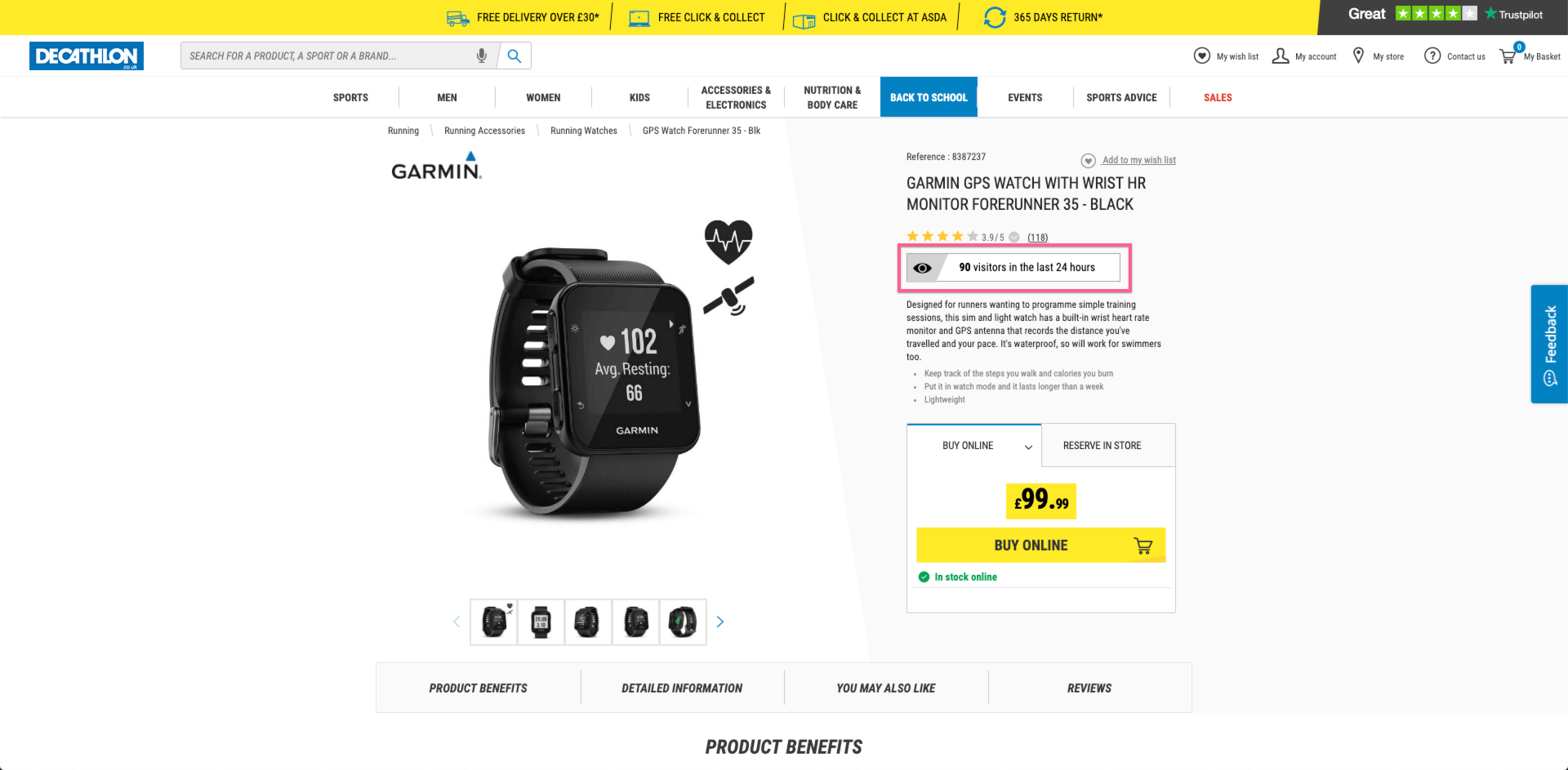
Decathlon social proof messaging
Product page with social proof messaging

“We thought it could be that extra little nudge to hit ‘add to basket’ – and might help certain customers continue through the purchase funnel,” elaborates Florent Beck, UX Leader at Decathlon UK. The team set up an A/B test on 400 product pages to see whether this kind of social proof messaging would have an impact on visitors’ purchase decisions. The text was inserted automatically just below the customer reviews ratings (another element of social proof), and above the product description. “What was really handy about the AB Tasty widget was that we can set a minimum amount of views before the message showed. In this case, we chose 20 – so if fewer than that number of people viewed the product, the message wouldn’t show, and once it hit 20, it would automatically appear,” explained Florent.

Results

Adding this simple line of social proof messaging not only increased clicks on the ‘Add to cart’ button, it also bumped up transactions and revenue. For all audiences, clicks increased by 1.5%, transactions by 2.4% and revenue by 1.3%.

Interestingly, when the team segmented the results by certain audience profiles, they realized that the social proof messaging worked better on returning visitors. They clicked 2.8% more, with an increase of 3.3% on transactions and 2.8% for revenue lift. “This might indicate that shoppers that know and trust the Decathlon brand are even more likely to put stock in others in the Decathlon community, versus first time visitors who are more wary,” explained David.

Even more interesting was when they dove into the data to look for what kinds of products this messaging worked best with. They also discovered that the social proof approach worked better for lower priced items – less than 10 pounds – versus more expensive, ‘investment items’, like a nice bike or set of skis. This kind of information can help Decathlon increase the efficacy of their campaigns in the future, and scale up this tactic for other markets.

“We value our community at Decathlon. What’s great about this kind of social proof messaging is that it’s a way to automatically let people take the opinions of other Decathlon shoppers into account – if a certain product is popular or trending, others can know that in real time as they’re browsing. From a business perspective, it increases our transaction rate and revenue, and from a customer experience perspective, it helps orient shoppers.” – Florent Beck, UX Leader, Decathlon UK

Spark
your curiosity!

Get your copy of "Decathlon Scores Big With Social Proof" now.

Case Studies

How Best Western® Hotels & Resorts Increased Loyalty Program Engagement

12% Increase in account creations

3 Audience segments

The American-based Best Western® Hotels & Resorts brand has been a leader in the hospitality industry for over 70 years, with a global network of 4,200 hotels in more than 100 countries and territories. With a strong presence in France, the group reported an annual revenue of 2.2 billion dollars in 2017. They have been an AB Tasty client since March, 2017

Challenge

For hotel brands like Best Western® Hotels & Resorts, customer loyalty is paramount; they aim to create a long-lasting relationship with each client. One of the ways to foster this kind of engagement is through an online membership community. For example, as a Best Western Rewards® member, customers can log in and benefit from discounts and other perks, like free stays, complimentary breakfasts, and upgrades.

The digital team at Best Western® France was looking for a way to encourage visitors to become members, use their accounts, and especially to take advantage of one of their discounts applicable to visits of two nights or longer. They decided the best way to do this would be to run a website personalization campaign using AB Tasty.

Personalization Campaign Idea

The team had an elegant idea: an internet user would be more likely to join the Best Western Rewards® program if they were shown offers directly relevant to their search query. For this, the team simply needed to create appropriate audience segments in AB Tasty using data from their data layer. Since their main goal was to encourage visitors to use or create their membership account, they opted for the following scenarios:

Upsell scenario: Trigger a pop-in to visitors who were logged in to their membership accounts and looking for a one-night stay, with an incentive to prolong their visit
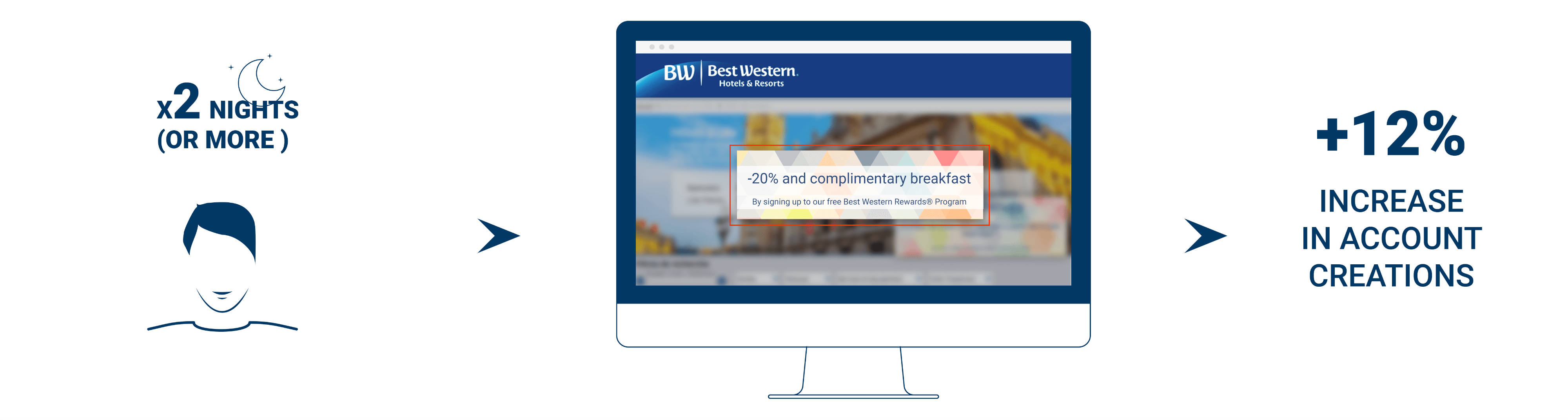
Encourage Best Western Rewards® account creation: Trigger a pop-in to visitors who were not logged in to a membership account and looking for at least a two-night stay, with a special promotional offer available only with a Rewards Account
Upsell and account creation: Trigger a pop-in to visitors who were not logged in to a membership account and looking for a one-night stay, with an incentive to create an account and prolong their stay

This way, the digital team could show discounts only to visitors who were eligible for them, making the browsing experience more relevant, and encouraging non-members to sign up. By promoting incentives and reduced rates for longer visits, they also aimed to increase revenue. In other words: they pushed the right message to the right website visitor at the right time.


Best western mock up personalization

Results

The results showed that this kind of personalized messaging can have big effects on engagement. The most successful scenario turned out to be the second one, with around 12% more Best Western Rewards® program sign-ups originating from this campaign. Unsurprisingly, it was easier to convince visitors to sign up for a free account to receive an incentive than to add an extra night’s stay! In addition, the team was able to say that they created a smoother, more relevant customer experience, by only showing promotional messages relevant to each visitor.

Takeaway Tip

Take advantage of your visitor data to create relevant, personalized messages. Not only will you create a more pleasant browsing experience, you’ll increase the number of ways you can increase engagement, transactions, and revenue, all the while optimizing an existing client scenario.

Spark
your curiosity!

Get your copy of "How Best Western® Hotels & Resorts Increased Loyalty Program Engagement" now.