Experiment Health Check: Proactive Monitoring for Reliable Experimentation
Emily Healy
Introduction
Running hundreds of experiments each year is a sign of a mature, data-driven organization – but it also comes with challenges.
How do you ensure that every test is running smoothly, and that critical issues don’t slip through the cracks?
At AB Tasty, we’ve listened to our clients’ pain points and are excited to announce the launch of Experiment Health Check: a new feature designed to make experimentation safer, smarter, and more efficient.
The Challenge: Keeping Experiments Healthy at Scale
For leading brands running over 100 campaigns a year, experimentation is at the heart of digital optimization.
But with so many campaigns running simultaneously, manually checking reports every day to spot issues is time-consuming and inefficient. Worse, problems like underperforming variations or sample ratio mismatches (SRM) can go unnoticed, leading to lost revenue or inconclusive results.
Our Solution: Experiment Health Check
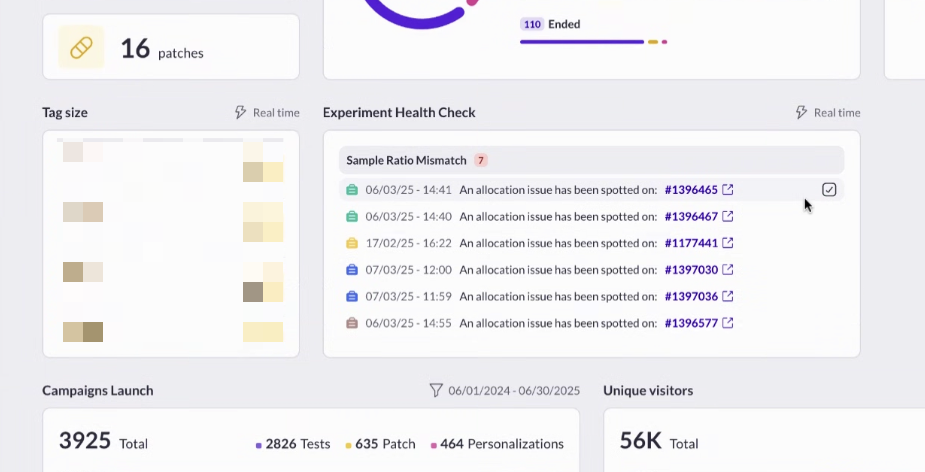
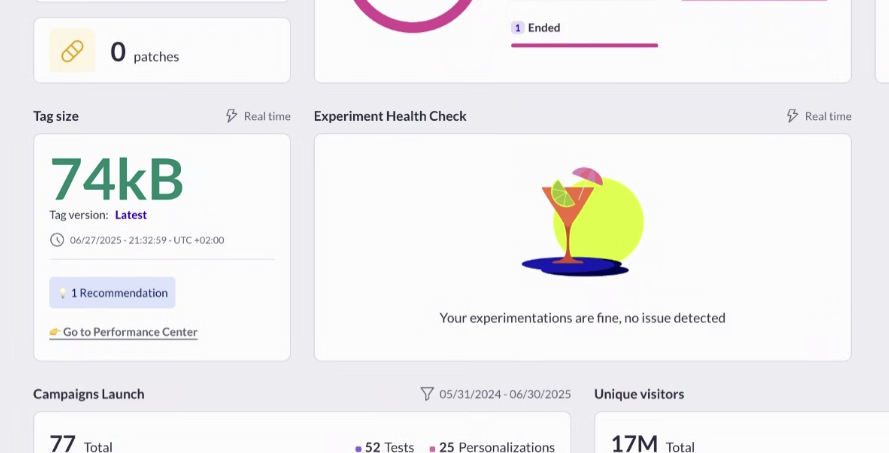
Experiment Health Check is an automated monitoring system built directly into AB Tasty. It proactively alerts you to issues in your experiments, so you can act fast and keep your testing program on track.
Key Features:
Automated Alerts: Get notified in-product (and by email, if you choose) when an experiment encounters a critical issue, such as:
Centralized Dashboard: Super-admins can view all alerts across accounts for a global overview.
Customizable Notifications: Choose which alerts to display and how you want to receive them.
Why It Matters
Proactive, Not Reactive: No more waiting until the end of a test or sifting through reports to find problems. Experiment Health Check surfaces issues as soon as they’re detected.
Saves Time: Focus on insights and strategy, not manual monitoring.
Peace of Mind: Most clients will rarely see alerts – only about 2% of campaigns encounter SRM issues – so you can be confident your experiments are running smoothly.
What’s Next?
Experiment Health Check is available to all AB Tasty clients as of June 2025.
Simply activate it in your dashboard to start benefiting from automated experiment monitoring. We’re committed to evolving this feature with more alert types and integrations based on your feedback.
9 AI Features that Transform How Digital Teams Test, Learn, and Grow
Emily Healy
Testing doesn’t have to feel like guesswork.
What if you could describe your vision and watch it come to life? What if understanding your visitors’ emotions was as simple as a 30-second scan? What if your reports could tell you not just what happened, but why it mattered?
That’s where AI steps in – not to replace your creativity, but to amplify it.
At AB Tasty, we’ve built AI tools that work the way teams actually think: curious, collaborative, and always moving forward. Here are nine features that help you test bolder, learn faster, and connect deeper with the people who matter most.
Insight: If you’re already an AB Tasty customer, you’ve already got access to some of our most popular AI features! But don’t stop scrolling yet, there’s more to discover.
1. Visual Editor Copilot: Your vision, our AI’s creation
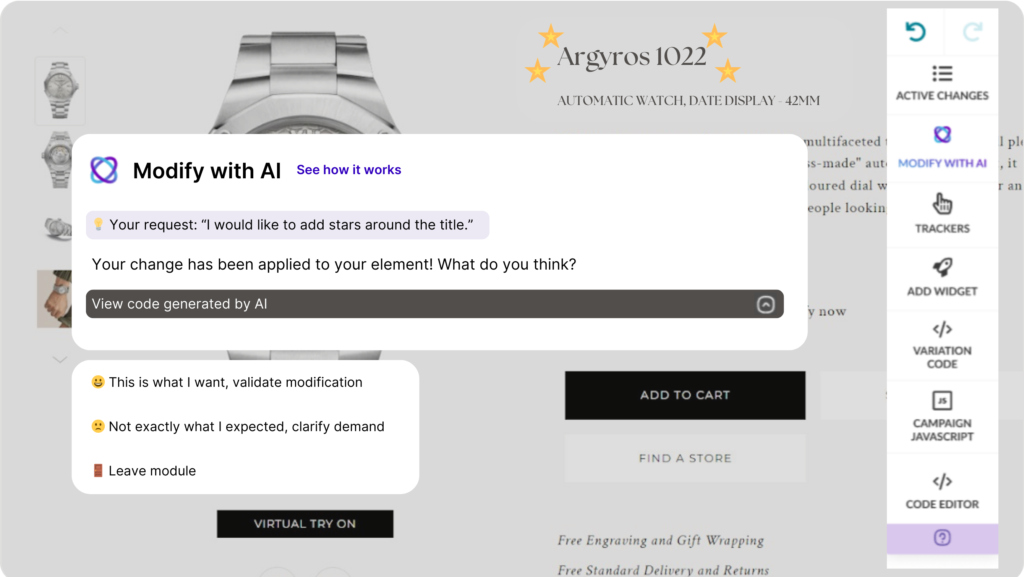
Visual Editor Copilot turns your ideas into reality without the endless clicking. Just describe what you want – “make that button green,” “add a fade-in animation,” or “move the CTA above the fold” – and watch our AI bring your vision to life.
No more wrestling with code or hunting through menus. Your creativity leads. Our AI follows.
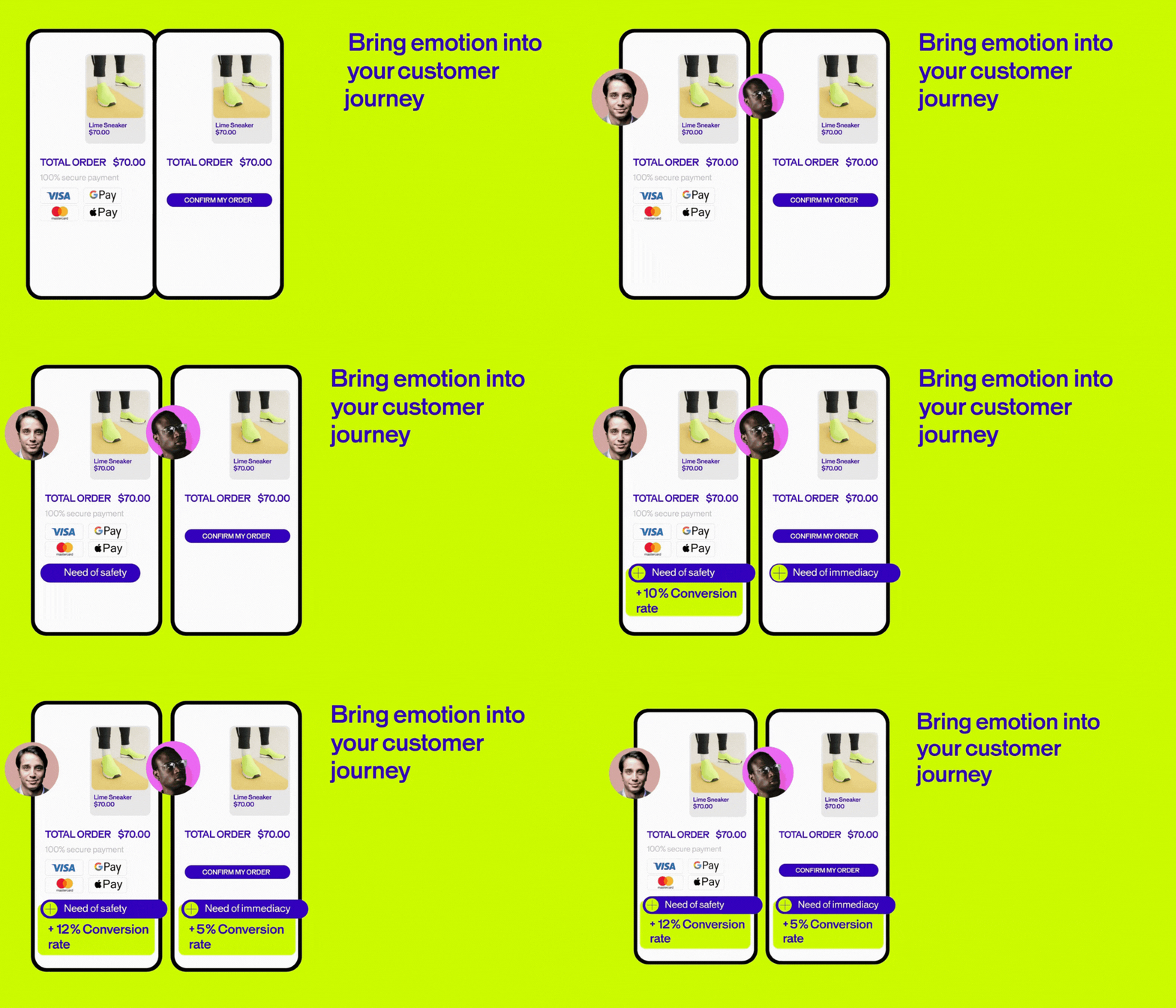
EmotionsAI Insights gives you a free peek into 10 emotional profiles that reveal what your visitors actually feel. Not just what they click – what moves them.
See the missed opportunities hiding in plain sight. Understand the emotional drivers that turn browsers into buyers. It’s personalization that goes beyond demographics to tap into what people really want.
3. Engagement Levels: Segment traffic for affinity and engagement
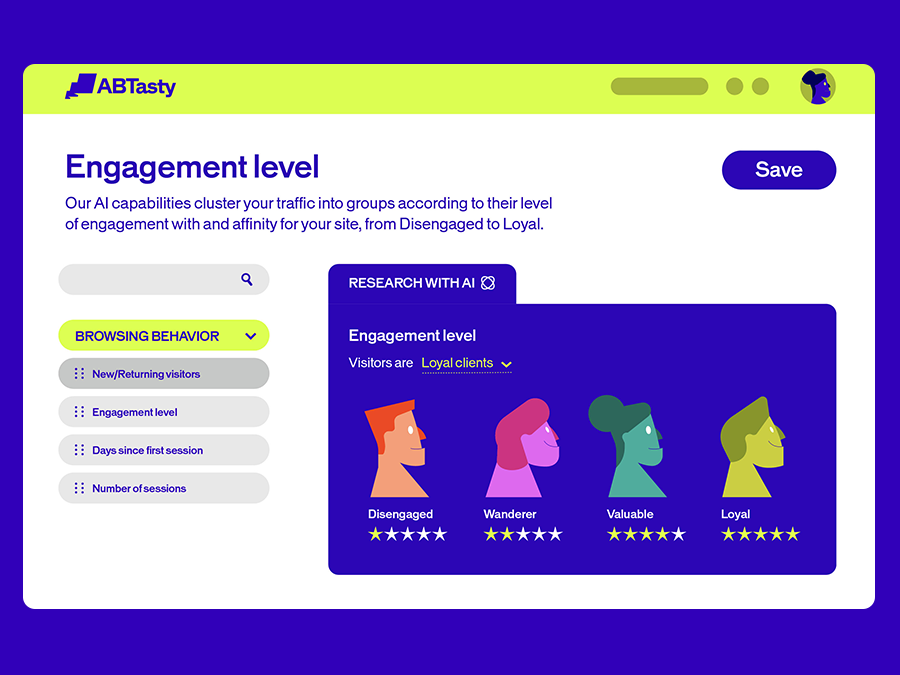
Our engagement-level segmentation uses AI to cluster visitors based on how they connect with your site. New visitors get the welcome they deserve. Returning customers get the recognition they’ve earned.
It’s traffic segmentation that makes sense – grouping people by affinity, not just attributes.
4. EmotionsAI: The future of personalization
EmotionsAI is personalization with emotional clarity. In just 30 seconds, see what drives your visitors at a deeper level. Turn those insights into targeted audiences and data-driven sales.
Your visitors have unique needs and expectations. Now you can meet them where they are – emotionally and practically.
5. Recommendations and merchandising
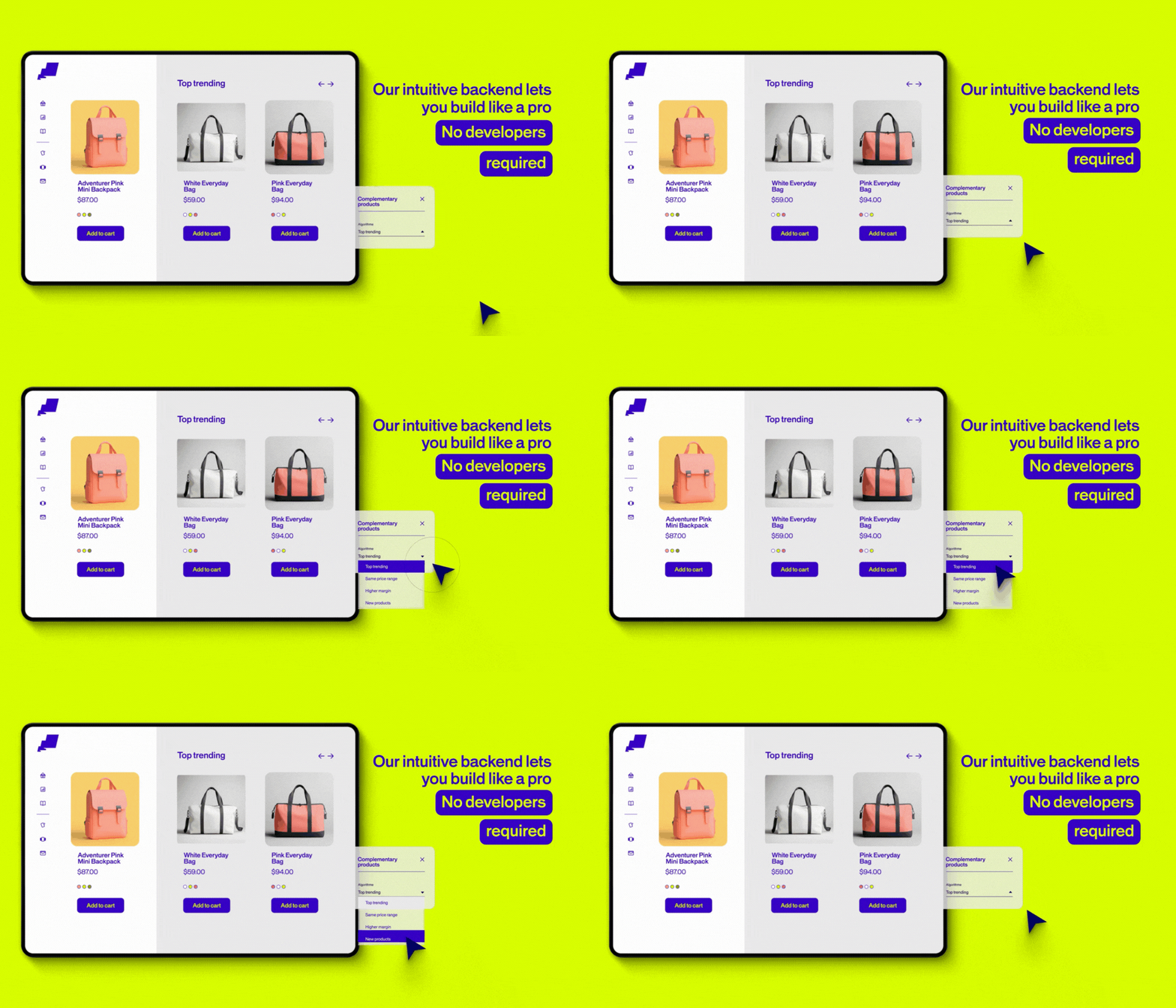
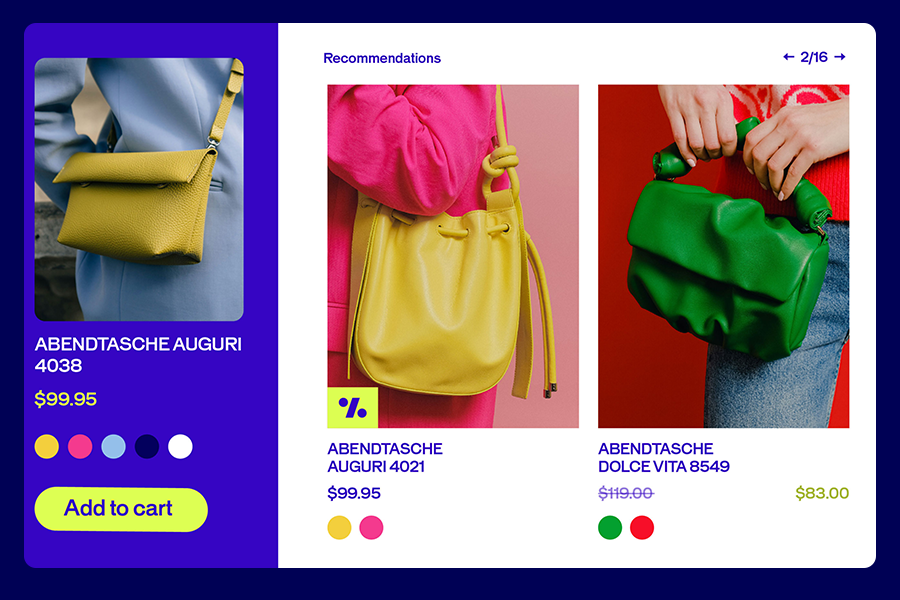
Recommendations and Merchandising turns the right moment into new revenue. Our AI finds those perfect opportunities to inspire visitors – whether it’s a complementary product or an upgrade that makes sense.
You stay in control of your strategy. AI accelerates the performance. The result? A delightful experience that drives higher average order value.
6. Content Interest: No more struggling to connect
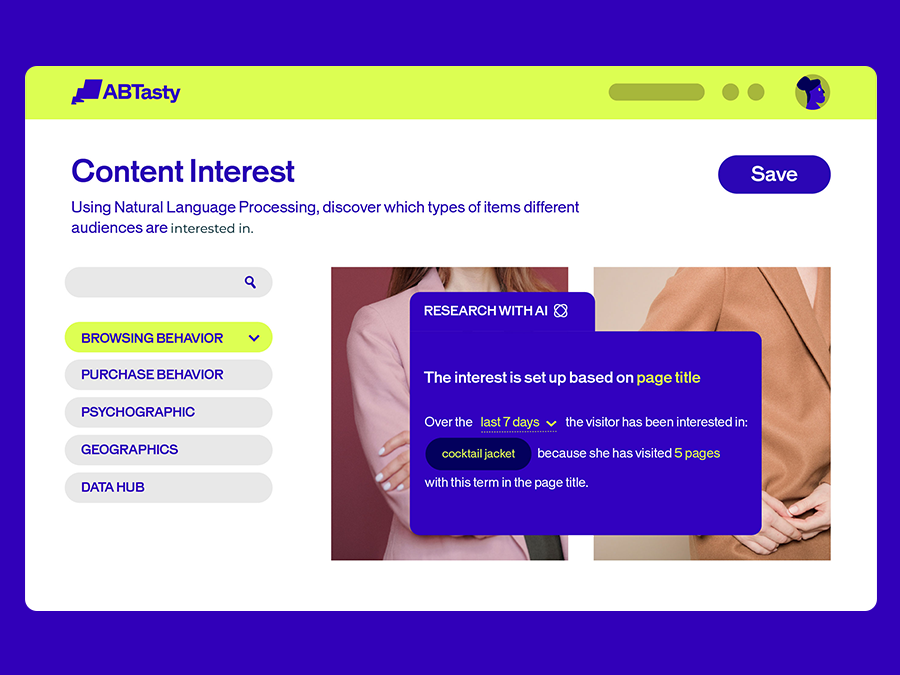
Content engagement AI identifies common interests among your visitors based on their browsing patterns – keywords, content, products. Build experiences that feel personal because they actually are.
It’s not about pushing content. It’s about finding the connections that already exist and making them stronger.
7. Report Copilot: Meet your personal assistant for reporting
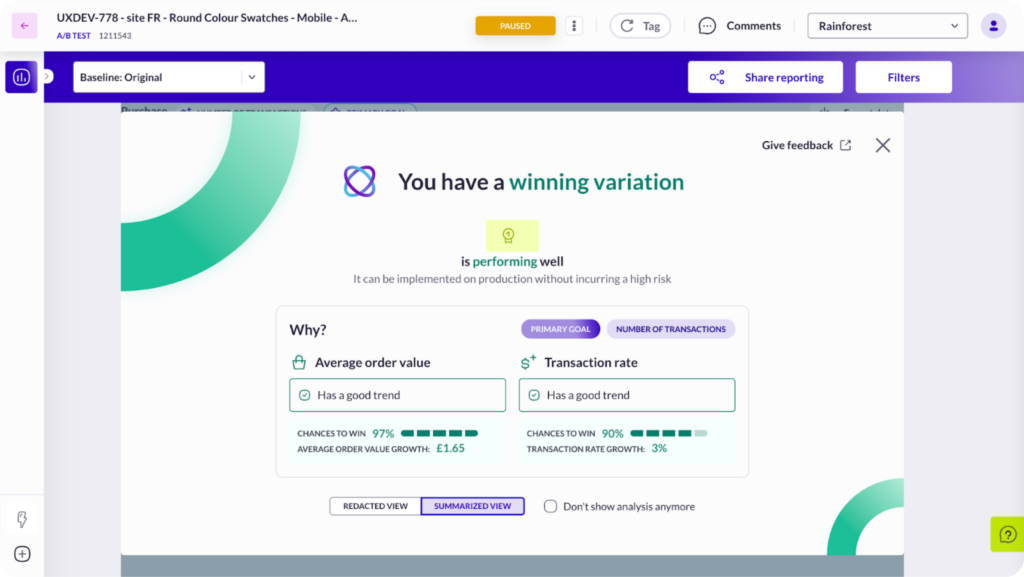
Report Copilot is your personal assistant for making sense of data. It highlights winning variations and breaks down why they drove transactions – so you can feel confident in your next move.
No more staring at charts wondering what they mean. Get clear insights that move you forward.
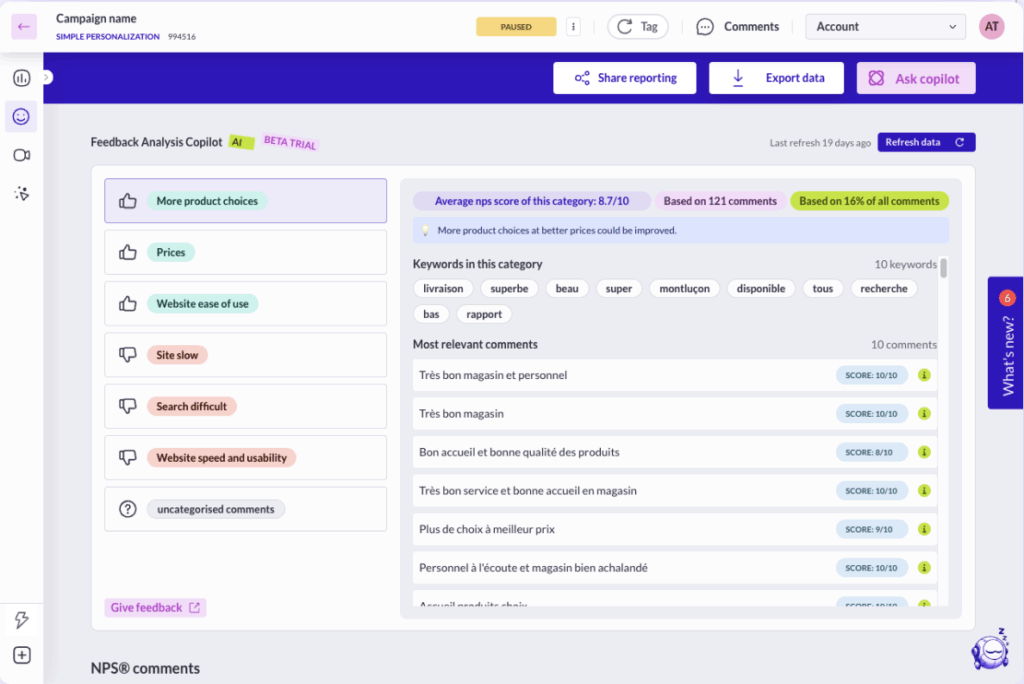
8. Drowning in feedback? Feedback Analysis Copilot saves you time
Feedback Analysis Copilot takes the heavy lifting out of NPS and CSAT campaigns. Our AI analyzes responses right within your reports, identifying key themes and sentiment trends instantly.
High volumes of feedback? No problem. Get the insights you need without the manual work that slows you down.
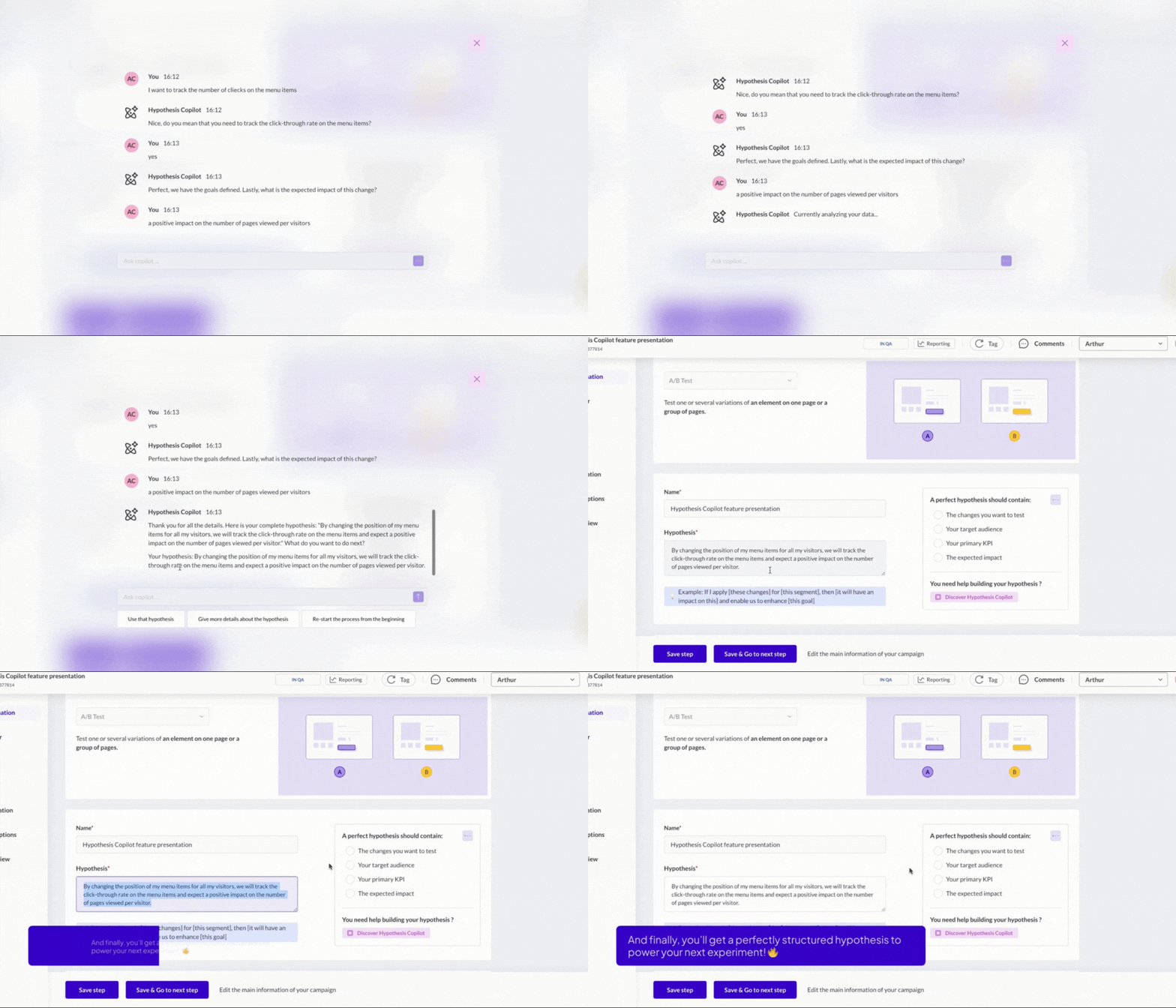
9. Struggling to craft the perfect hypothesis for your experiments?
Hypothesis Copilot helps you craft experiments that start strong. Clear objectives, richer insights, better structure – because every great test begins with a rock-solid hypothesis.
No more struggling with the “what if” – start testing with confidence.
AI That Amplifies Human Creativity
These aren’t just features – they’re your teammates. AI that understands how teams really work: with curiosity, collaboration, and the courage to try something new.
Every tool we build asks the same question: How can we help you go further?
Whether you’re crafting your first experiment or your thousandth, these AI features meet you where you are and help you get where you’re going. Because the best optimization happens when human insight meets intelligent tools.
Ready to see what AI-powered experimentation feels like? Let’s test something bold together.
FAQs about AI in digital experimentation
How is AI used in digital experimentation and A/B testing?
AB Tasty offers clients multiple AI features to enhance A/B testing by automating test setup, analyzing emotional responses, segmenting audiences, and generating data-driven recommendations—all aimed at faster insights and better personalization.
What are the benefits of using AI in website optimization?
AI reduces guesswork, accelerates testing, improves personalization, and turns raw data into actionable insights. It empowers teams to learn faster and create better digital experiences.
How does AI help marketing and product teams test and learn faster?
AB Tasty empowers marketing and product teams with AI tools like Report Copilot and Hypothesis Copilot to streamline data analysis and test planning, helping teams move from idea to iteration quickly and confidently.
What AI features does AB Tasty offer for experimentation and personalization?
AB Tasty offers features like Visual Editor Copilot, EmotionsAI, Content Interest segmentation, and Report Copilot to streamline testing, personalization, and reporting.
Your Domain, Your Rules: Domain Delegation by AB Tasty
Emily Healy
In an era where privacy regulations tighten, browser restrictions escalate, and trust is hard-won, brands need more than great ideas to drive their digital experiments — they need full control over how their technologies behave.
That’s why AB Tasty is proud to introduce Domain Delegation, a groundbreaking feature designed to place independence, performance, and compliance at the heart of your experimentation strategy.
Why Domain Delegation changes the game
The digital landscape is constantly shifting at a fast pace. With evolving browser privacy policies (like ITP and ETP), widespread ad blockers, and stricter data regulations, third-party scripts are increasingly vulnerable — slowing down your site, triggering blockers, or worse, being outright rejected.
For enterprises operating under rigorous security standards, these challenges can make it nearly impossible to deploy tools like AB Tasty efficiently.
That’s where Domain Delegation steps in.
This powerful new feature allows you to serve the AB Tasty tag from a custom subdomain you control (e.g., abt.yourdomain.com), while AB Tasty takes care of the heavy lifting behind the scenes.
What you can do with Domain Delegation
Host the AB Tasty tag on your own subdomain (e.g., abt.brand.com)
Easily delegate DNS management to AB Tasty through an intuitive guided setup
Bypass blockers, improve load speed, and boost reliability
Deliver the tag under your own brand, reinforcing trust and compliance
Minimal technical effort, fully managed from the AB Tasty interface
What’s in It for You
✅ Higher tag reliability ⚡ Better site performance & Core Web Vitals ? Stronger data governance & security posture ? More brand trust with white-labeled tag delivery
Who benefits the most?
Highly regulated industries: Finance, healthcare, government
Privacy-first brands: Total data flow ownership
Tech teams optimizing performance and autonomy
Any organization battling browser or ad blockers
Why Now?
Privacy restrictions aren’t going away. Ad blockers aren’t easing up. With Domain Delegation, AB Tasty empowers you to take back control over your experimentation stack — ensuring you stay compliant, performant, and trusted.
This isn’t just a technical feature. It’s a strategic foundation for the next era of digital experimentation.
How It Works
Define your subdomain (e.g., abt.mybrand.com)
Follow the easy delegation flow in AB Tasty’s interface
Let us handle the rest (provisioning, certificates, delivery)
Your tag. Your domain. All powered by AB Tasty.
Domain Delegation Availability
Interested in Domain Delegation? Contact your AB Tasty Customer Success Manager to get started.
Evi Feedback (Copilot): Turn The Customer Voice Into Action in Seconds with AI
Emily Healy
Every insight starts with a story, and every story deserves to be heard. But when your NPS® or CSAT campaigns generate thousands of responses, how do you turn all that feedback into real action, fast?
That’s why we created EviFeedback (formerly known as Feedback Copilot), the AI-powered assistant that transforms your NPS® or CSAT campaigns into actionable intelligence – instantly.
The problem collecting feedback: Too many voices, not enough time
Let’s face it: analyzing feedback is a nightmare. Even when users leave valuable insights in NPS campaigns, the manual work required to analyze hundreds (or thousands) of verbatim responses can paralyze teams. One client told us:
“We received 5,000 verbatim responses. That’s two weeks of manual work.”
And because it’s so time-consuming, teams either:
Underutilize feedback tools like NPS/CSAT
Or don’t act on the insights at all
The solution to overwhelming feedback? Evi Feedback
Evi Feedback was born from this pain point – combining the best of AI with our all-in-one experimentation platform. It’s available for free within AB Tasty, and automatically activated for NPS/CSAT campaigns with over 100 responses.
What Evi Feedback does:
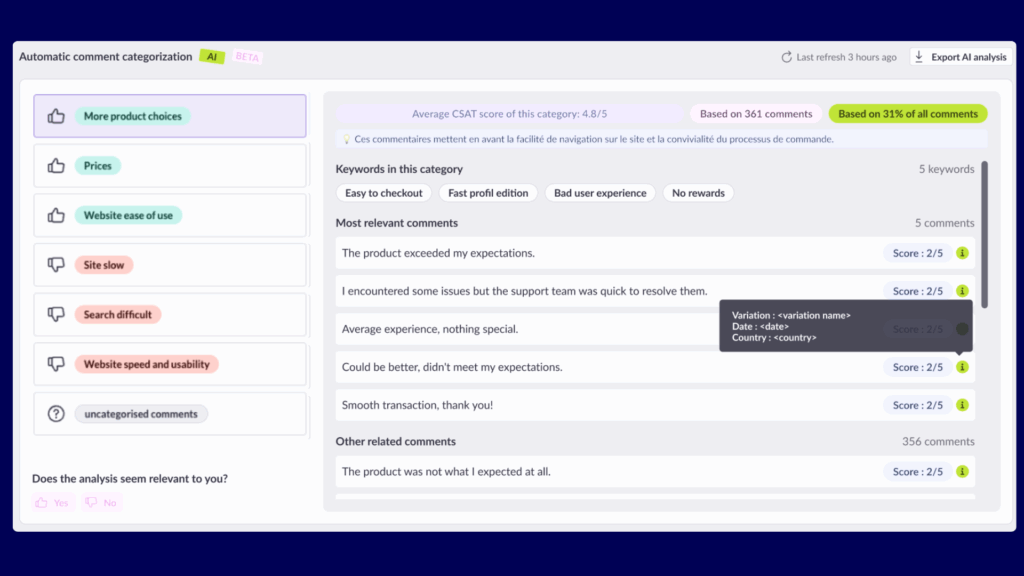
Segments feedback by sentiment: Instantly separates positive and negative comments based on campaign scores.
Clusters similar comments into key themes: Groups feedback into topics like “price,” “delivery,” or “UX.”
Summarizes each theme: Provides a short description, confidence score, and sample comments for every theme.
Highlights what matters most: Surfaces the top 3 positive and top 3 negative drivers of satisfaction.
Exports labeled feedback: Download results for use in Excel, PowerPoint, and more.
And it does all this while respecting data privacy, using a self-hosted model (Hugging Face) instead of sending sensitive content to third-party LLMs.
What makes our Feedback Copilot unique?
Instant categorization of massive feedback volumes
Quantification of qualitative input – finally, your verbatim responses have numbers to back them
Integrated NPS/CSAT in your test workflows – measure why something works, not just if it does
Enterprise-grade privacy: Comments stay on AB Tasty’s infrastructure
Who benefits from Evi Feedback?
CROs & Product Managers: Prioritize optimizations based on real user pain points.
UX & Research Teams: Detect trends and go beyond basic survey stats.
Marketing & Customer Success: Understand friction points before and after launches.
What’s next?
Early adopters already report major productivity gains – and they’re asking for more:
Direct A/B test ideas from negative themes
Verbatim-based segmentation for campaign targeting
Improved theme granularity for enterprise-scale campaigns
We’re just getting started. Evi Feedback is not just a feature – it’s your co-pilot in delivering better, faster, and more human-centered product decisions.
Test, Dress, Impress: Top Fashion Consumer Trends 2025
Kate Feng
Forget traditional shopping journeys, today’s fashion consumers are rewriting the rules! Our 2025 Fashion Consumer Trends report reveals the shifts in how consumers discover, decide, and commit to fashion brands today.
Introduction
In a recent webinar, 3 experimentation leaders came together to unpack the latest consumer trends shaping the fashion industry. The conversation brought together Ben Labay, CEO of Speero, Jonny Longden, Speero’s Chief Growth Officer, and Mary Kate Cash, Head of Growth Marketing for North America at AB Tasty. They shared valuable insights from AB Tasty’s recent global fashion consumer survey, highlighting what drives inspiration, conversion, and retention in today’s fast-evolving fashion landscape.
Social Media is Changing the Game
Traditional search engines remain the top channel for fashion discovery, followed by direct website visits, Google Shopping, and Social Media ads. However, the differences between these top four channels are shrinking year over year, with social media rapidly gaining ground, especially among Gen Z consumers, where 60% of survey respondents highlighted Social Media ads as their preferred avenue to finding new products. Jonny predicts this trend will expand across all age groups.
“Social and fashion just go so hand in hand. The big change that’s happened with social is that fashion itself has become more rapid in the way it changes, and so it’s really driving different consumer behaviour.”
Jonny Longden, Chief Growth Officer at Speero
Different Channels, Different Mindsets
People use search when they know what they want. Social media, on the other hand, encourages experimentation. As Ben pointed out, shoppers arriving from social media are often inspired to try new styles or connect with communities, engaging in “social shopping” and not just focusing on finding a specific product. This opens the door for more tailored experiences based on where customers are coming from and what type of inspiration they’re seeking.
What the Fashion Consumer Trends 2025 Tell Us About Expectations
Reward Loyalty in Meaningful Ways – When asked how brands could make customers’ experiences more personal, the top answer was clear: rewarding brand loyalty. Discounts, early access, or perks for repeat buyers make shoppers feel seen and increase the chances of account creation and repeat visits.
Jonny pointed out that “the really interesting tension in this whole industry at the moment is the difference between what is the right thing to do and what is the profitable thing to do. about finding that balance is experimentation in the broadest sense of the word.”
Make Recommendations That Actually Fit – Consumers want relevant suggestions that go beyond basic personalization. Jonny compared it to having a personal stylist: a brand should know both the customer and the market, understanding trends and styles while matching these to individual preferences.
What Actually Drives Conversions
When it comes to converting browsers into buyers, shoppers across generations are surprisingly aligned.
Product quality leads the way across all age groups and regions. Shoppers are still willing to pay for craftsmanship, comfort, and durability, even in a price-sensitive market.
Discounts come next, but the strategy matters. Overuse can cheapen brand perception. As Jonny put it: “Fashion, especially the lower price point fashion has ended up in a kind of race to the bottom where discounting is the way to compete. […] and a lot of consumers wouldn’t consider paying full price. The challenge is how to be careful with the commerciality of discounting.”
Sizing and fit clarity also ranks high, especially in fashion, where hesitation often comes from uncertainty about how something will feel or look. Ben noted that some major retailers are tackling this head-on, investing heavily in tools to improve sizing and try-on experiences.
For Gen Z, high-quality reviews and transparency around production methods, sustainability, and pricing are big drivers. Ben shared tactical approaches to transparency on product detail pages, like using engaging CTAs such as “Do you want to know a secret?” to reveal value props related to sustainability and ethical production.
Why Shoppers Abandon Carts
Cart abandonment remains a major friction point, and two reasons dominate globally:
Not ready to buy – Many shoppers use the cart to explore shipping, delivery timeframes, or total cost before making a decision. Jonny explained it simply: “People use the checkout of an ecommerce website just to see what’s gonna happen. […] When’s it gonna be delivered? What are the delivery options? How much is delivery gonna cost?
Payment Methods not being accepted – This came in a close second, showing how overlooked payment flexibility still is. Buy-now-pay-later options like Klarna may move the needle, especially in fashion, where customers often purchase multiple sizes with the intention of returning some items. Jonny emphasized that payment method testing is one of the best arguments for AB testing and experimentation, as the “best practice” of offering many payment options doesn’t always lead to better conversion.
Retention: Loyalty Built on Familiarity
Finally, we explored what drives customers to create accounts with fashion brands, buy products from them, and what motivates them to stick around.
Loyalty Rewards Drive Engagement – Globally, the top reason for account creation is earning loyalty points, especially among Gen Z and Millennials. Discounts and sale updates follow closely behind.
Balancing Novelty and Trust – Shoppers crave both newness and familiarity: new products ranked highest in driving retention, but previously purchased items and trusted brands followed close behind. This balance is key to keeping customers engaged long-term.
Jonny raised an interesting point: a lot of loyalty programs end up rewarding people who would have come back anyway. Mary Kate added that tools like segmentation can help brands tell the difference between genuinely loyal customers and those just passing through, making it easier to design rewards that actually make an impact.
While conventional wisdom discourages forced account creation, Ben challenged this assumption, arguing it can work when paired with compelling promotions or rewards, especially in social ads. “Social ads that inspire and combine short-term promotions, rewards, and discounts are increasingly leading into forced account creation sequences.”
Conclusion
As shown in our 2025 Fashion Consumer Trends report, the e-commerce fashion industry is evolving, along with consumer expectations. To remain competitive, brands must go beyond simply selling products. They must deliver seamless, personalized shopping experiences that speak directly to the modern shopper’s needs.
This is where experimentation becomes a critical advantage. The most successful brands are those willing to test assumptions about everything from product discovery and presentation to payment options, loyalty strategies, and the evolving role of social commerce. Experience optimization is no longer a nice-to-have. It’s the foundation for building trust, loyalty, and long-term growth in the fast-moving world of online fashion.
Want a deeper dive? Watch the full webinar below to hear expert insights and practical strategies shaping the future of fashion commerce.
Minimal Detectable Effect: The Essential Ally for Your A/B Tests
Hubert Wassner
In CRO (Conversion Rate Optimization), a common dilemma is not knowing what to do with a test that shows a small and non-significant gain.
Should we declare it a “loser” and move on? Or should we collect more data in the hope that it will reach the set significance threshold?
Unfortunately, we often make the wrong choice, influenced by what is called the “sunk cost fallacy.” We have already put so much energy into creating this test and waited so long for the results that we don’t want to stop without getting something out of this work.
However, CRO’s very essence is experimentation, which means accepting that some experiments will yield nothing. Yet, some of these failures could be avoided before even starting, thanks to a statistical concept: the MDE (Minimal Detectable Effect), which we will explore together.
MDE: The Minimal Detectable Threshold
In statistical testing, samples have always been valuable, perhaps even more so in surveys than in CRO. Indeed, conducting interviews to survey people is much more complex and costly than setting up an A/B test on a website. Statisticians have therefore created formulas that link the main parameters of an experiment for planning purposes:
The number of samples (or visitors) per variation
The baseline conversion rate
The magnitude of the effect we hope to observe
This allows us to estimate the cost of collecting samples. The problem is that, among these three parameters, only one is known: the baseline conversion rate.
We don’t really know the number of visitors we’ll send per variation. It depends on how much time we allocate to data collection for this test, and ideally, we want it to be as short as possible.
Finally, the conversion gain we will observe at the end of the experiment is certainly the biggest unknown, since that’s precisely what we’re trying to determine.
So, how do we proceed with so many unknowns? The solution is to estimate what we can using historical data. For the others, we create several possible scenarios:
The number of visitors can be estimated from past traffic, and we can make projections in weekly blocks.
The conversion rate can also be estimated from past data.
For each scenario configuration from the previous parameters, we can calculate the minimal conversion gains (MDE) needed to reach the significance threshold.
For example, with traffic of 50,000 visitors and a conversion rate of 3% (measured over 14 days), here’s what we get:
The horizontal axis indicates the number of days.
The vertical axis indicates the MDE corresponding to the number of days.
The leftmost point of the curve tells us that if we achieve a 10% conversion gain after 14 days, then this test will be a winner, as this gain can be considered significant. Typically, it will have a 95% chance of being better than the original. If we think the change we made in the variation has a chance of improving conversion by ~10% (or more), then this test is worth running, and we can hope for a significant result in 14 days.
On the other hand, if the change is minor and the expected gain is less than 10%, then 14 days will not be enough. To find out more, we move the curve’s slider to the right. This corresponds to adding days to the experiment’s duration, and we then see how the MDE evolves. Naturally, the MDE curve decreases: the more data we collect, the more sensitive the test becomes to smaller effects.
For example, by adding another week, making it a 21-day experiment, we see that the MDE drops to 8.31%. Is that sufficient? If so, we can validate the decision to create this experiment.
If not, we continue to explore the curve until we find a value that matches our objective. Continuing along the curve, we see that a gain of about 5.44% would require waiting 49 days.
That’s the time needed to collect enough data to declare this gain significant. If that’s too long for your planning, you’ll probably decide to run a more ambitious test to hope for a bigger gain, or simply not do this test and use the traffic for another experiment. This will prevent you from ending up in the situation described at the beginning of this article, where you waste time and energy on an experiment doomed to fail.
From MDE to MCE
Another approach to MDE is to see it as MCE: Minimum Caring Effect.
This doesn’t change the methodology except for the meaning you give to the definition of your test’s minimal sensitivity threshold. So far, we’ve considered it as an estimate of the effect the variation could produce. But it can also be interesting to consider the minimal sensitivity based on its operational relevance: the MCE.
For example, imagine you can quantify the development and deployment costs of the variation and compare it to the conversion gain over a year. You could then say that an increase in the conversion rate of less than 6% would take more than a year to cover the implementation costs. So, even if you have enough traffic for a 6% gain to be significant, it may not have operational value, in which case it’s pointless to run the experiment beyond the duration corresponding to that 6%.
In our case, we can therefore conclude that it’s pointless to go beyond 42 days of experimentation because beyond that duration, if the measured gain isn’t significant, it means the real gain is necessarily less than 6% and thus has no operational value for you.
Conclusion
AB Tasty’s MDE calculator feature will allow you to know the sensitivity of your experimental protocol based on its duration. It’s a valuable aid when planning your test roadmap. This will allow you to make the best use of your traffic and resources.
How We Made AB Tasty’s Feature Experimentation SDK OpenFeature-Compatible — And Even Easier to Adopt
Julie Dumont
Why We Chose to Adopt OpenFeature
At AB Tasty, we believe a great product experience starts with smooth feature delivery and personalization. Our Feature Experimentation SDK empowers tech teams to control feature rollout and tailor interfaces to each visitor.
But in today’s complex, fast-moving ecosystems, interoperability is key. That’s where OpenFeature comes in.
What is OpenFeature?
OpenFeature is an open-source specification that defines a standardized API for feature flag management. It lets developers manage feature flags consistently across tools and platforms.
Why it matters:
Interoperability: A unified API across providers.
No vendor lock-in: Switch tools without rewriting business logic.
Thriving community: Backed by CNCF and designed for cloud-native development.
What We Built: The Official AB Tasty OpenFeature Provider
To ensure our SDK plays well with OpenFeature, we created an official provider: @flagship.io/openfeature-provider-js
You can now use our feature flags in any OpenFeature-compliant setup, like this simple Node.js example:
We’ve made onboarding even easier. Our CLI tool, which is also bundled with the AB Tasty VSCode Extension, includes a powerful codebase analyzer.
What it does:
Scans your codebase
Detects flags and usage from other providers (e.g., Optimizely, Kameleoon, etc.)
Identifies if you’re already using OpenFeature
Automatically generates corresponding flags in Flagship
Example: Already using OpenFeature with a competitor? Just plug in our CLI, and AB Tasty will detect your flags and preconfigure them for you — saving you hours of manual setup.
Understanding the Impact of Tariffs on E-Commerce Pricing Elasticity
Edoardo Aliprandi
This is a guest article written by Edoardo Aliprandi from our partners at Converteo on the effect of US tariff hikes in both the US and Europe. Edoardo is a lead data pricing manager analytics engineer with a background in economics and has given us a guide as to how the threat of new tariffs will impact e-commerce websites, the economy, and price-elasticity.
Entering turbulence and historical precedents
One April morning, standing behind a bed of tulips in the White House garden, Donald Trump unveiled his chart for international trade to a global audience: to sell in America, thou shalt pay tariffs. Very soon, the golden calf took a hit: the bull market, already faltering for weeks, completely collapsed. Since April 2, major stock indices have been in free fall, casting a shadow of uncertainty over the global economic outlook. Price stability—barely recovering from post-Covid turbulence—is once again being tested. This political bombshell and the market turmoil it triggered is reminiscent of the first oil shock of 1973. In the aftermath of the Yom Kippur War, amid declining U.S. oil reserves, OPEC imposed an oil embargo on Western economies, causing oil prices to skyrocket by 70%. The deeper reason? To strengthen their geopolitical standing and wield powerful bargaining leverage—a logic not unlike today’s White House. The outcome is well-known: stalled growth, rising inflation and unemployment… in a word, stagflation, which defined the 1970s as much as ABBA’s greatest hits.
Since then Trump has backtracked, offering a 90-day reprieve for most countries except China, but it’s not exactly clear where anyone stands. While financial markets breathed a sigh of relief—though it remains to be seen whether this marks a true recovery or just a “dead cat bounce”—uncertainty continues to hang over the economic outlook and supply chains of American and European companies. This article explores a scenario in which the United States continues to use tariffs as a geopolitical weapon, along with the economic implications and pricing strategy consequences for businesses.
If tariff hikes are sustained, companies will need to adjust to a new paradigm: rising input costs, lost markets, and the emergence of new ones—forcing a shift in strategies and pricing to reflect these new realities.
Supply and demand shocks: pricing implications
By simulating the behavior of economic agents—businesses and consumers—the Aggregate Supply–Aggregate Demand (AS-AD) macroeconomic model helps estimate the impact of such shocks on activity and prices. It is based on two core principles:
All else equal, companies seek to maximize margins and will try to increase sales as the price index rises. Supply is thus positively correlated with the price index.
Consumers’ real income and savings fall as prices rise, making them feel poorer and less inclined to spend (Pigou effect). Demand is thus negatively correlated with the price index.
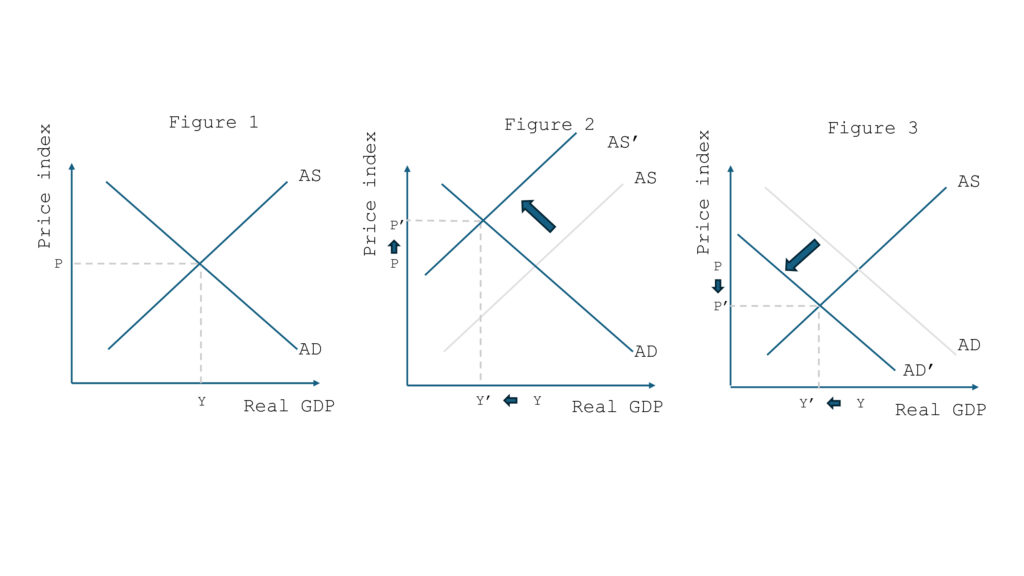
In simple terms, two curves intersect at equilibrium (Figure 1), defining an equilibrium price and output. So, what would be the impact of a shock—like a tariff hike—on prices?
The AS-AD model describes two plausible scenarios, each with different effects on the price index:
Supply shock: Input costs rise, squeezing business margins. For a given price index, companies are willing to produce less, shifting the aggregate supply curve left (Figure 2). In this case, reduced activity and restricted supply push prices up: we’re in a stagflation scenario.
Demand shock: Households experience income losses (e.g., due to reduced exports), and for a given price level, they consume less, shifting the demand curve left (Figure 3). Falling demand pushes businesses to lower prices to sell their products, leading to deflation.
Clearly, a US tariff hike or oil shock affects both supply and demand curves: rising input costs hurt business margins and production capacity, while households lose income due to declining economic activity. Still, one effect usually dominates—stagflation in the 1970s, for instance, was mainly supply-driven. What about the shock triggered by the new U.S. tariffs?
Inflation spiral in the U.S., deflationary pressure in Europe?
Trump’s trade war is turning into a full-blown crusade against the rest of the world (EU, China, BRICS). So the impact will likely differ between the initiator and those on the receiving end: one economy closing itself off, and others losing a major export market.
In the U.S., trade barriers will significantly raise the cost of imports—possibly as much as the tariff increases themselves. Even domestic production won’t be spared, as many raw materials and components are imported and account for a large share of final costs, especially in strategic sectors like autos and electronics. Companies will face a choice: absorb the added costs or relocate production—a risky and expensive move in an uncertain context that could dampen investment. The economy may thus face a supply shock and stagflation, driven by margin pressures that discourage production expansion.
In Europe, falling exports to the U.S. could reduce incomes. Companies may respond by adjusting their labor force, weighing on household demand. While input costs will also rise, the effect should be milder, since retaliation will likely target only U.S. products. A demand shock—and thus deflation—is more likely, potentially worsened by Chinese products dumped onto the European market after being rerouted from the U.S.
These assumptions appear to be confirmed by recent moves from central banks. Jerome Powell at the Fed has become more cautious about rate cuts initiated in late 2024, to curb price surges. In contrast, JP Morgan predicts three rate cuts in Europe this year, aimed at stimulating demand and fighting deflation.
Different challenges for businesses on each side of the Atlantic
In the U.S., businesses will need to revisit sourcing strategies and manage inflationary conditions.
In Europe, they must prepare for falling demand and weaker consumer willingness to pay for certain products.
Pricing in a fragmented world: adapting to local elasticities
In a world marked by trade fragmentation and rising protectionism, businesses must pay renewed attention to pricing strategy. The U.S. trade war—triggered by sudden tariff hikes—will not have symmetric effects across regions. The U.S. may face inflation from rising input costs, while Europe could experience a negative demand shock and deflationary pressures, worsened by Asian imports redirected from America.
In this context, understanding price elasticity becomes crucial — both as a tool for analysis and for experimentation. In Europe, where purchasing power is under pressure, raising prices can quickly lead to a sharp drop in sales volumes. But cutting prices isn’t a silver bullet either: if demand is inelastic, it may have little impact. That’s why businesses need detailed elasticity analysis by segment, drawing on internal data, market insights, and advanced analytics. The goal? Take a defensive approach on highly price-sensitive products, while maintaining stable pricing for high-value items where demand is less elastic.
Experimentation plays a key role in this process. By testing different price points across products and segments, companies can see in real time how cost changes impact conversion rates and overall sales. Understanding the impact of tariffs can help fine-tune pricing strategies to strike the right balance between volume, margin, and customer retention. This test and learn process would eventually enable companies to estimate a price tipping point, for which the business objective is optimized.
In the U.S., the new tariffs shuffle the deck but don’t offer immediate wins for all. Restructuring supply chains, reshoring production, or sourcing from new partners in unaffected regions is complex, risky, and costly. Market leaders—with stronger financial and contractual leeway—are better positioned to invest and possibly turn these challenges into long-term advantages, absorbing costs or even improving margins through price repositioning.
In inflationary settings, market leaders might also pursue aggressive commercial strategies, accepting temporary margin losses to outpace competitors. Weaker players, unable to absorb costs or adjust prices, could suffer under this new paradigm. Competitive pressure may accelerate market consolidation, benefiting the best-prepared firms.
Conclusion
In a reshaped global economy, understanding the Impact of tariffs on E-Commerce pricing elasticity is a critical lever of competitiveness. It requires a tailored, market-specific approach, combining knowledge of local elasticities with logistical adaptability. Only then can companies transform tariff constraints into sustainable competitive advantages.
The Mobile Playbook: Personalization, Performance, and Profitability
John Hughes
Mobile commerce has revolutionized how consumers interact with brands — from browsing products on the go to researching the latest trends. Yet, despite mobile usage soaring, the full potential of mobile commerce remains untapped. While traffic from mobile devices continues to rise, conversion rates still trail behind other channels. What’s driving the gap between browsing and purchasing on mobile?
In this post, we’ll explore key mobile performance stats, delve into the challenges behind these numbers, and showcase how Quantum Metric and AB Tasty collaborate to help brands close this gap. If you want the your own mobile playbook, the insights shared here are based on data from Quantum Metric’s eBook, How Mobile Performance Builds Consumer Confidence.
1. Mobile is everywhere, but conversions lag.
Mobile traffic is not just a trend, it’s the backbone of online shopping. Consumers are increasingly using their phones for everything from discovering products to making final purchase decisions. However, despite this surge in mobile traffic, conversions still don’t match the volume of visits. So, what’s going wrong?
Insight:
Mobile accounts for 73% of monthly traffic, but only 47% of sales.
Travel sees the highest mobile traffic (73%), but the lowest sales share (39%).
Challenge: Consumers love to browse on mobile — reading reviews, comparing prices, and window shopping. But when it comes time to make a purchase, they often shift to desktops or other channels. This disconnect between browsing and buying is a critical challenge.
Solution: Quantum Metric delivers real-time insights to identify where users drop off in their mobile journeys, helping brands pinpoint key friction points. Armed with this data, AB Tasty can run A/B tests and experiments to optimize mobile conversions by improving layouts, simplifying checkout, or personalizing offers based on user behavior.
2. Personalization drives engagement (and sales).
With so much information available at their fingertips, consumers expect personalized experiences that speak to their unique preferences. But while mobile apps can deliver these tailored experiences, it’s not always the case that mobile users receive the level of customization they desire. So, how can brands keep up with the demand for hyper-personalized mobile experiences?
Insight:
39% of consumers prefer mobile apps, but 33% have reduced app usage.
Conversion rates on mobile apps are 3X higher than on mobile web.
Challenge: Consumers are increasingly expecting experiences that are customized to their preferences. Whether it’s personalized product recommendations or location-based offers, users demand content that resonates with them on a deeper level. But how do brands manage to provide this while maintaining convenience and ease of use?
Solution: Quantum Metric provides detailed session data, revealing exactly what users are engaging with and where they’re dropping off. AB Tasty then uses this data to create personalized experiences through hyper-targeted experiments, ensuring that each user sees content that’s most relevant to them — ultimately boosting engagement and driving conversions.
3. Building confidence in mobile transactions.
Even with mobile traffic growing, many consumers are still hesitant to make purchases — especially larger ones — on their phones. Trust is a major factor in whether or not a consumer feels confident enough to complete a mobile transaction. But how can brands overcome the hurdles of security concerns and poor mobile experiences?
Insight:
59% of consumers only feel confident making purchases of $50 or less on mobile.
Desktop AOVs are 70% higher than mobile for retail and nearly 2X higher for travel.
Challenge: Security concerns and clunky mobile experiences can drive away customers before they even hit the checkout button. Many consumers feel more comfortable making purchases on desktops, where they associate higher transaction values with a more secure, familiar environment.
Solution: Quantum Metric identifies friction points — slow load times, security concerns, or error messages — that can erode trust. AB Tasty uses A/B testing and experiments to address these pain points, creating smoother, more secure user flows that enhance trust and improve conversion rates.
4. Performance matters more than ever.
With consumers’ expectations for speed at an all-time high, mobile performance can make or break the user experience. From slow loading times to app crashes, mobile performance issues are a significant barrier to conversions. So how can brands ensure their mobile experiences are fast and seamless?
Insight:
59% of users have experienced slow performance; 43% have faced app crashes.
API error rates are 2-3X higher on mobile than desktop, with issues like long spinner rates causing 48% higher friction.
Challenge: Users have little patience for performance issues. A slow-loading page or app crash can lead to frustration and, ultimately, abandonment. The pressure to deliver fast, smooth mobile experiences is higher than ever.
Solution: Quantum Metric’s real-time data quickly highlights performance issues, from slow page loads to API errors. Once identified, AB Tasty can experiment with various solutions, optimizing mobile performance and delivering a smoother, faster user journey.
5. Turning data into action.
In the fast-paced mobile landscape, time is of the essence. Consumers expect quick, efficient mobile experiences, and if a transaction takes too long, they won’t hesitate to abandon it. So, how can brands ensure they are responding to user behavior in real time?
Insight:
55% of consumers will abandon a mobile transaction if it takes longer than 3-5 minutes.
Challenge: The pressure to scale innovation without losing sight of the customer is real. Mobile transactions need to be fast and seamless, or customers will simply walk away — especially when it comes to on-the-go transactions.
Solution: Quantum Metric empowers brands with real-time behavioral data that shows where and when users drop off during their mobile journey. AB Tasty then helps turn this data into action by running targeted experiments that address specific friction points, reducing abandonment and improving the overall mobile experience.
Conclusion: turning mobile commerce into your competitive edge.
Mobile commerce isn’t just another sales channel — it’s a key competitive advantage. To succeed, brands must focus on delivering fast, personalized, and secure mobile experiences that build consumer trust. By combining Quantum Metric’s real-time behavioral insights with AB Tasty’s experimentation platform, brands can close the gap between browsing and buying, unlocking the true potential of mobile commerce.
Online merchandising is more than just showcasing products; it’s capturing your audience’s attention, keeping them engaged, and guiding them smoothly toward a purchase. Let’s explore the essentials of online merchandising, breaking down actionable tips and strategies to elevate your e-commerce storefront.
What is Online Merchandising?
Online merchandising is the art of strategically organizing, showcasing, and promoting products on your e-commerce site to maximize engagement and conversions. Think of it as combining the precision of data analytics with the creativity of visual storytelling. Whether it’s through well-optimized product pages, eye-catching images, or personalized recommendations, the goal is the same: making shopping intuitive and enjoyable.
The Rise of Mobile-First Merchandising
Mobile is king in e-commerce. Have you ever noticed that smartphones seem to be glued to our hands? You’re not alone. According to Statista, over 54% of global website traffic now comes from mobile devices. For e-commerce, this means a mobile-first approach is non-negotiable.
How to master mobile merchandising:
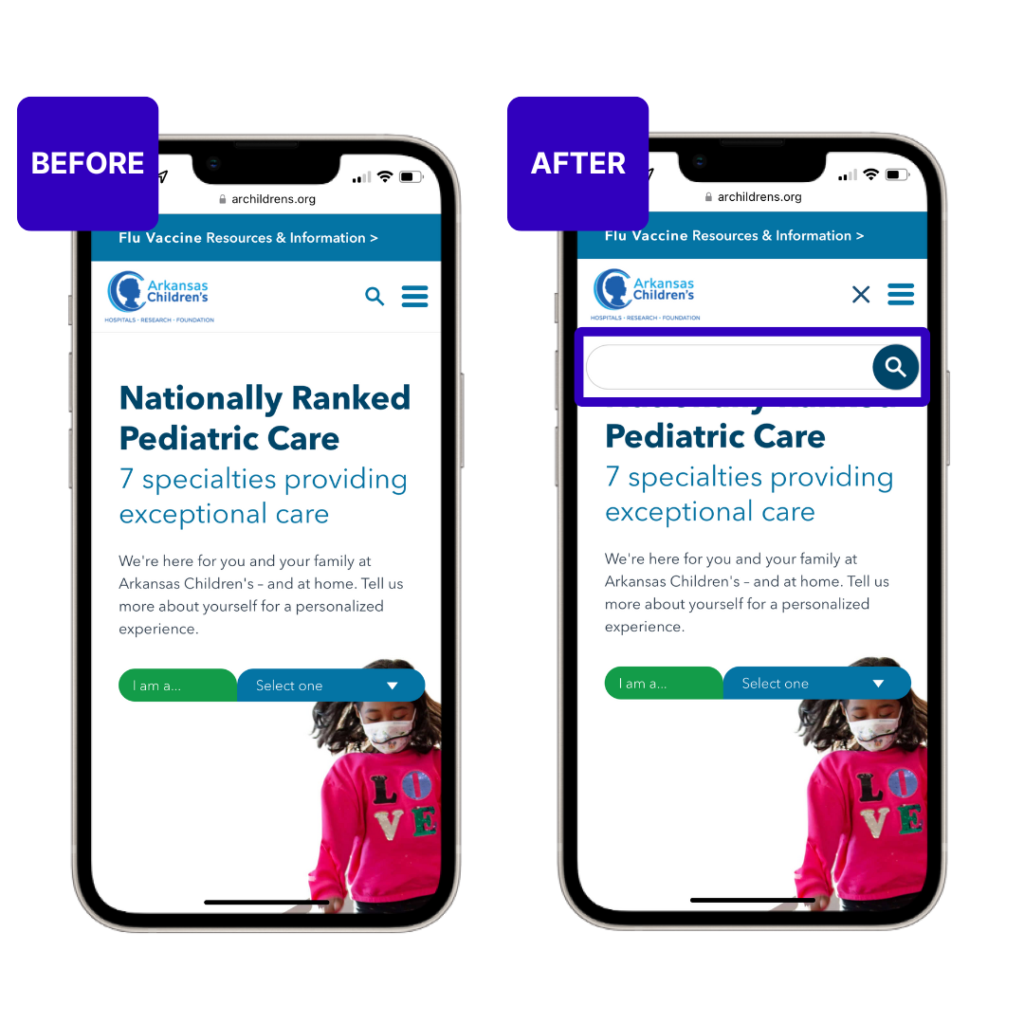
Responsive Design: Online shopping is no longer linear. You have to ensure that your site is responsive across devices for a smoother shopping experience. This means making sure your design is responsive on desktop, mobile, and tablets.
More speed = more spending: According to Deloitte, a mere 0.1s change in loading time can improve the customer journey and improve conversion rates. It’s time to start minimizing code, optimizing images, and reducing redirects to speed up your mobile performance.
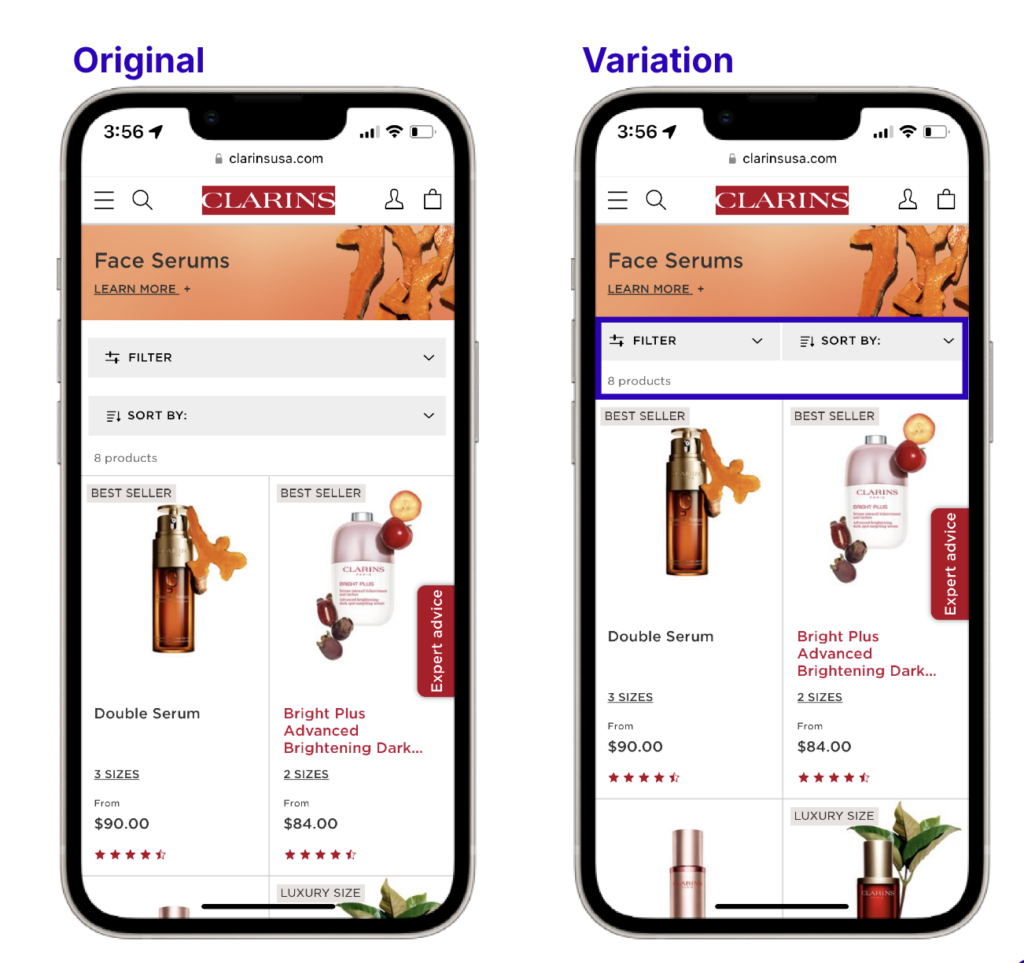
Streamlined Filters: Simplify searches with easy-to-use filters that don’t feel overwhelming on a smaller screen.
Mobile-Friendly CTAsand Buttons: On desktops, consumers click. On mobile, visitors tap with their fingers. A CTA (or any button) that’s too small can lead visitors to click on the wrong icon and derail their user journey. The CTA should be an optimal size (around 44×44 pixels) to avoid frustration.
Make your words worth it: With the constraints of a smaller screen, you may need to adapt your copy. Something as simple as changing your CTA button from “Contact Customer Service” to “Contact Us” can have a big impact.
Pro Tip: Dive further into mobile-first merchandising with our Smartphone Survival Guide to see how mobile impacts consumer behavior and how you can optimize your user experience to boost conversions.
Merchandising During Sales Periods
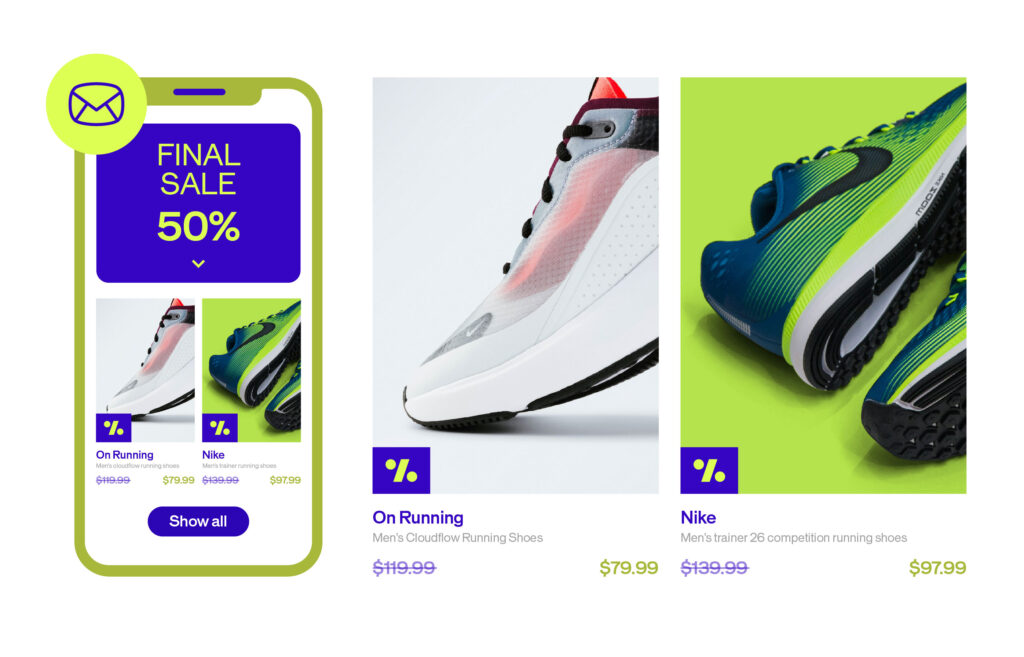
Sales periods like Black Friday, Cyber Monday, Singles Day, Valentine’s Day, or other seasonal events are more than just discounts galore – they’re an opportunity to drive traffic to your website, clear inventory, and welcome new visitors.
How to maximize impact during sales
Curate Themed Landing Pages: Think “Gifts Under $25” or “Holiday Must-Haves.” Tailored pages simplify the shopping journey and give customers exactly what they’re looking for while saving them time browsing.
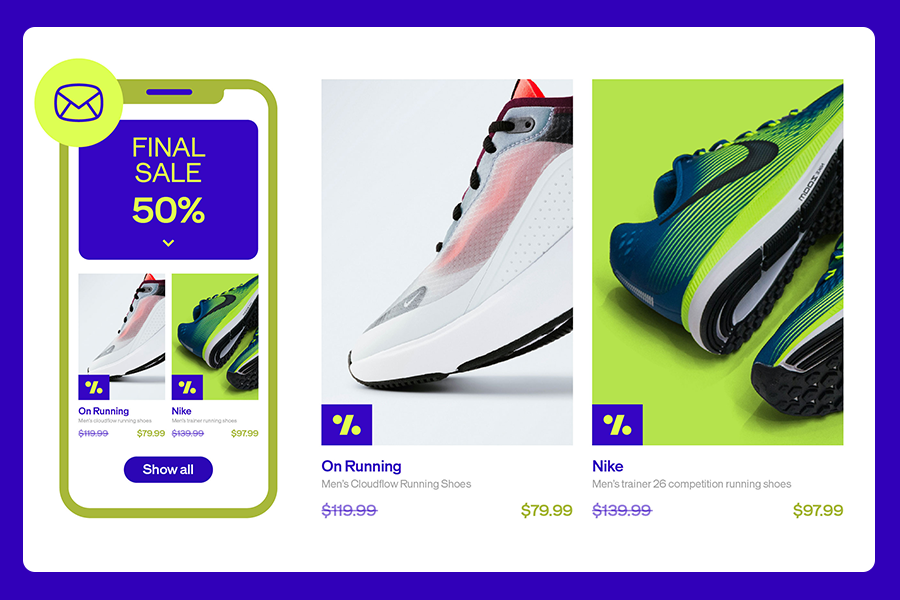
Urgency Tactics: Phrases like “Limited Stock” or “24-Hour Sale” pressure visitors to buy quicker by creating a sense of FOMO (fear of missing out).
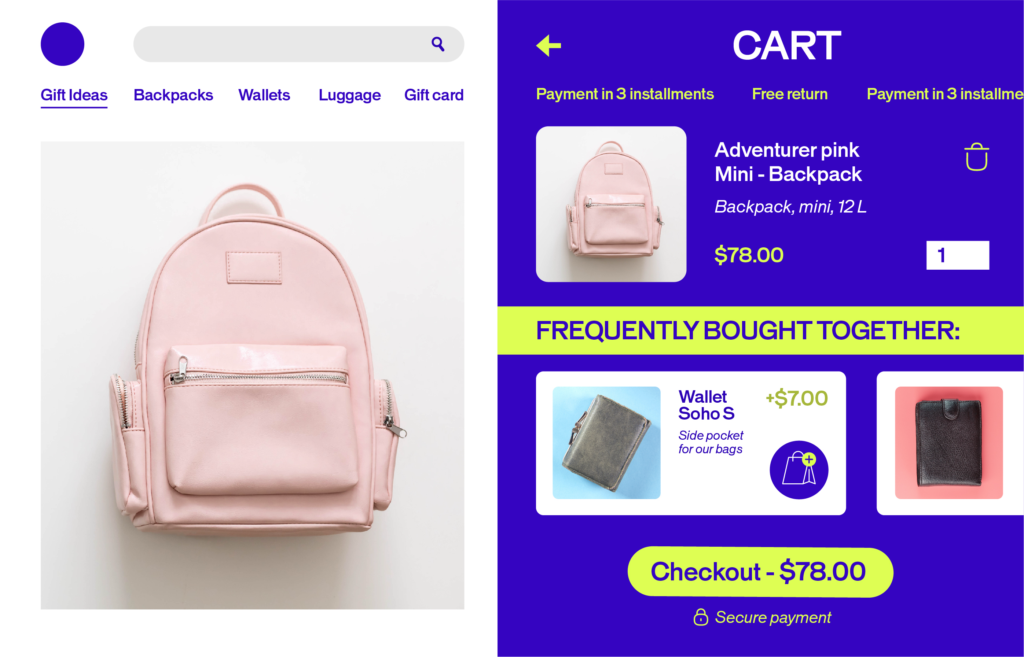
Bundle Deals: Push more products in your inventory by highlighting bundles. Grouping products into bundles with a “frequently bought together” algorithm increases the average order value while offering perceived savings.
These strategies not only boost sales but also make your customers feel like they’ve struck gold on your website by finding just what they’re looking for.
The Power of Personalized Product Recommendations
Ever added a pair of shoes to your cart and instantly been tempted by a matching belt? That’s cross-selling at work. Personalized recommendations, when done right, are like having a helpful salesperson who’s available 24/7 to help you find what you need. So, how do you implement recommendations?
Implementing Recommendations:
Use AI to Analyze Behavior: With experience optimization platforms like AB Tasty, you can implement personalized recommendations by using their AI-powered recommendation engine to predict and personalize what visitors might like based on past activity.
Offer Related Products: When visitors start browsing different products, you can show complementary items to help your customers have the most complete purchase. Selling skincare? Why not recommend helpful products to help your visitors “complete their nighttime routine.”
Personalize Email Follow-ups: Abandoned carts? Send a friendly nudge with personalized email recommendations to remind your customers what’s waiting in their basket.
Want to see the results of recommendations in action? Check out Alltricks’s success story where they saw a +5% in average order value or Jacadi earning +13% more revenue per user with AB Tasty’s recommendations and merchandising solution.
Optimizing Product Pages for Search Engines
Your product pages are like magnets for customers – if they’re SEO-optimized. According to AB Tasty’s E-commerce Consumer Trends Report, nearly half of online experiences begin with a search engine. By improving your SEO and therefore visibility, you’ll make it easier for shoppers to find you.
Must-Have SEO Features:
Targeted Keywords: The more details – the better. It’s always best to use longer, search-friendly terms like “women’s waterproof hiking boots” rather than generic ones like “boots.”
Enticing Meta Descriptions: In addition to a descriptive title, the meta description is your one opportunity to communicate key information about your product with a short, clickable summary to draw in potential buyers.
Alt text for images: Not only does alt text help you meet accessibility standards, but it also improves your chances of showing up in Google Image results.
Detailed Product Descriptions: write descriptions that are informative and keyword-rich while avoiding keyword stuffing.
Leveraging Customer Reviews and Returns Data
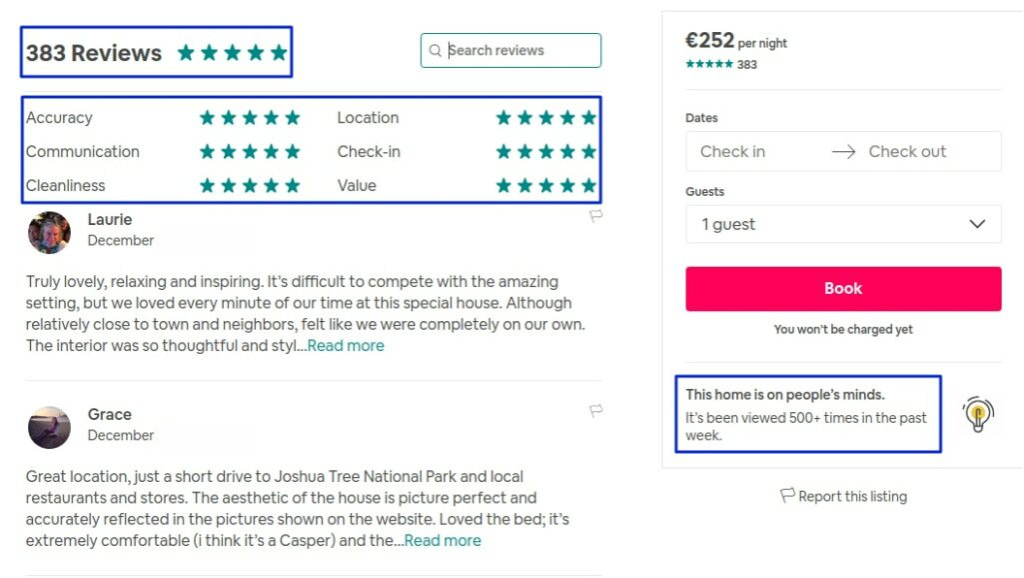
Did you know that the majority of consumers read reviews before buying? In fact, Gen Z considers reviews to be the most important thing to consider before making a purchase (source). Reviews help build trust and provide social proof which helps undecided shoppers feel more confident in their purchases.
Ways to Leverage Reviews:
Spotlight success stories: We all love a zero-to-hero story! Highlight top-rated reviews directly on product pages to give confidence to your potential buyers.
Encourage feedback: Be proactive in building reviews for your e-commerce site by sending a post-purchase email asking for reviews (bonus tip: offer a small discount or loyalty points as an incentive).
Feature photos: Take your reviews a step further by encouraging your buyers to upload user-generated images of your products in real life to help build trust.
Turn returns into opportunities
Returns aren’t the end of the world, they’re learning opportunities. Analyze return trends to identify products, flaws, sizing issues, or misleading descriptions. Then, tweak your strategy accordingly to reduce future returns.
Conclusion:
Online merchandising is where creativity meets strategy. By embracing mobile-first designs, leveraging AI, optimizing for SEO, and personalizing the shopping experience, you can turn casual browsers into loyal customers. In today’s competitive e-commerce world, standing out isn’t optional – it’s essential.
With these best practices, you’re not just selling products, you’re creating an experience worth remembering.
FAQs: Online Merchandising
What is online merchandising, and why is it important?
Online merchandising is the process of strategically presenting products on your website to boost sales and engagement. It’s vital because it directly impacts the customer experience and your bottom line.
2. How does mobile-first design impact online merchandising?
A mobile-friendly site ensures a seamless experience for the majority of shoppers, who browse and buy via smartphones. This boosts conversions and reduces bounce rates.
3. How can I optimize my product pages for better visibility?
Use targeted keywords, detailed descriptions, high-quality images, and SEO-friendly meta tags to improve both search rankings and user engagement.
4. Why are customer reviews crucial for online sales?
Reviews provide social proof, build trust, and influence purchasing decisions. Highlighting reviews can significantly boost conversions.
5. What tools can help with AI-driven merchandising?
Platforms like AB Tasty offer advanced AI features to personalize recommendations and enhance the overall online shopping experience.